

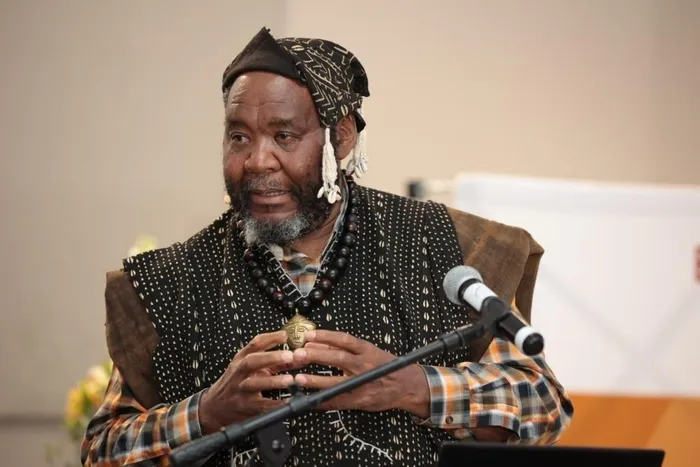
Dr Pali Lehohla is a Professor of Practice at the University of Johannesburg, a Research Associate at Oxford University, and a distinguished Alumni of the University of Ghana. He is the former Statistician-General of South Africa.
Image: Supplied
In this article that marks fifty years on from June 16, I posit through the Lehohla Ledger a speculative question about the next six hundred years to complete a century of Southern Africa interaction with 1652 when Van Riebeck landed on the Cape.
I use the intervening centennial posture of 1976 - 2076 as a pivotal century.
This millennial-centennial confrontation using the"Lehohla Ledger" framework, is a theoretical macro-historical model that conceptualizes the millennium from 1652 to 2652.
An acknowledgement of the crucial methodological constraint of the Ledger like all predictive analytics especially done over a prolonged period is that it cannot predict future events with certainty but it can expand and defrost the cranial rigor mortis that has afflicted the class of 1976 who handover an arguably rotting carcass to the class of 2026.
While it can identify historical trajectories and suggest potential scenarios based on data from 1652 to the present, any description of the decades leading up to 2076 is speculative, but the rot they are handed over perhaps will keep their sensory nerves alert and sensitize them to the Lenaka la Mohlomi – a Mosotho visionary, philosopher, chief and medicine man whose wisdom on responsible leadership remains legendary .
In this analysis, the Ledger examines the historical data from 1652 through 2026 as established fact, and then extrapolates the implications of the "Soweto Pivot" to model potential trajectories for the remaining 50 years of the century.
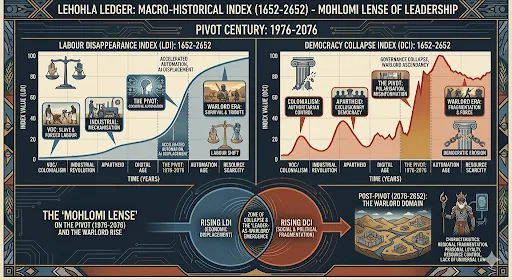
In this analysis, the Ledger examines the historical data from 1652 through 2026 as established fact, and then extrapolates the implications of the "Soweto Pivot" to model potential trajectories for the remaining 50 years of the century.
Image: Supplied.
Within the 1,000-year arc of the Lehohla Ledger (1652–2652), the century spanning 1976 to 2076 serves as the vital pivot.
The first 324 years (from 1652) were a period of colonial consolidation, resource extraction, and the systematic institutionalization of structural exclusion.
The events of June 16, 1976—the Soweto Student Revolt—acted as a fulcrum, initiating a sequence that broke the momentum of the previous three centuries and catalyzed a process of radical, though incomplete, transformation.
This analysis tracks the intergenerational transmission of responsibility during this critical pivot.
We examine the specific legacy the 1976 Generation bequeathed to the current generation of 2026, and the speculative, yet modeled, trajectory of what the 2026 Generation must cultivate for the generations of 2076, as the Ledger’s pivot century concludes.
The Lehohla Ledger models the 1652–1976 period as one dominated by the 'Colonial/Extraction Loop.' In this system, the majority of the population was excluded from both economic value and meaningful political agency.
The Soweto uprising was a radical disruption because it rejected the fundamental premise of this loop: that submission to state power was absolute. Led by youth, the revolt challenged the colonial education system (specifically the imposition of Afrikaans as a medium of instruction), identifying it as a mechanism for reinforcing subordination.
The Ledger indicates that 1976 began a irreversible decline in the state's capacity to maintain control through coercion alone. This initial disruption defined the mission of that generation:
The generation of 1976 (defined here as those who were youth during the intense struggle period, 1976–1994) achieved their primary historical mandate: the dismantling of the formal structures of the colonial-apartheid state. They destroyed the "Extraction Loop’s" legal and constitutional framework.
What they handed over to the generation of 2026 was formal political sovereignty and constitutional agency. This was not merely the right to vote, but a sophisticated democratic charter designed to reset the Ledger’s trend line.
This legacy is the essential toolkit for the next phase:
This legacy was potent, but also burden-laden. The 1976 generation destroyed the machinery of the old system but struggled to build a functional replacement economy (the 2026 'Structural Impasse').
Fifty years on, the generation of 2026 is grappling with the unfinished business of the pivot century.
The data in the Lehohla Ledger (up to 2026) suggests that the formal democracy established after 1994 has stalled. While the political loop has been reset, the economic and structural loops retain the inertial patterns established over the preceding 300 years (extreme inequality, resource dependence, and structural unemployment).
The generation of 2026 views the 1976 generation with immense respect for their courage but frustration with their governance. The defining characteristic of the 2026 context is impatience with the 'Deferred Dividend.' The promise of 1994 has not materialised in tangible economic transformation.
The task of the 2026 generation is to move beyond the exercise of constitutional rights (which they inherited) and toward the creation of structural utility.
The Ledger models this imperative as shifting from an 'Extraction Model' (relying on raw materials and low-skilled labor) to an 'Empowerment and Innovation Model' (leveraging human capital and sustainable technology).
The 2026 generation must break the cycles of systemic dysfunction by focusing on the 'Structural Utility Mandate':
The Lehohla Ledger cannot predict if the generation of 2026 will succeed. However, by synthesizing the historical context (1652–2026) with the urgent structural needs identified in the 2026 data, the model can speculate on the implications of their actions.
The next 50 years (2026–2076) represent the period where the new trajectories initialized during the pivot must achieve escape velocity from the old historical gravity.
If the generation of 2026 fulfills its mandate of structural reconstruction, the Lehohla Ledger extrapolates that they will hand over a fundamentally different societal operating system to the generations of 2076.
The defining characteristic of this projected 2076 society is achieved resilience and realized potential.
In this projected scenario, the generated 2076 generation is not tasked with fighting a state (as in 1976) or reconstructing a broken economy (as in 2026), but with managing a realized civilization that has broken the cycles of the previous millennia.
The Lehohla Ledger (1652–2652) positions the century (1976–2076) as the pivotal moment in a millennium. 1976 was the generation that provided the Disruption (Sovereignty).
2026 is the generation that must provide the Construction (Structural Utility).
By modeling these trajectories, the Ledger highlights that the generations of 2076 are the intended recipients of The Realized Dividend—a society finally free from the inertial drag of 1652, and capable of charting its own destiny.
The Lehohla Ledger is a data driven spatio-temporal diagnostic infrastructure that interrogates development challenges and permits joint solutions development and implementation systems to resolve.
Whilst averages are still important the spatio-temporal analysis is superior in that it drills into lower levels of geography and qualifies it as a true instrument for district development models.
Dr Pali Lehohla is a Professor of Practice at the University of Johannesburg, a Research Associate at Oxford University, and a distinguished Alumni of the University of Ghana. He is the former Statistician-General of South Africa.