

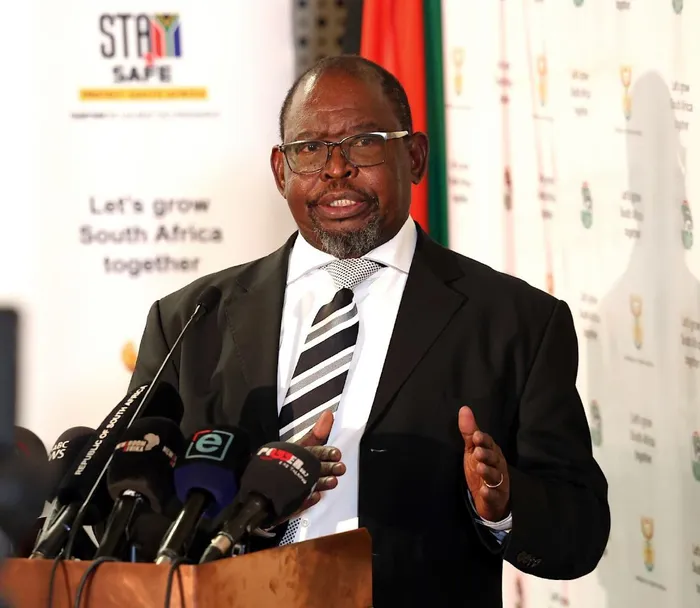
Finance Minister Enoch Godongwana. Treasury said a preliminary report on the review process would be tabled by the Minister of Finance in October 2026 and would guide future reforms to local government funding.
Image: Supplied
The National Treasury has defended the country’s local government funding framework while acknowledging growing concerns from provinces over municipal finances, infrastructure backlogs and the need for reforms to the provincial equitable share system.
This emerged during the Parliamentary's Select Committee on Appropriations meeting on the 2026 Special Appropriations Bill, where Treasury officials responded to negotiating mandates and submissions made by provinces and external stakeholders.
The meeting focused heavily on concerns raised by provinces about the allocation of nationally raised revenue to municipalities and the effectiveness of conditional grants.
Dr. Letsepa Pakkies, the director for the local government fiscal framework at Treasury, told the committee that concerns raised repeatedly by the Eastern Cape regarding local government allocations were being taken seriously as part of an ongoing review of the White Paper on Local Government and the broader fiscal framework.
This comes as the Eastern Cape provincial representatives argued that local government continues to receive only 9.7% of nationally raised revenue, which they said undermines the provincial municipalities’ ability to deliver services effectively.
Responding to the concerns, Pakkies said equitable share allocations were not the only source of funding available to municipalities, pointing to conditional grants and fuel levy sharing arrangements for metropolitan municipalities.
Treasury officials said total support to local government amounted to R182.3 billion in the 2016/17 financial year through multiple funding mechanisms.
Officials further acknowledged concerns that the original assumptions underpinning the 90/10 revenue split envisaged in the White Paper may no longer reflect current realities.
“The White Paper is currently under review, so even the 90-10 principle is being looked at with the assumptions that informed it being interrogated,” Pakkies told the committee.
Treasury said a preliminary report on the review process would be tabled by the Minister of Finance in October 2026 and would guide future reforms to local government funding.
The Eastern Cape also called for a differentiated municipal funding model that would allocate greater support to municipalities with weak revenue bases and limited ability to generate income through property rates and electricity sales.
Treasury agreed with the principle of differentiated funding but cautioned that technical modelling was still underway to determine the most sustainable allocation framework.
Pakkies noted that some municipalities may require allocations even higher than the proposed 15% threshold because of structural economic weaknesses.
The committee also discussed the use of census data in the provincial equitable share formula after concerns were raised about outdated demographic information affecting provincial allocations.
Treasury explained that the latest census data had not been used in the 2024 formula update because the information became available too late and was subsequently overtaken by newer population estimates.
Pakkies said updated mid-year population estimates were later incorporated into the 2025 Medium-Term Expenditure Framework process and implemented gradually over three years to minimise disruptions.
Another key issue raised during deliberations was the need for a dedicated funding model for traditional leaders.
Treasury acknowledged that current arrangements remain inadequate and confirmed that discussions involving the Department of Cooperative Governance and Traditional Affairs were underway to review policy and funding mechanisms linked to traditional leadership structures.
The committee also raised concerns about the phasing of library grants into the equitable share framework, warning that essential community services could be weakened.
Treasury said the process would be implemented gradually, beginning with compensation of employee costs in 2027/28 before the capital component is incorporated later.
Provincial concerns over road maintenance grants, urbanisation pressures and infrastructure backlogs were also highlighted during the meeting.
Treasury said ongoing reforms aimed at streamlining and rationalising conditional grants were intended to reduce fragmentation, improve alignment and ensure infrastructure spending delivers better economic outcomes.
Pakkies said the number of conditional grants had increased significantly over the years due to evolving policy responses, but some grants had begun overlapping with others, necessitating reform.
Treasury confirmed that additional grant rationalisation measures are planned for the 2027 budget cycle as government seeks to improve efficiency while protecting service delivery.
BUSINESS REPORT