

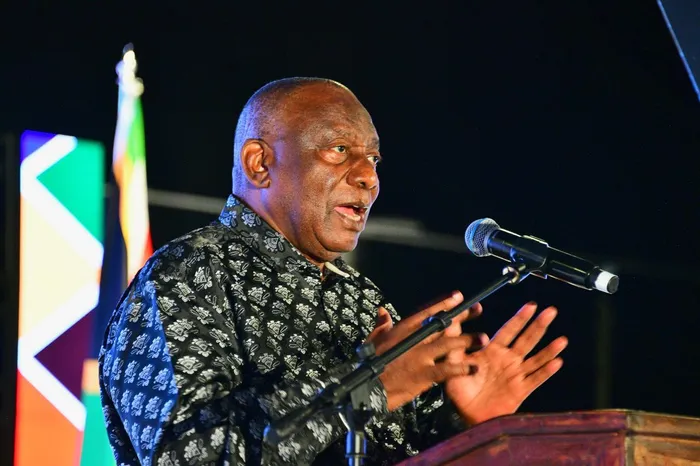
President Cyril Ramaphosa delivered the keynote address at the 2026 National Local Economic Development (LED) Summit in Ekurhuleni on Wednesday.
Image: GCIS
President Cyril Ramaphosa has called for a decisive shift in how municipalities drive economic growth, placing small businesses and service delivery at the centre of efforts to rebuild local economies.
Delivering the keynote address at the 2026 National Local Economic Development (LED) Summit in Ekurhuleni on Wednesday, Ramaphosa said municipalities must reposition themselves as “incubators of economic activity” rather than passive administrators.
The summit follows the recent South Africa Investment Conference, which secured R890 billion in pledges. However, Ramaphosa stressed that investment ultimately materialises at local level.
“When investors build their business in our country, they don’t set up factories… in front of the Union Buildings,” he said. “This investment takes place in metros, cities, towns and villages,” Ramaphosa said.
He warned that weak governance continues to undermine economic potential, linking poor municipal performance directly to stalled development.
“Without fixing governance, we cannot fix service delivery and without fixing service delivery, we cannot unlock local economic development,” Ramaphosa said.
He outlined four priorities: fixing infrastructure and service delivery, reducing red tape, repositioning municipalities as drivers of growth, and strengthening institutional capacity.
Central to this is improving the ease of doing business. Ramaphosa expressed concern over bureaucratic delays, particularly in issuing business licences.
“More often than not, bureaucratic delays at municipal level prevent local investments from getting over the line,” he said.
Minister of Cooperative Governance and Traditional Affairs, Velenkosini Hlabisa, echoed these concerns, saying structural weaknesses in local government continue to constrain economic development.
“The core problem… is misalignment between municipal mandates and funding instruments, weak integration between planning, budgeting and implementation, and fragmented intergovernmental investment,” Hlabisa said.
He said the ongoing review of the White Paper on Local Government aims to reposition municipalities as “economic enablers, not administrative bottlenecks.”
“Where municipalities struggle to provide infrastructure, streamline licensing, manage land use or coordinate investment, local economies stagnate, and small enterprises fail to grow,” he added.
South African Local Government Association (Salga) president Bheke Stofile called for a broader and more strategic understanding of local economic development, warning against reducing it to informal trading alone.
“Local economic development cannot be left to chance or surrendered to the invisible hand of the market,” Stofile said.
He argued that municipalities must actively drive production and industrialisation by leveraging their assets, including land, infrastructure and procurement budgets.
“LED means producing more, processing more, trading more, and owning more of the local economy,” he said.
Stofile also highlighted the urgent need to address rural infrastructure, proposing a large-scale interlocking brick road programme to boost employment and improve connectivity.
“Roads are the arteries of development… yet many rural communities still rely on damaged gravel roads,” he said.
Minister of Small Business Development Stella Ndabeni reinforced the central role of small businesses in tackling unemployment and inequality, noting that micro, small and medium enterprises (MSMEs) are expected to generate the majority of new jobs.
“The Government of National Unity has made inclusive growth and job creation its apex priority, with MSMEs at the centre,” Ndabeni said.
She outlined a range of policy interventions and support mechanisms aimed at strengthening the small business ecosystem, including funding instruments, incubators and market access programmes.
“Our goal must be clear, to build municipalities that are capable, accountable, and truly developmental institutions that act as economic enablers,” she said.
Ndabeni emphasised that success depends on coordination across all spheres of government, as well as partnerships with the private sector.
“South Africa’s growth and jobs challenge will be won or lost at a local level,” she said.
The summit, held under the theme of “re-engineering local economies,” is expected to produce a collaborative blueprint with clear targets and timelines to revitalise municipalities and unlock inclusive growth.
Ramaphosa said the outcome must translate into tangible change on the ground.
“South Africa is a country of entrepreneurs. Our task is to unleash their potential and, in so doing, to build an inclusive economy that creates opportunities for all,” he said.
BUSINESS REPORT