

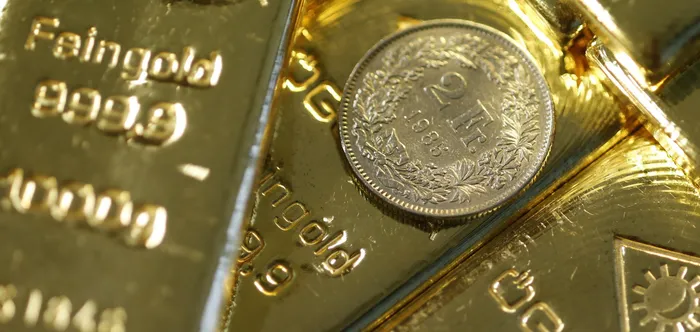
Institutional investors, central banks and individuals have been snapping up gold in the past six months, which was reflected in a volatile gold price.
Image: Reuters
Gold has been one of the strongest performing assets over the past year, even after a wild six months for the gold price that has only recently begun to lose some lustre.
The World Gold Council's Gold Mid-Year Outlook released Wednesday noted that gold had set more than 12 all-time highs through the past six months and reached a record $5,405/oz in late January, before falling to a low of $4,002/oz in June, and is now down about 7% year-to-date, with volatility rising to 30%.
“Gold has come under pressure near US$4,000/oz this year and previously rebounded, supported by organic demand from long-term buyers across multiple geographies. That structural demand from central banks, institutional investors, and consumers worldwide is what underpins gold's resilience," said World Gold Council Global Head of Research and Regional CEO Juan Carlos Artigas in a statement.
The report noted that the US-Iran conflict and shifting rate expectations were the biggest swing factors for the price over the past six months, and possibly over the next six months, while Asian trading sessions accounted for much of the price action – signalling how central Asian investors have become to global price discovery.
“At current levels, gold’s price is broadly in line with a global backdrop of moderate growth, cooling but still elevated inflation, and expectations of further – but limited – central bank tightening,” the report said.
“The Council's framework points to gold trading within about 5% of $4,100/oz through year-end if current macro conditions hold, with clear catalysts that could move it in either direction,” the authors of the report said.
They said gold faced "a pivotal second" half that will be shaped by unpredictability from geopolitics, rates, and investor sentiment.
Elevated geopolitical risk, driven in large part by the US-Iran conflict, was the most significant contributor to first-half performance, alongside momentum from investor positioning and profit-taking, according to the World Gold Council's Gold Return Attribution Model (GRAM).
Opportunity cost had a mixed effect as markets repriced rate and US dollar expectations. Notably, the bulk of gold's price movement occurred during Asian and US trading sessions, reflecting the increasingly central role of Asian investors in global price discovery.
“Unlike assets primarily driven by domestic dynamics, gold reflects demand from consumers, investors, and institutions worldwide. At current levels, the price is broadly consistent with consensus: at least one Fed rate hike in 2026, likely by October; parallel tightening from the Bank of England, Bank of Japan, and European Central Bank; and US inflation peaking near 3.9% in Q2. If these conditions hold, gold may trade within 5% of about US$4,100/oz through year-end.”
The metal’s price could resume its upward trend if geopolitical or economic conditions deteriorate, or if rate expectations shift, “though only a strong signal of global deceleration is likely to push gold above US$4,500/oz,” the report said.
On the downside, dollar strength, rate hikes above expectations, and risk-on sentiment are the primary headwinds.
“Sustained trading below US$4,000/oz could trigger further selling, though a drop of more than 10% from current levels will likely bring organic demand from long-term buyers across multiple geographies, based on historical performance,” the reportl said.
In India - gold’s second largest market after China with net demand of 800 tons per year - oil supply and energy prices had been affected by the US-Iran conflict, and the government was forced to intervene to conserve foreign exchange reserves. Since early April, it had adopted measures aimed at moderating gold imports, including a duty increase – from 6% to 15% – and consumer-directed messaging aimed at curtailing gold purchases.
An analysis suggested that the import duty increases alone would reduce jewellery, bar, and coin demand by 50 tons – 60 tons, or by about 10% year-on-year, the report noted.
Visit:www.businessreport.co.za