

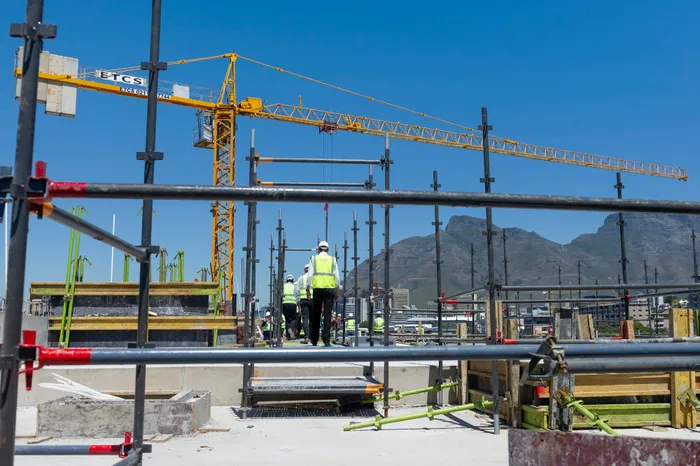
Former JSE-listed construction company Group Five has emerged out of six years of business rescue with all creditors paid and most jobs retained.
Image: File
Group Five, the former JSE-listed construction group of close to 6,000 employees operating in 38 countries before it struck a debt iceberg in 2019, has come out of business rescue, with all secured creditors paid, while employment has substantially been preserved.
The Business Rescue Practitioners (BRPs) of Group Five Construction and Group Five Limited, Dave Lake and Peter van den Steen of Metis Strategic Advisors, said on Tuesday the business rescue proceedings of both companies had terminated following the substantial implementation of the adopted business rescue plans.
When business rescue proceedings started in March 2019, Group Five faced about R7 billion in creditor and contingent exposures, more than 2,300 creditors, 119 active construction and engineering projects, and close to 6,000 employees employed in 180 companies.
Independent analysis by PwC at that time calculated that, in the alternative scenario of an immediate liquidation (as opposed to business rescue), secured creditors would have received as little as 65 cents in the rand, and concurrent creditors only 3.4 cents in the rand, with no prospect of any shareholder recovery.
“The picture today is materially different, following the termination of the business rescue proceedings,” the BRPs said in a statement.
All secured and preferent creditors had been paid in full, and all concurrent creditors had been paid in full, or funds for their payment had been provided for in accordance with the adopted plans.
In addition, “the structured implementation of both plans has preserved substantial employment and has now positioned Group Five to potentially deliver a surplus return to its shareholders once all residual matters have been finalised,” the BRPs said.
“This outcome materially exceeds the liquidation alternative that was modelled at the commencement of business rescue,” said Group Five Joint BRP, Dave Lake.
“The process has over-achieved in its primary objectives: maximising recoveries for creditors and lenders, saving jobs and business entities, settling tax obligations, likely unlocking some value for shareholders, while stabilising and restructuring a highly complex group in an orderly manner,” he said.
The BRP's strategy had been to avoid a disorderly collapse and to preserve viable value wherever possible. Of the 119 construction projects, 101 were successfully managed through to completion or preservation. This reduced further bond calls, damages claims, and value erosion.
In parallel, approximately 60 entities and asset sale processes were completed. Key subsidiaries, including Intertoll Europe and Everite, were sold as going concerns, rather than being forced into closure, with proceeds exceeding pre-business rescue value expectations.
A central outcome of the process was the protection of jobs wherever possible. At the commencement of business rescue, the group employed about 5,862 people. Less than 15% of those employees were retrenched over the past six years.
In many cases, employees transitioned with businesses that were sold, allowing operations and livelihoods to continue under new ownership beyond the restructuring itself.
The broader economic implications of the Group Five restructuring were significant.
At a time when South Africa’s construction sector had experienced prolonged contraction and the failure of several major contractors, an uncontrolled liquidation of a group of this scale would have placed further strain on already fragile supply chains, subcontractors, and infrastructure delivery.
“By implementing a structured and phased rescue process, the BRPs were able to reduce the risk of a cascading impact across projects, suppliers, and communities linked to those projects,” said Lake.
Group Five enters a finalisation phase focused on concluding a few asset sales, resolving residual outstanding litigation, managing long-tail contractual obligations, and resolving residual corporate matters such as audits, tax, and collapsing the large multi-national group structure.
Where surplus value remains after all obligations have been settled, it may be returned to shareholders.
“In complex business rescue processes of this scale, shareholder recoveries are uncommon, particularly where liquidation modelling initially projected no possible return. While any potential distribution to shareholders remains subject to the resolution of residual matters and conservative provisioning, the prospect of surplus value reflects the disciplined execution of the restructuring process,” said Lake.
Visit:www.businessreport.co.za