

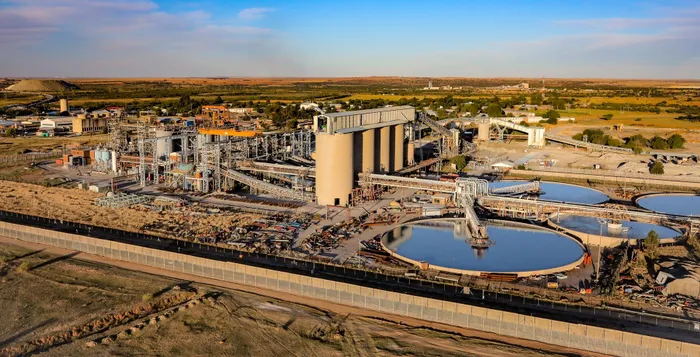
The Beatrix operation is a mature, shallow to intermediate depth underground gold operation. It is located near the towns of Welkom and Virginia, in the Free State province.
Image: Supplied
Sibanye-Stillwater’s three legacy gold mine assets have underpinned the growth of the mining group and despite high operational gearing, at current gold prices, these assets are still generating substantial value.
CEO Richard Stewart stated in a Capital Markets Day presentation on Tuesday that, after producing 12.2 million ounces (Moz) since 2013 and generating earnings of R19.5 billion, the three assets—Kloof, Beatrix, and Driefontein—still retain 3.3 Moz of reserves.
The DRDGOLD and Burnstone projects will transition the South African gold operations to a higher-margin, shallower gold mining business, he said. The group’s South African operations, which also include its platinum mining interests in the country, remain the core earnings and value driver.
Commenting on the outlook for the gold price, Kleantha Pillay, executive vice-president Sales & Marketing noted that gold had overtaken US treasury bonds as the largest central bank reserve asset in 2025, rising from 20% to 27% over the year ending June 2026.
However, net central bank gold purchases were expected to continue at a slower pace as the rise in gold prices had reduced its share of central bank reserves.
He mentioned that there had been a price correction after significantly overbought levels. Global ETF holdings were down to 3.6 Moz, a decrease of 3.5% since the February peak.
“Stability of the Iran-US ceasefire and how the economic after-effects will play out through inflation, interest rates, and global economic growth will determine gold’s medium-term price path,” he said.
The Driefontein mine holds reserves for a life-of-mine (LoM) of 11 years, Beatrix’s LoM is 6 years, and Kloof’s is 1 year. The 50.1% stake in DRDGOLD has a LoM of 22 years, while the Burnstone project has a LoM of 25 years. Cooke is a surface retreatment operation with a 25-year LoM, focused on processing historic Randfontein tailings.
Deep-level, hard rock mining expertise is a core competency of the group, but the current focus is on safe production and disciplined capital allocation rather than deep-level growth investment.
The group is transitioning to a shallower, higher-margin, and lower-risk South African gold business.
The 50.1% stake in DRDGOLD, acquired in 2018 for R1.1bn, is now valued at R16bn, with R2.1bn in cash dividends received to date. The Burnstone project is a low-cost, shallow brownfields project.
While the group’s South African gold operations mainly comprise deep-level underground mining to date, surface retreatment operations provide a lower-risk, longer-life base as legacy underground mines wind down, said the chief operations officer Richard Cox.
Dawie van Aswegen, executive vice president of Mining Operations, said that the South African gold operations are still generating substantial value at current gold prices, despite high operational gearing. Adjusted EBITDA (earnings before interest, tax, depreciation, and amortisation) has been strong since 2022.
There had been a sharp increase in AISC (all-in-sustaining costs) related to the high fixed cost of mature assets and lower volumes. AISC has risen from around R800,000 per kilogram in 2021 to close to R1.9 million per kilogram at the end of 2025.
He noted that Driefontein, with the longest life legacy operation, holds a strong medium-term profile with reducing capital expenditure.
The mature, conventional, deep to ultra-deep mining operation, at depths of 3,300 m below the surface, had produced consistent and stable performance over the past three years, he said.
At Kloof, which has been in production since the 1960s and has a LoM of 1 year, there was potential to extend mining beyond the one year in the current high gold price environment based on safety, cash generation, and funding its own capital requirements. The potential to extend the LoM to three years was dependent on safety and the gold price.
Beatrix, in operation since the late 1970s, is a conventional, shallow to intermediate mine at depths of 1,350 m below the surface.
Its LoM had been extended to 6 years through the inclusion of below-infrastructure mining at a reduced annual production rate. Steady, consistent delivery was foreseen to the end of life with no major planned capital expenditure for the Beatrix underground operation.
BUSINESS REPORT