

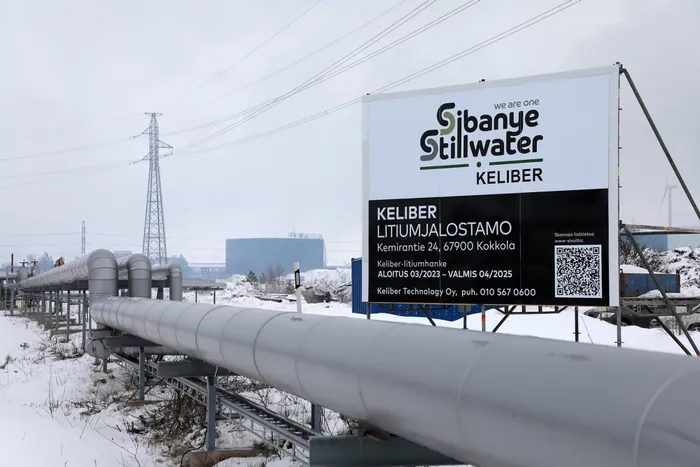
Sibanye-Stillwater is progressing with the Keliber project in Finland. It has completed the construction phase and has started mining in the first quarter of 2026.
Image: Supplied
Sibanye-Stillwater’s Keliber Project in Finland, a lithium operation being established at a cost of about R15 billion, has completed its construction phase on schedule and lithium mining started at the Syväjärvi mine in the first quarter of this year.
This was according to the JSE-listed Sibanye Stillwater’s International and Recycling capital markets day presentation released on Monday. Hannu Hautala, senior vice president of the Keliber project, presented on the lithium operation that combines mining, concentration, and refining in the Central Ostrobothnia province. It is Europe’s first integrated lithium project.
Lithium is a backbone of the global energy storage and electronics industries, and the Keliber project, first announced by Sibanye in 2021 when it took a 30% interesr, will see the group transitioning from a gold-focused miner into one of the world’s largest diversified producers of precious and green-energy metals.
Planned steady-state production is projected to start in 2028, with nameplate capacity at 15,000 tpa of battery-grade lithium hydroxide monohydrate.
Extensive regional mineral resources also offered the potential for organic growth and to extend the operating life, said Hautala.
There would be significant regional financial benefits from ongoing investment, job creation, and local contractors’ services over the planned 18-year life. Mined ore production was currently in the ramp-up phase, and would amount to 540 ktpa when fully ramped up. Construction of the concentrator in Päiväneva was completed in January.
“A staged start and ramp-up reduces project risk by ensuring mining and concentrating operational readiness before making a decision on the timing of the commissioning of the refinery based on market conditions,” he said in the presentation.
A conditional hot commissioning of the refinery in Kokkola is planned for the fourth quarter of 2026.
Sibanye-Stillwater owns 79.8% of the Keliber Project, and the Finnish Minerals Group holds 20%, through which the Finnish government is represented.
The aim is to supply lithium hydroxide to the European battery ecosystem. The project is designated an EU Strategic Project under the Critical Raw Materials Act (CRMA), directly supporting European supply security aligned with the EU’s 2030 localisation target.
On the market outlook for lithium towards the end of the decade, the group said that in a de-globalising world, resulting in riskier supply chains, Europe was "extremely short" of feasible regional lithium projects. The operating life-of-mine from Syväjärvi and Rapasaari mines stood at 18 years.
The demand outlook for lithium was strong, with an annual compound average growth rate of 12% predicted from 2026 to 2034 as increased electrification of world energy needs continues. Although a medium short-term surplus was expected, growing shortfalls were predicted from the end of the decade.
There was no shortage of new probable projects, but steeper and sustained incentive prices were required for investments to materialise. Short-term fundamentals were being driven by Chinese actions.
Sibanye-Stillwater said it welcomed the EU’s foundational steps to build a resilient critical raw materials (CRM) supply chain. However, further evolution of the regulatory environment was necessary to unlock the industry's potential and ensure Europe's long-term resilience.
The EU incentives toolbox was still lacking the tailored support that CRM projects needed to mitigate investment risks relating to floor prices, early support for innovative projects, strategic project ramp-up support, and protection of European energy prices and high operating expenses.
Europe’s CRM producers also faced insufficient protection from unfair global competition by way of state subsidies and price manipulation, the group said.
The Finnish mining industry has criticised Finland’s increase in its mined metallic minerals tax on the metal content mined to 2.5%, from January 1, 2026 - the tax was first introduced in 2024 as 0.6%. For Keliber, the average annual mined metallic mineral tax payable was €5.3 million in the 2027 to 2032 operational phase.
Sibanye-Stillwater’s share price slipped 3.2% on the JSE Monday morning to R55.48, a decrease that was in line with a decline in other precious metal mining group share prices at the same time. However, Sibanye’s share price is well up from R23.30 a year ago.
BUSINESS REPORT