

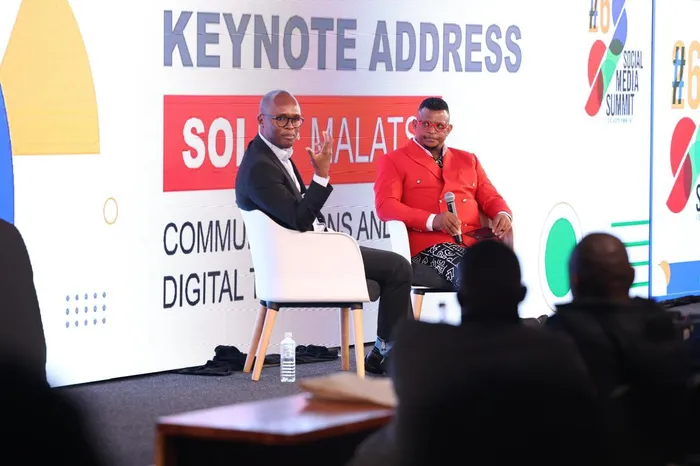
Minister of Communications and Digital Technologies Solly Malatsi makes a point during the Social Media Summit for Government. The writer argues that the future will not belong to artificial intelligence alone. It will belong to augmented intelligence, where AI enhances human capability rather than replaces it.
Image: Supplied
Muzi Dladla
One of the questions I explored during a panel discussion at the 6th Government Social Media Summit was deceptively simple: As artificial intelligence becomes increasingly capable, what should remain uniquely human?
It is a timely question. Much of today's conversation is captivated by what AI can do. It can analyse vast amounts of data, recognise patterns, generate content and translate languages in real time. The pace of innovation is extraordinary and with it comes understandable excitement.
Yet I left the discussion convinced that we may be asking the wrong question.
For several years, the debate has been framed as though Artificial Intelligence (AI) and Human Intelligence (HI) are competing forces. Will AI replace analysts, lawyers, teachers or even leaders? Implicit in these questions is the assumption that the more intelligent machines become, the less valuable human intelligence becomes.
I believe precisely the opposite.
The future will not belong to artificial intelligence alone. It will belong to augmented intelligence, where AI enhances human capability rather than replaces it.
This is not a new idea. Human progress has always depended on tools that extend our capabilities. We invented calculators to perform arithmetic, GPS to calculate routes and search engines to retrieve information at extraordinary speed. None of these technologies made us less intelligent. They simply allowed us to focus our minds on more complex problems.
Psychologists Evan Risko and Sam Gilbert describe this as cognitive offloading: the deliberate use of external tools to reduce cognitive demand while preserving our capacity for reasoning, creativity and judgement.
Artificial intelligence is simply the latest chapter in that story.
Building on this, Steven Shaw and Gideon Nave argue that the emergence of generative AI presents a new challenge they describe as cognitive surrender. The concern is no longer simply that humans delegate cognitive tasks to technology, but that they begin accepting machine-generated conclusions without sufficient scrutiny or independent reasoning.
But it also introduces an important distinction.
Cognitive offloading is delegation, while cognitive surrender is abdication.
When I use a calculator, I delegate arithmetic. I still decide whether the answer makes sense. When GPS recommends a route, I remain responsible for deciding whether that route is safe or appropriate. The technology performs the computation. I retain the judgement.
Artificial intelligence becomes problematic only when we begin delegating the judgement itself.
This is the concern increasingly raised by scholars. The risk is not that machines become more intelligent. The greater risk is that humans become less intellectually engaged, accepting algorithmic outputs without questioning them, understanding them or placing them in context.
History reminds us that society's greatest failures have rarely been failures of information. They have been failures of judgement.
No algorithm understands legitimacy. No machine experiences empathy. No model can weigh competing constitutional rights or appreciate the social consequences of a decision. Artificial intelligence can estimate probabilities. It cannot determine what ought to be done. This distinction is not theoretical. It is one we confront in practice.
At Sasria, in partnership with the Council for Scientific and Industrial Research (CSIR), we have been developing predictive risk analytics that combines machine learning, behavioural science, sentiment analysis and geospatial intelligence to better understand emerging social risks. We developed the Four Levels of Defence, a model designed not merely to predict unrest, but to strengthen society's resilience against it.
The technology can identify patterns across millions of data points that no individual analyst could reasonably detect. But it cannot explain what those patterns mean. Rising negative sentiment may indicate genuine social instability, political mobilisation or simply a temporary public reaction to an isolated event.
The algorithm detects the signal. Human intelligence interprets the context. That is not artificial intelligence replacing human intelligence. It is artificial intelligence augmenting it.
Moreso, this is where research on Hybrid Intelligence converges. The strongest outcomes are achieved not when humans compete with AI, but when each contributes what it does best. AI expands our capacity to know. Human intelligence remains responsible for interpreting that knowledge through the lens of ethics, context and accountability.
That has profound implications for leadership.
The organisations that will thrive will not necessarily be those with the most sophisticated algorithms. They will be those that combine technological capability with sound judgement, effective governance and ethical leadership.
Perhaps, then, we should change the question.
For years we have measured AI by asking how much human work it can automate. Perhaps we should instead ask how much human capability it can elevate.
There is an important difference. One future replaces people. The other empowers them.
As governments, businesses and society continue investing in artificial intelligence, we should be equally intentional about investing in human intelligence. Because while AI may transform how we work, communicate and govern, it cannot replace the qualities that make leadership distinctly human.
The future will not be shaped by those who build the smartest machines. It will be shaped by those who continue asking the smartest questions.
And perhaps that is the real promise of augmented intelligence. Not that machines will one day think like humans, but that humans, supported by intelligent machines, will think better than ever before.
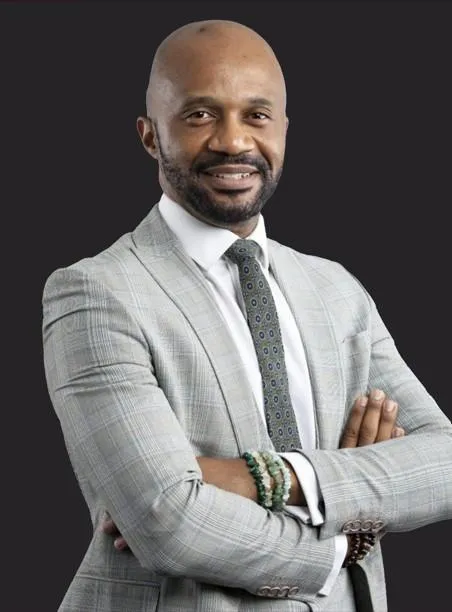
Muzi Dladla is the executive manager for stakeholder engagement at Sasria.
Image: Supplied
* Muzi Dladla is the executive manager for stakeholder engagement at Sasria.
** The views expressed do not necessarily reflect the views of IOL or Independent Media.
BUSINESS REPORT