

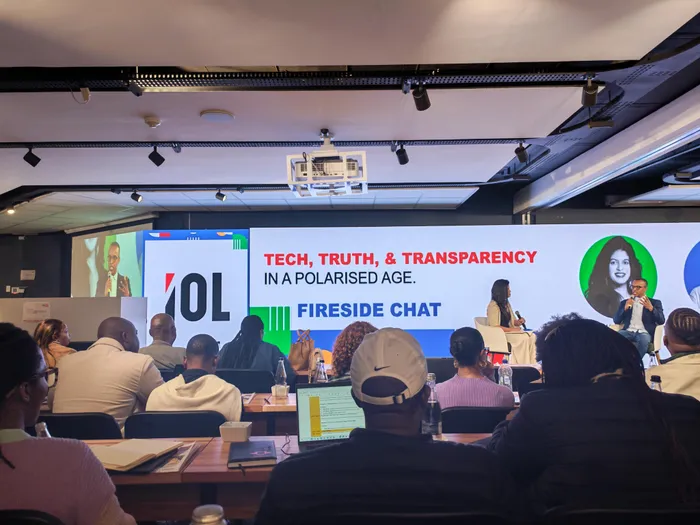
One of the sessions from this year’s Social Media Summit for Government reflected on how AI is transforming the relationship between government and citizens.
Image: Supplied
Mandla J Radebe
Not so long ago, governments were still debating whether social media belonged in official communication strategies, but today that debate is over. With the rapid rise of technologies such as artificial intelligence (AI), which have fundamentally changed the conversation about public sector communication, digital platforms have become indispensable to government itself.
Now, the more urgent question is whether governments are prepared to communicate effectively in an era increasingly shaped by AI.
This was one of the central themes emerging from this year’s Social Media Summit for Government, hosted by the University of Johannesburg in partnership with Decode under the theme “Life on an Engagement Spectrum”. Over two days, policymakers, academics, communication professionals and technology experts reflected on how AI is transforming the relationship between government and citizens.
Perhaps the most important lesson from the summit was that artificial intelligence is not a substitute for human intelligence but instead a powerful tool whose value depends entirely on human judgement, ethics, creativity and leadership.
This distinction is critical because much of the public debate surrounding AI has focused on replacement. Will AI replace communicators? Will algorithms replace public servants? Will chatbots replace human iteration? Such questions misunderstand both the nature of communication and the purpose of democratic governance.
The real opportunity lies in augmentation rather than substitution. AI can analyse millions of public comments in real time, detect emerging social concerns, translate government information into multiple languages, identify misinformation before it spreads, and assist public institutions in communicating more efficiently. These capabilities have enormous potential, particularly in countries such as South Africa where governments often face resource constraints.
Yet AI cannot exercise political judgment. It cannot understand context. It cannot build trust between the government and its citizens. Trust remains the true currency of digital governance. Citizens are unlikely to judge governments by the sophistication of their algorithms but rather by whether digital technologies make government more responsive, transparent and accountable. Technology that merely automates bureaucracy without improving people’s everyday lives cannot be regarded as meaningful innovation.
This is precisely the reason the summit repeatedly returned to a simple principle that data and technology must ultimately serve people.
However, embracing AI also requires an understanding of the broader political economy within which digital communication operates. New media do not exist outside the material conditions that shape every other aspect of society. Digital platforms are neither politically neutral nor economically independent. They operate within a global capitalist system in which data, attention and information have become valuable commodities.
Governments therefore increasingly communicate with citizens on digital infrastructures they neither own nor control. Platform algorithms determine visibility while commercial incentives shape engagement. Public communication increasingly competes with entertainment, misinformation and viral content for public attention.
This should concern policymakers.
The assumption that social media platforms merely facilitate communication ignores the economic interests embedded within them. Whether one watches mainstream television, reads online news or listens to independent podcasts, communication increasingly operates according to similar commercial logic.
Even podcasting, a prominent topic at the summit, is frequently presented as an alternative to traditional media but remains dependent on subscriptions, sponsorships, advertising and audience matrics. In that sense, the commodification of information cuts across the entire media ecosystem.
The differences between mainstream media and many digital alternatives are often less substantial than they appear.
This reminds us that communication has always been about more than transmitting information. It is also about power.
Media power is not merely the power to report events but also the power to frame reality andinfluence what societies think, discuss and ultimately accept as truth.
In this context, AI should never become another instrument through which citizens are merely profiled, monitored or algorithmically persuaded. In a democratic society, public sector communication exists to inform, empower and engage citizens and not to manipulate them.
AI should therefore be deployed to strengthen democratic participation, improve service delivery and deepen trust between governments and the people they serve. Whether through multilingual communication, improved access to information, real-time engagement or responsible responses to misinformation, technology must enhance the state’s ability to serve citizens rather thansimply automate bureaucracy.
This is why the summit has become such an important platform. Beyond showcasing new technologies, it creates space for critical conversations about governance, ethics and the future of public communication in the AI era. Beyond the message that human intelligence must remain at the centre of artificial intelligence, another message that resonated through the summit was that trust must remain the foundation of digital governance.
Achieving this vision requires collaboration because no single institution possesses all the expertise necessary to navigate the rapidly evolving AI landscape. Governments, universities, civil society, technology companies and communication practitioners must work together to develop ethical standards and governance frameworks that ensure AI advances the public interest rather than narrow commercial or political objectives.
The conversations must now move beyond the conference hall and into public institutions. Governments must invest in digital capabilities, establish robust AI governance frameworks and equip communicators with the requisite skills to communicate responsibly in an increasingly digital environment.

Mandla J Radebe is the founding convenor of the Social Media Summit for Government, professor of strategic communication at the University of Johannesburg and editor of “Public Sector Communication in the Digital Age” (UJ Press).
Image: Supplied
* Mandla J Radebe is the founding convenor of the Social Media Summit for Government, professor of strategic communication at the University of Johannesburg and editor of “Public Sector Communication in the Digital Age” (UJ Press). He writes in his personal capacity.
** The views expressed do not necessarily reflect the views of IOL or Independent Media.
BUSINESS REPORT