

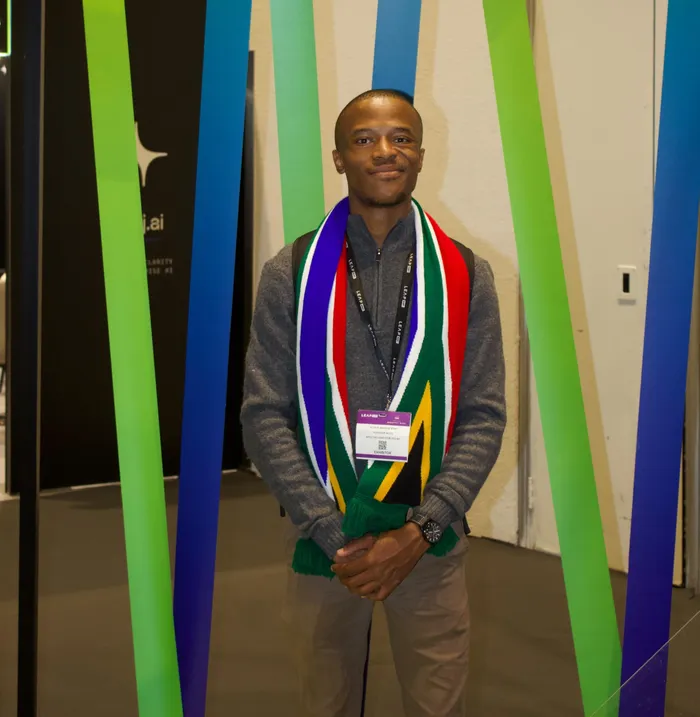
Elihle Stali is redefining assistive technology with his groundbreaking smart glasses for the blind.
Image: Supplied
In a previous interview with 24-year-old inventor Elihle Stali, he was turning to his fellow South Africans on TikTok to help fund a plane ticket to Hong Kong.
He was not simply looking to represent his country; he wanted to prove that an idea born in the Eastern Cape, in the township of eMdantsane, could stand alongside the world’s most advanced technology.
Weeks later, Stali has returned home with the future of African assistive tech packed tightly inside his briefcase.
He engaged with 11 venture capital investors from India, Brazil, China, the UnitedStates, Spain, France and the United Kingdom, opening early-stage discussions about possible future investment.
He is currently in talks with a potential international manufacturing partner, with negotiations still at an early stage.
If negotiations succeed, the partnership could pave the way for mass production ofSpectacles4TheBlindSA, moving the device beyond the prototype stage.
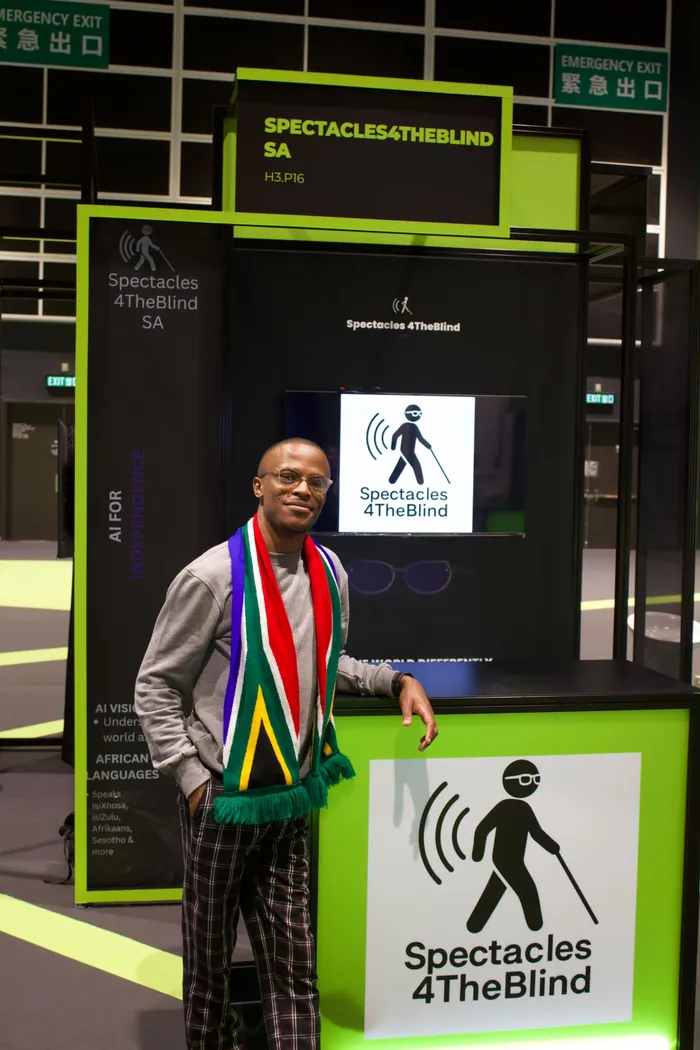
The young South African inventor whose AI-powered glasses are set to empower millions of visually impaired individuals. A promise to his grandmother fuels his mission!
Image: Supplied
Long before global venture capitalists took notice of his company, there was a grandson and a grandmother. Growing up in South Africa, Stali watched his grandmother lose her independence to visual impairment.
Every daily task required a guide: walking to church, navigating the kitchen, or stepping outside the front door.
As a teenager, Stali looked at the rapid rise of artificial intelligence and asked a pivotal question: What if wearable tech could restore dignity and independence to millions of visually impaired individuals?
That question birthed Spectacles4TheBlindSA. The cutting-edge device utilises advanced computer vision and object-recognition software to scan surroundings in real time.
The software then translates visual data into descriptive audio, whispering precise navigation cues directly to the user. Crucially for the African continent, the software communicates in several indigenous languages, including IsiXhosa, Zulu, Sesotho and Afrikaans, bridging a massive accessibility gap left wide open by Western tech giants.
"I achieved more than I could ever imagine," Stali said. "I made a promise to my grandmother, and I've stayed committed to that promise."
Selected as one of just 150 leading innovators worldwide, Stali spent three high-intensity days demonstrating his device to global tech firms. While other creators relied on slick slide decks and corporate charts, Stali put his live, functioning prototype directly into the hands of global investors.
"I wanted people to experience it," Stali explains. "Whenever visitors stopped at my stand, I didn't rush through a standard sales pitch. I told them about my grandmother. Most people connected deeply with the raw human purpose behind the code."
While talks with potential manufacturers continue under confidentiality agreements, the specific corporate names remain under strict confidentiality agreements.
For Stali, identifying potential partners capable of executing his technical visionmarks an important step forward.
"I wanted someone who could actually build this innovation. For me, that was one of the biggest wins. I'm only 24. I want to build more than a product. I want to build jobs. I want to build a legacy."
The high-stakes trip also reinforced a critical business lesson: African ideas need aggressive legal protection.
While international commercial negotiations continue under non-disclosure agreements, Stali and his legal team are focused on protecting their intellectual property.
"We know that historical patterns show Black inventions get exploited or stolen," Stali states frankly. "Before this enters mass production, we are aggressively trademarking the brand and safeguarding our patent rights."
Ironically, while international investors rushed to back the device, Stali found that securing support at home was far more difficult.
Before travelling overseas, he approached several local funding bodies, innovation agencies and South African government programmes. The majority of his applications went completely unanswered.
"I’ve knocked on many doors at home," Stali reflects. "My dream isn't only about helping blind people navigate the world safely. It's about building a sustainable manufacturing plant right here in South Africa to create high-skilled jobs for our youth."
Hong Kong was not the finish line; it was the launchpad. The breakthrough brings the real possibility of moving from live demonstrations to mass market production, a crucial step if the technology is ever going to reach the communities it was designed to serve.
The young man who once needed social media crowdfunding to catch a flight is now in discussions with global electronics manufacturers about how the technology could be scaled in the future.
True medical and technological innovation does not require a Silicon Valley zip code.