

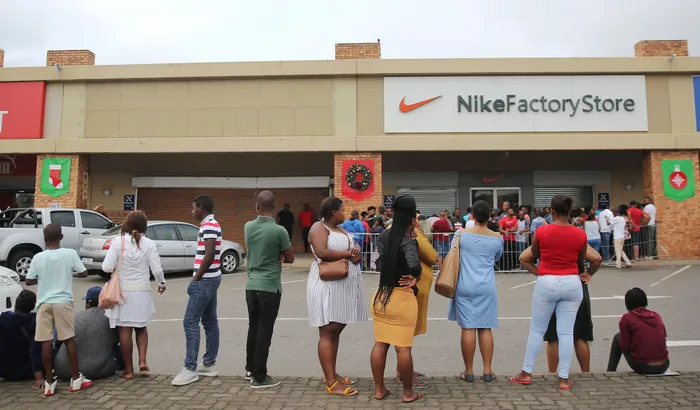
Retailers selling textiles, clothing, footwear and leather goods recorded one of the strongest recoveries, with sales rebounding 3.7% after contracting 1% in April.
Image: Motshwari Mofokeng/Independent Newspapers
South Africa's retail sector maintained its growth momentum in May, buoyed by a rebound in clothing sales and resilient online shopping demand.
However, economists have warned that rising inflation, higher fuel costs and the prospect of another interest rate hike are likely to weigh on household spending in the months ahead.
Statistics South Africa (Stats SA) on Wednesday reported that retail trade sales increased 2.3% year-on-year in May, accelerating from a downwardly revised 1.2% increase recorded in April.
On a seasonally adjusted monthly basis, retail sales edged up 0.1% after rising 0.9% in April, while sales over the three months to May were 2% higher than the corresponding period last year.
Stats SA deputy director for distributive trade statistics Raquel Floris said the improvement was broad-based, with five of the seven retail categories recording annual sales growth.
"South African retail trade expanded by 2.3% year-on-year in May. Five of the seven retail groups recorded a rise in sales, with the miscellaneous category and textiles and clothing the largest drivers of growth," Floris said.
She noted that the miscellaneous category includes online retailers as well as businesses specialising in jewellery, stationery and sporting goods, highlighting the continued expansion of e-commerce.
Retailers selling textiles, clothing, footwear and leather goods recorded one of the strongest recoveries, with sales rebounding 3.7% after contracting 1% in April.
The "other retailers" category also strengthened, reflecting sustained demand through online shopping platforms.
Sales of household furniture, appliances and equipment remained robust, increasing 8.1% year-on-year, only marginally slower than April's 8.6% growth, while pharmaceutical, medical goods, cosmetics and toiletries retailers saw sales growth accelerate to 2.1% from 0.6%, supported by seasonal winter demand.
General dealers also maintained steady growth of 1%. However, not all retailers shared in the gains.
Sales at specialist food, beverage and tobacco retailers declined 0.4%, marking the sixth consecutive month of annual contraction, while hardware, paint and glass retailers also recorded a 0.4% decline after modest growth in April.
FNB senior economist Siphamandla Mkhwanazi said the latest figures suggest consumers continued to prioritise clothing, household goods and online purchases despite mounting financial pressures.
"The strongest support came from a recovery in clothing and footwear sales, with volumes rising by 3.7% year-on-year after contracting previously. Growth in the 'other retailers' category also accelerated, underscoring ongoing resilience in e-commerce activity," Mkhwanazi said.
He added that strong demand for household furniture and appliances indicated consumers were still prepared to spend on durable goods despite the recent fuel price shock.
Mkhwanazi said households entered 2026 in relatively good financial shape, supported by improving purchasing power, healthier balance sheets and lower borrowing costs, helping sustain consumer spending during the first half of the year.
However, he warned that the environment has become less supportive as consumer confidence weakened sharply during the second quarter amid higher fuel prices and growing uncertainty, while the boost from stronger household wealth has also started to fade.
"A less supportive external environment and softer confidence are likely to encourage more cautious spending behaviour in the months ahead," Mkhwanazi said.
"Nevertheless, household consumption should remain the primary driver of economic growth in 2026, although its contribution is likely to be more modest than previously anticipated."
Investec economist Lara Hodes said recent survey data also pointed to a divergence in consumer spending patterns.
According to the Bureau for Economic Research's retail survey, retailers selling non-durable goods were the only segment to report improved confidence during the second quarter, largely because consumers continue prioritising essential purchases.
Hodes said higher fuel prices, driven by renewed conflict in the Middle East, have increasingly crowded out discretionary spending, while deteriorating consumer confidence has further weakened demand for big-ticket items.
Consumer confidence fell to -19 in the second quarter from -7 previously, with households becoming increasingly reluctant to purchase durable goods.
Hodes added that inflation accelerated to 5% in June, while financial pressures on consumers continue to intensify. Meanwhile, real salaries have declined despite modest wage increases, leaving households with less purchasing power as administered prices such as electricity and municipal tariffs continue rising faster than inflation.
With the South African Reserve Bank widely expected to raise interest rates again, economists believe borrowing costs will remain elevated, placing further strain on disposable incomes and consumer spending during the remainder of the year.
BUSINESS REPORT