

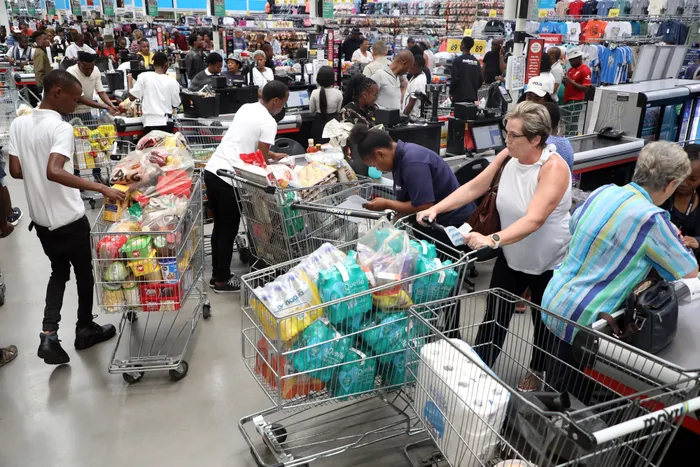
Data released by Statistics South Africa (StatsSA) on Wednesday showed that retail trade sales increased by 1.3% compared with April 2025, although the pace of growth slowed from a revised 2.5% increase recorded in March.
Image: Oupa Mokoena/Independent Newspapers
South African consumers continued to open their wallets in April, with retail sales rising by 1.3% year-on-year, supported by strong demand for household goods, furniture and a broad range of miscellaneous retail products despite mounting pressure from rising fuel costs.
Data released by Statistics South Africa (StatsSA) on Wednesday showed that retail trade sales increased by 1.3% compared with April 2025, although the pace of growth slowed from a revised 2.5% increase recorded in March.
The figures suggest that consumers remained active in the retail sector, even as higher living costs and economic uncertainty weighed on household budgets.
Raquel Floris, deputy director for distributive trade statistics at StatsSA, said five of the seven major retail categories recorded growth during the month.
“South African retail trade sales increased by 1.3% year-on-year in April. Five of the seven retail groups were stronger, with the miscellaneous category, all other retailers, the largest driver of growth,” Floris said.
The strongest performing category was “all other retailers”, which recorded annual growth of 7.3%. Retailers selling household furniture, appliances and equipment also enjoyed a robust month, with sales climbing 9.5%.
General dealers, pharmaceutical and medical goods retailers, as well as food and beverage stores, also made positive contributions to overall growth.
In contrast, retailers specialising in textiles, clothing, footwear and leather goods experienced a decline in sales, falling by 0.7% compared with the same month last year. Hardware, paint and glass retailers recorded flat growth.
FNB senior economist Siphamandla Mkhwanazi said consumers entered 2026 on a firmer footing, supported by improving purchasing power, stronger balance sheets, and lower borrowing and debt-servicing costs.
Mkhwanazi said this backdrop helped lift consumer sentiment, particularly among higher-income households.
“Looking ahead, however, a less supportive external environment and tighter financial conditions are likely to weigh increasingly on domestic demand. Elevated operating costs, particularly via the oil price channel, alongside heightened uncertainty, could compress margins and dampen investment through weaker confidence. In turn, this may translate into softer employment and income growth, constraining household spending,” he said.
“Encouragingly, recent developments in the oil price suggests a degree of easing in cost pressures. If sustained, this should provide partial relief to consumers and help moderate the extent of the expected slowdown in spending. Nevertheless, consumers are still expected to support GDP growth in 2026, albeit at a slower pace than initially anticipated.”
On a monthly basis, consumer spending showed greater momentum. Seasonally adjusted retail sales increased by 0.9% in April compared with March, accelerating from a modest 0.1% increase recorded in the previous month.
Retail trade sales for the three months ending in April were 1.8% higher than during the corresponding period a year earlier, indicating that spending activity has remained relatively resilient.
However, economists caution that the headline figures may overstate the strength of consumer demand.
Dr Elna Moolman, Standard Bank Group head of South Africa macroeconomic research, said underlying trends remain subdued.
“Retail sales increased nearly 1% in April from March in real or inflation-adjusted terms, quite a reasonable pace of expansion. However, amid some volatility, this masks the generally weak trend,” Moolman said.
She noted that retail sales declined by 1.3% on a seasonally adjusted basis in the three months ending April compared with the preceding three-month period.
According to Standard Bank’s client data, much of the recent spending activity was linked to fuel purchases ahead of sharp fuel price increases.
“Standard Bank's client data shows a jump in fuel spending from March, initially because people were refuelling ahead of the price spike in April, and then in response to higher fuel prices,” she said.
Despite signs of financial strain, Moolman said consumers remain in relatively good shape compared with historical trends, although retail activity is expected to remain under pressure during the second quarter until fuel price relief begins filtering through to households.
BUSINESS REPORT