

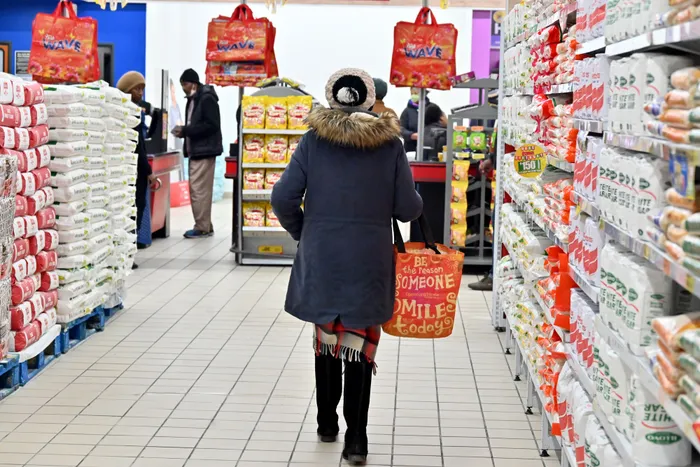
Analysts said this data largely predates the sharp fuel price increases linked to escalated tensions in the Middle East, which are likely to dampen sentiment and weigh on consumer activity going forward.
Image: Ayanda Ndamane / Independent Newspapers
South Africa’s retail sector showed modest resilience in March, but economists have warned that rising fuel prices and growing global uncertainty linked to tensions in the Middle East could weigh heavily on consumer spending in the months ahead.
According to Statistics South Africa, retail trade sales increased by 2.6% year-on-year in March 2026, up from revised growth of 1.6% in February. However, retail sales volumes for the first quarter of the year remained flat, suggesting limited support for overall economic growth.
Raquel Floris, deputy director for distributive trade statistics at Stats SA, said six of the seven retail categories recorded positive annual growth.
“With general dealers and the miscellaneous category, and all other retailers being the most significant contributors,” Floris said.
General dealers, which include supermarkets, recorded growth of 1.7% year-on-year, while the “all other retailers” category — which includes online retailers as well as jewellery, stationery and sports goods stores — expanded by 7.1%.
“Together, both categories added 1.5 percentage points to overall growth,” Floris said.
However, food and beverage retailers continued to struggle, with sales declining by 5.6% year-on-year.
On a month-on-month basis, seasonally adjusted retail trade sales edged up by just 0.1% in March after contracting by 1.1% in February.
Floris said the March data concluded the first quarter’s results, which showed no quarter-on-quarter growth in retail trade volumes.
“Seasonally adjusted retail trade was flat in the first quarter of 2026 compared to the fourth quarter of 2025,” she said.
Siphamandla Mkhwanazi, FNB senior economist, said the flat quarterly outcome implied the retail sector made “no meaningful contribution” to GDP growth during the quarter.
Mkhwanazi said this data largely predates the sharp fuel price increases linked to escalated tensions in the Middle East, which are likely to dampen sentiment and weigh on consumer activity going forward.
“Spending activity increased in six of the seven retail categories. Pressure on specialist food and beverage retailers persisted, with sales declining by a further 5.6% year-on-year (from -5.3%), marking a fourth consecutive annual contraction,” he said.
He said specialist food and beverage retailers remained under severe pressure, marking a fourth consecutive annual contraction in sales volumes.
At the same time, several discretionary spending categories still showed resilience. Furniture retailers posted robust growth of 11.3%, while pharmaceutical and cosmetic retailers recorded growth of 5.4%. Clothing and footwear sales rose 4%, although slightly slower than in February.
Hardware and building material sales remained subdued, increasing by only 0.3% year-on-year.
Mkhwanazi said consumers entered 2026 in a relatively stronger financial position, supported by lower debt-servicing costs, improved purchasing power and healthier household balance sheets.
“This backdrop helped lift consumer sentiment, particularly among higher-income households. Looking ahead, however, a less supportive external environment and tighter financial conditions are likely to weigh increasingly on domestic demand,” he said.
“Rising operating costs, particularly via higher oil prices, alongside heightened uncertainty, could compress margins and dampen investment through weaker confidence.”
However, he warned that a less favourable global environment and rising operating costs would increasingly pressure domestic demand.
“Nevertheless, consumers are still expected to support GDP growth in 2026, albeit at a slower pace than initially anticipated.”
Investec economist Lara Hodes said the flat quarter-on-quarter retail performance aligned with weakening sentiment reflected in the Bureau for Economic Research’s first-quarter retail survey.
“The survey was completed before the onset of the war in the Middle East, which is likely to have weighed further on confidence,” Hodes said.
She added that higher fuel prices and rising living costs were expected to curb discretionary spending in the near term.
“According to PayInc, “weaker discretionary spending and softer demand for non-essential goods and services” is anticipated in the near term as a result of the war, which has seen fuel prices surge, driving up living costs.”
BUSINESS REPORT