

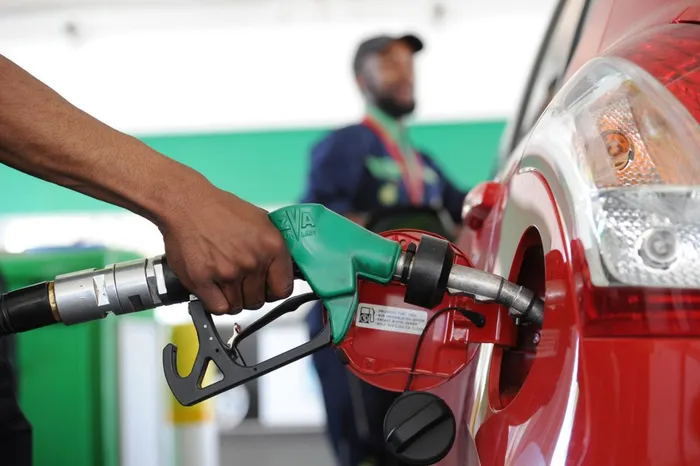
The price of fuel is set to increase next Wednesday. Patrick Kelly, Stats SA's chief director for price statistics, said higher fuel prices were overwhelmingly responsible for the acceleration.
Image: Karen Sandison / Independent Media
A sharp rise in fuel prices pushed South Africa's annual consumer inflation rate to its highest level in two years in June, with motorists and commuters bearing the brunt of higher transport costs as geopolitical tensions continued to filter through to the local economy.
Statistics South Africa (Stats SA) on Wednesday reported that annual consumer price inflation accelerated to 5% in June, up from 4.5% in May and above market expectations of 4.7%.
This marked the fourth consecutive monthly increase and the highest inflation reading since June 2024, when the rate stood at 5.1%, and could force the SA Reserve Bank to adjust upwards its monetary policy rate to arrest the inflation acceleration.
On a monthly basis, consumer prices rose by 0.7%, matching the increase recorded in May.
The biggest contributor to the increase was transport, with annual inflation in the category jumping to 12.7% from 9.4% in May.
Patrick Kelly, Stats SA's chief director for price statistics, said higher fuel prices were overwhelmingly responsible for the acceleration.
"Transport was the largest contributor to both annual and monthly changes in the CPI. This was mainly underpinned by higher fuel prices," Kelly said.
Fuel prices climbed 34.3% over the past 12 months, reflecting increases of 50.8% for diesel and 31.7% for petrol, largely driven by elevated global oil prices linked to the conflict involving Iran.
The higher cost of fuel quickly filtered through to public transport, with passenger transport inflation surging. The category recorded a monthly increase of 8.1%, pushing annual inflation to 12.5% from just 4% in May.
Minibus taxi fares rose 11.5% during the month, while e-hailing services increased 8.7%, long-distance bus fares climbed 8.4%, and school transport costs were 3.7% higher.
Housing and utilities also continued to place upward pressure on inflation, with annual inflation in the category reaching 5.5%. Water supply costs increased 6.9%, while electricity, gas and other fuels rose 3.9%.
Rental inflation also gathered pace following the quarterly update incorporated into the consumer price index. Actual rentals increased by 1.1% from the March quarter, lifting annual rental inflation to 4.1%. Townhouse rentals increased 5.4%, flats 4.6%, and house rentals 3.7% over the past year.
Underlying price pressures also strengthened, with core inflation, which excludes food, fuel and energy, rising to 4.1%, its highest level since September 2024.
Despite broader inflationary pressures, food price inflation remained relatively subdued.
Inflation for food and non-alcoholic beverages eased further to 1.6% in June from 1.9% in May and 2.9% in April.
Kelly said several staple foods continued to become cheaper. Cereal products recorded a fifth consecutive month of deflation at -1.5%, with white rice prices down 13.4%, maize meal 5.9% cheaper and porridge declining 1.3% compared with a year earlier.
Meat inflation also continued to moderate, easing to 5.1% from a recent peak of 13.5% in January. Beef mince inflation slowed sharply to 3.9%, while stewing beef entered deflation at -2.7%.
However, some food items remained under pressure. Pork inflation remained elevated at 13.9%, while mutton and lamb inflation accelerated to 8.4%. Processed meat products also recorded notable increases, with sausages rising 11.8%, corned meat 10.2%, and bacon 8.6%.
Hot beverages remained another source of persistent inflation, with prices increasing 7.4% annually. Black tea rose 8.3%, while instant coffee was 7% more expensive than a year ago.
The June inflation figures underscore how external energy shocks are increasingly feeding into domestic prices, with higher fuel costs spilling over into transport, services and broader inflation, even as food prices remain relatively contained.
BUSINESS REPORT