

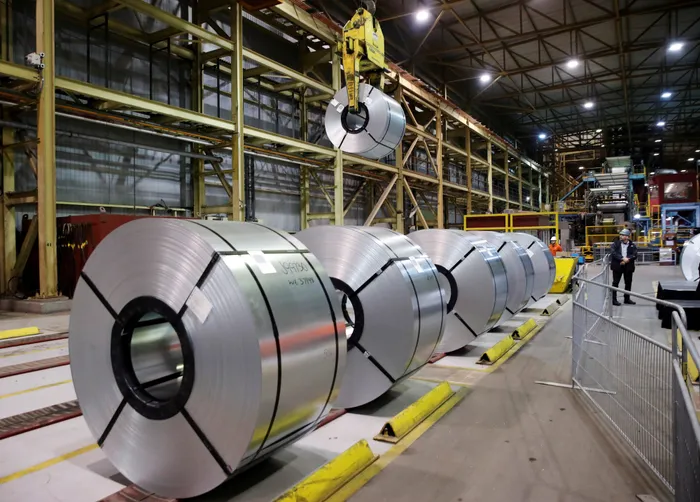
The committee urged government to strengthen localisation policies, enforce local procurement requirements in public infrastructure projects and tighten import controls to curb illicit and underpriced steel imports.
Image: File
South Africa's steel industry requires urgent and coordinated government intervention to prevent further job losses and industrial decline, Parliament's portfolio committee on trade, industry and competition said on Wednesday.
This comes as policymakers and industry stakeholders warned that the sector is facing one of its most severe crises in decades.
The committee called on government to develop a comprehensive rescue strategy for the steel value chain following a follow-up engagement with the Department of Trade, Industry and Competition (the dtic), industry bodies and labour representatives.
Committee chairperson Mzwandile Masina said the industry remained critical to South Africa's industrialisation ambitions and could not be allowed to collapse.
"The steel sector must be saved. However, this requires holistic government support and industry investment to ensure that a modern and competitive sector can emerge. Therefore, the dtic and its entities should prioritise the review of the Master Plan and affected interventions," Masina said.
Various stakeholders told MPs that the sector continues to face mounting pressure from weak domestic demand, rising electricity costs, logistics bottlenecks, cheap imports, policy misalignment and declining investment.
They also highlighted concerns about the growing demand for low-carbon steel internationally while South Africa's industry remains largely carbon-intensive.
The committee urged government to strengthen localisation policies, enforce local procurement requirements in public infrastructure projects and tighten import controls to curb illicit and underpriced steel imports.
During the briefing, acting deputy director-general for sectors at the dtic, Tebogo Makube, described steel as a strategic industry that supports a broad network of upstream and downstream sectors.
"The steel industry is one of the sectors that are being prioritised because of the multipliers associated with the industry, both upstream and downstream, including the export earnings that we can generate as a country," Makube said.
However, much of the discussion centred on the future direction of industrial policy and trade protection measures.
Ayabonga Cawe, chief commissioner of the International Trade Administration Commission of South Africa (ITAC), argued that the challenges facing the sector are more complex than simply raising tariffs or scrapping existing policies.
Cawe told MPs that government's recently approved Industrial Development Strategy already provides a framework for rebuilding the steel industry through a dedicated steel value chain roadmap, trade policy reforms and support for downstream manufacturing.
"The industrial development strategy that was adopted by Cabinet over the last few days sets out two very specific areas in relation to the future of steel," Cawe said.
"The first is a steel value chain roadmap. That sets out the terms of the diversification of the technologies, blast furnace vis-a-vis electric arc furnace, and of course the diversification of the product mix, the type of steels that you produce and their uses and downstream applications."
He said the strategy also includes a review of tariff protections, anti-dumping measures, safeguards, import controls and the Preferential Pricing System (PPS), while promoting the development of a circular economy based on steel recycling and lower-carbon production.
Addressing criticism of the PPS, which regulates scrap metal exports, Cawe cautioned against simplistic solutions.
"The assessment of the PPS must not start by saying you need to jettison the PPS," he said. "The assessment of the PPS must start with saying, what is our assessment if indeed we want to decarbonise how it is that we make steel, which is what the industrial development strategy is saying."
He noted that major steel-producing nations such as China, India and Turkey were increasingly promoting scrap metal use as part of their transition towards greener steelmaking technologies.
Cawe also revealed the scale of the industry's decline, pointing to a dramatic erosion in employment and production capacity over the past decade.
"End of 2009, by the quarterly employment statistics, you had over 50,000 people employed in basic iron and steel. There's less than 25,000 now, 23,178 by December of last year," he said.
"The capacity utilisation data is showing us that you've halved utilisation over a very short period in the post-Covid moment."
While industry participants have called for stronger trade protection measures, Cawe said South Africa's obligations under global trade agreements complicate the policy response.
"Many of the industry on the line in the steel review said to us there is an emergency that no 15% or at best in downstream products, 30% bounded duty can help me with. I probably need much greater protection because of the structural overcapacity."
He added that policymakers may ultimately need to consider whether existing commitments under the World Trade Organisation remain adequate in addressing the challenges posed by global steel overcapacity and rising imports.
BUSINESS REPORT