

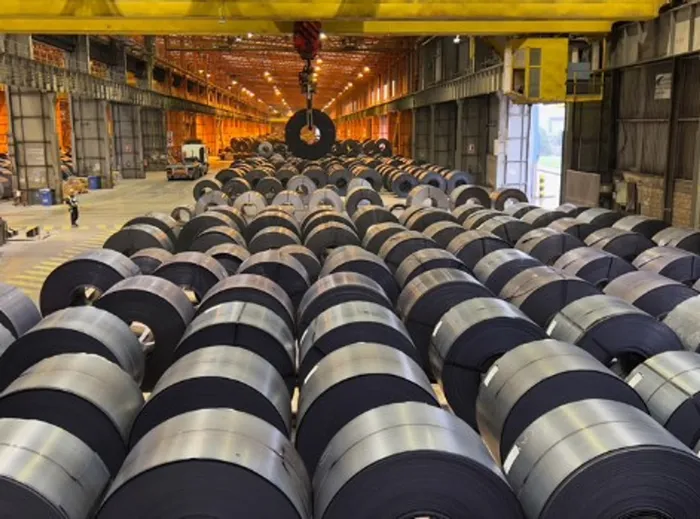
Dr Tebogo Makube, chief director for industrial procurement at the dtic., acknowledged that the closure of ArcelorMittal South Africa’s Newcastle plant had disrupted supply chains, particularly for the automotive sector, forcing government to temporarily permit imports of certain steel products.
Image: File
South Africa’s steel industry remains central to the country’s industrialisation ambitions, but faces mounting pressure from weak economic growth, high electricity costs, cheap imports and global overcapacity, Parliament heard on Tuesday.
Briefing the portfolio committee on the implementation of the Steel and Metal Fabrication Master Plan, the Department of Trade, Industry and Competition (the dtic) on Wednesday outlined a series of interventions aimed at protecting local manufacturers, boosting demand for locally produced steel and accelerating the sector’s transition to greener production technologies.
Dr Tebogo Makube, acting deputy director-general of sectors at the dtic, described the steel sector as a strategic industry that underpins industrial development and supports a wide range of upstream and downstream industries.
“The steel industry is one of the sectors that are being prioritised because of the multipliers associated with the industry, both upstream and downstream, including the export earnings that we can generate as a country,” Makube said.
He told MPs that government’s objective was to deepen domestic steel production and strengthen downstream industries that depend on locally manufactured steel products.
Makube acknowledged that the closure of ArcelorMittal South Africa’s Newcastle plant had disrupted supply chains, particularly for the automotive sector, forcing government to temporarily permit imports of certain steel products.
“Given the placing of the Newcastle plant, we have worked with the auto industry in terms of some of the requirements of steel products and we have temporarily allowed for the importation of those products so that we don’t jeopardise our programme in the auto industry,” he said.
However, he stressed that reducing dependence on imports remained a key priority.
“It is important that we support the steel industry and limit our reliance on imports so that we can also increase the local content requirement, particularly in the auto industry where we have seen that local content has gone down,” Makube said.
The dtic identified slow economic growth, rising electricity costs and a surge of low-priced imports as among the biggest challenges facing the industry.
Makube said government was working with the Department of Electricity and Energy to address power costs, while the International Trade Administration Commission of South Africa (ITAC) had intensified trade protection measures.
“We have been busy coming up with trade remedies which are aimed at dealing with cheap imports, but also protecting and supporting the industry,” he said.
According to the department, around 10 trade measures, including anti-dumping actions, safeguard measures and tariff investigations, have been approved since the committee’s previous engagement on the sector.
Makube noted that the challenges confronting South Africa’s steel producers reflected broader global trends.
“What we are facing is not only a South African problem, but it is also a global problem,” he said, pointing to excess steel production capacity in major producing countries such as China and India.
The briefing also highlighted growing international demand for low-carbon steel, driven by stricter environmental regulations in major export markets such as the European Union and the United Kingdom.
“It is important that we respond to that, given the requirements for green steel globally, particularly in the EU and the UK,” Makube said.
To support the transition, government is developing a steel sector roadmap focused on decarbonisation, renewable energy integration and investments in new technologies such as electric arc furnaces and direct-reduced iron production.
“We don’t have an option as a country to decarbonise, and that is part of the industrial development strategy which has been approved by Cabinet,” he said.
Government is also exploring the establishment of green steel industrial zones in Saldanha Bay and other strategic industrial nodes.
On the demand side, the dtic is working with Eskom, the National Transmission Company of South Africa and the Industrial Development Corporation (IDC) to maximise local steel content in major infrastructure projects, including the country’s planned 14,000-kilometre electricity transmission expansion programme.
“There is now a memorandum of agreement between the IDC and the National Transmission Company of South Africa to support manufacturers as we are deepening localisation, particularly the supply of steel and other related ancillary products,” Makube said.
Acting chairperson of the committee, Dr Malusi Gigaba, said the committee remained concerned about several unresolved issues affecting the sector.
These included the abandonment of supplier development programmes by state-owned enterprises, the impact of pricing policies on downstream manufacturers and small businesses, and the need to strike a balance between market forces and state intervention.
BUSINESS REPORT