

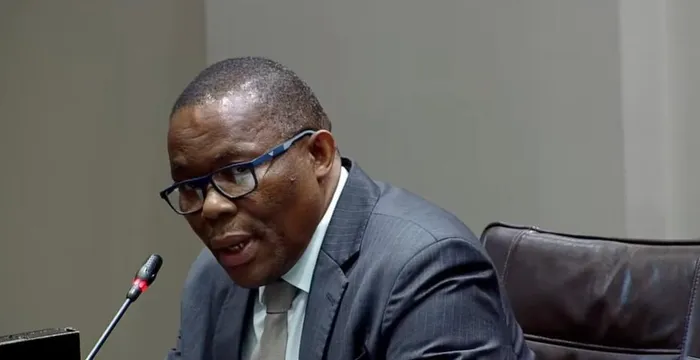
Appearing before Scopa in Parliament on Wednesday, eThekwini Mayor Cyril Xaba defended the municipality’s response, saying the city had already committed to strengthening accountability and governance.
Image: YouTube screengrab
The eThekwini Municipality has come under intense scrutiny over more than R6.4 billion in irregular expenditure written off over two financial years, with senior municipal officials admitting to shortcomings in accountability and procurement compliance while insisting corrective measures are being implemented.
The issue emerged during the City's appearance before the Standing Committee on Public Accounts (Scopa) to account for its 2024/25 audit outcomes in Parliament on Wednesday.
DA MP Farhat Essack confronted municipal leadership over findings by the Auditor-General (AG) that cited repeated transgressions of laws and regulations.
Essack questioned the City Manager Musa Mbhele about the AG’s findings, which stated that the accounting officer was not adequately implementing recommendations relating to monitoring, oversight and compliance.
“The AG says as the accounting officer, you sir are not implementing recommendations relating to monitoring and oversight compliance, multiple repeat transgressions with laws and regulations,” Essack said.
Mbele acknowledged the concerns raised by the AG and conceded that progress in resolving audit findings had been unsatisfactory.
“The statement by the auditor general is correct in a sense that it does reflect an unsatisfactory progress in dealing with some of the findings that they have raised,” Mbele said.
However, he argued that the municipality was improving its internal controls and accountability systems.
“We are doing consequence management for those people who are not complying. So we are doing all the best we can to ensure that we change the situation around,” he said.
Essack then turned his attention to the scale of irregular expenditure, noting that eThekwini recorded R4.84bn in irregular expenditure during the 2023/24 financial year after already recording R1.66bn the previous year.
“In 24 months, R6.43bn was written off in two financial years,” Essack said. “How do you account for R6.43bn being written off in 24 months? Has there been any investigations? Who is responsible?”
Responding to the questions, eThekwini chief financial officer Dr Sandile Mnguni said a significant portion of the irregular expenditure stemmed from non-compliance with local content regulations under the 2017 Preferential Procurement Policy Framework Act regulations.
Mnguni explained that some municipal tenders failed to specify local content requirements while, in other cases, bidders did not properly indicate compliance with those requirements.
“As a result of that, those were found to be in breach of the 2017 regulations,” he said.
Mnguni said the municipality subsequently reviewed all affected contracts and declared the expenditure irregular.
“There’s a big chunk of that expenditure that relates to local content,” he said.
He added that another major contributor involved a long-running municipal plumbers’ programme originally designed to empower local plumbers and support infrastructure repairs.
However, he admitted that the municipality failed to comply with provisions of the Municipal Finance Management Act (MFMA), which limits certain contract arrangements to three years unless proper procedures are followed.
“That process was not complied with. As a result, it was declared irregular,” Mnguni said, adding that the plumbers’ matter accounted for roughly R800 million of the irregular expenditure.
The municipality also cited water tanker contracts as another source of irregular expenditure. According to Mnguni, the city decided not to issue new three-year contracts because Council had resolved to insource water tanker services after purchasing more than 150 tankers.
Instead, the municipality extended existing contracts using section 116 of the MFMA, a decision later deemed inappropriate.
“We accepted it and we then declared it as irregular expenditure,” he said.
Mnguni said all irregular expenditure cases undergo investigation under section 32 of the MFMA and are reviewed by a financial misconduct board comprising municipal executives, external legal experts and provincial government representatives.
“So the cases are being investigated where consequence management is required,” he said.
Meanwhile, eThekwini Mayor Cyril Xaba defended the municipality’s response, saying the city had already committed to strengthening accountability and governance.
Xaba referred to a letter he addressed to the AG in January 2026 outlining commitments to improve oversight, ICT governance, infrastructure management and monitoring of audit action plans.
“We have elevated the monitoring on the implementation of the audit action plans,” Xaba said.
He added that cluster committees now monitor implementation monthly, while quarterly reports are tabled before council as part of efforts to improve governance and audit outcomes.
BUSINESS REPORT