

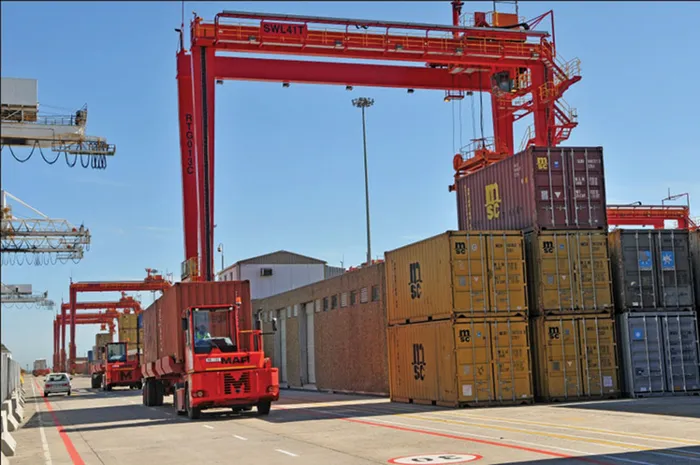
Transnet Port Terminals said the fuel neutrality charge will be applicable at its container terminals that utilise diesel-dependent equipment in handling import and export cargo and aims to recover costs amid ongoing global supply chain disruptions.
Image: Supplied
Transnet Port Terminals (TPT) has increased its fuel neutrality charge on container cargo to R78 per container from June, as rising diesel costs continue to place pressure on port and logistics operations amid ongoing global supply chain disruptions.
The revised charge, which takes effect on 1 June 2026, applies to container terminals that rely on diesel-powered equipment to handle import and export cargo.
TPT on Friday said the adjustment is aligned with South Africa’s regulated fuel pricing framework and linked to coastal diesel index thresholds determined by the Department of Mineral and Petroleum Resources.
TPT general manager for commercial and planning Michelle van Buren Schele said the surcharge is intended as a temporary cost-recovery mechanism rather than a profit-generating measure.
“The fuel charge is being implemented as a transparent, cost-recovery mechanism following diesel increasing by between R13.26 to R13.43 since March 2026 due to ongoing global supply chain disruptions,” van Buren Schele said.
She added that TPT had begun consulting customers as early as March while contingency plans were being developed to secure fuel supply and avoid operational disruptions at ports.
According to TPT, the surcharge will only partially recover the increased fuel costs, with the company absorbing some of the financial burden itself. The utility also stressed that the charge would be reviewed monthly and only applied during periods of extreme fuel price volatility.
“We place our customers at the centre of our operations and will continue to engage transparently and proactively with all industry stakeholders, ensuring consistent communication, clarity on any impact, and collaborative solutions that support supply chain resilience,” van Buren Schele said.
The latest increase follows TPT’s earlier announcement in April that it would introduce an initial fuel neutrality charge of R52 per container from 1 May, which drew mixed reactions from industry stakeholders concerned about the broader economic consequences of escalating logistics costs.
Last month, Road Freight Association CEO Gavin Kelly criticised both the terminology and practical implications of the surcharge, arguing that there is little “neutral” about passing additional costs through the supply chain.
“Firstly, there is nothing ‘neutral’ about adding R52 or any cost into the logistics chain. Secondly, when last the association loaded a container, there was no engine that consumed fuel,” Kelly said.
Kelly warned that while transport operators may not directly absorb the charge, the added costs would inevitably be passed on to businesses and consumers.
“The cost (surcharge) will be added to the transport bill of the customer. The total logistics cost will increase and be reflected in upward pressure of the final price of the goods when purchased by the consumer,” he said.
Shipping and logistics specialist Malcolm Hartwell also cautioned that further diesel price increases could trigger even steeper surcharges in coming months.
“That increase would be an additional R75 per twenty-foot equivalent units (TEU) if calculated on the same basis as the current increase,” Hartwell said.
He noted that although shipping lines may initially absorb some of the costs, the increases would ultimately filter through the economy and place additional pressure on inflation.
“This will no doubt have an impact on inflation as almost every product and service in the economy relies to some extent on the logistics chain and the costs incurred in that chain,” Hartwell said.
Industry stakeholders have also warned that rising logistics costs could weaken consumer demand and place additional strain on businesses already battling fragile economic conditions.
BUSINESS REPORT