

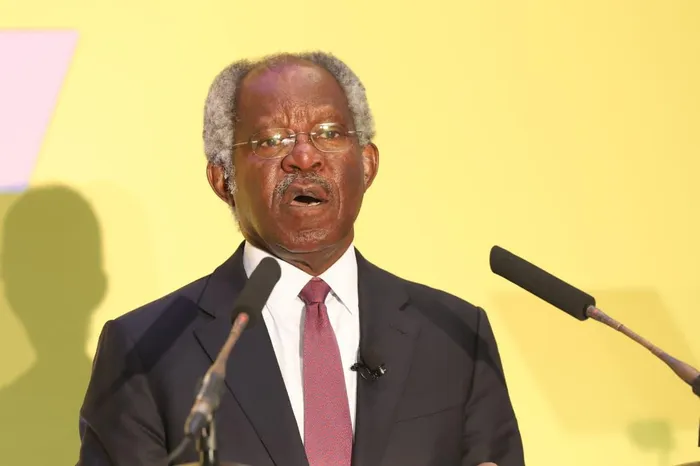
Adebayo Ogunlesi, chairman and CEO of Global Infrastructure Partners, now part of BlackRock, speaking at the BlackRock South Africa Infrastructure Investment Summit alongside President Cyril Ramaphosa in Cape Town on Wednesday.
Image: GCIS
Chairman and CEO of Global Infrastructure Partners, now part of BlackRock Inc, Adebayo Ogunlesi has said that South Africa stands at a critical turning point where infrastructure investment could unlock long-term economic growth, job creation and regional competitiveness.
Speaking at the BlackRock South Africa Infrastructure Investment Summit alongside President Cyril Ramaphosa on Wednesday, Ogunlesi said infrastructure investment was central to the country’s economic future and that private capital was ready to participate if the right conditions were created.
“We think that infrastructure in South Africa and indeed on the African continent as a whole is at an inflection point. The simple fact is that South Africa, like many other countries, has underinvested in infrastructure that underpins its strength and vitality,” Ogunlesi said.
He said South Africa had underinvested in key infrastructure over many years, particularly in electricity, logistics and transport systems.
“In the 21st century there simply is no excuse for unreliable electricity supply. Reliable and affordable energy is a foundation requirement for growth,” he said.
Ogunlesi pointed to electricity transmission, renewable energy, rail, ports, airports and digital infrastructure as critical sectors that could unlock economic potential and improve South Africa’s competitiveness.
“Strengthening the transmission and distribution networks, which I know the President is very focused on, and accelerating the growth of renewable energy, will allow us to make progress in this regard,” he said.
“Improving the efficiency of the airports, ports, and rail systems can unlock trade, reduce costs, and enhance South Africa’s position as a gateway for the continent.”
Ogunlesi also highlighted the importance of digital infrastructure and artificial intelligence, saying AI would require major investment in data centres and energy systems.
“AI itself will require robust infrastructure, from data centers to energy capacity, further reinforcing the need to get infrastructure right,” he said.
Ogunlesi said the traditional model of relying solely on governments to finance infrastructure was no longer sustainable and that countries were increasingly competing for private capital.
“The good news is that private capital is eager to engage,” he said.
“But we must also remember that South Africa is in competition. It’s competing with the U.S., with Germany, GCC countries, Asian and Latin American countries, and so we have to present a compelling case for investing in South Africa.”
He added that policy certainty, transparent procurement systems, stable regulation and the rule of law were critical to attracting global investment capital.
BlackRock is the world’s largest asset manager, overseeing approximately $14 to $15 trillion in assets under management, and serving institutional, intermediary, and individual investors.
Ogunlesi revealed that BlackRock currently manages around R500 billion worth of assets in South Africa and said he expected that exposure to double over the next five years.
Ramaphosa joked that doubling the investment was not enough and that BlackRock should quadruple it instead. He used the summit to market South Africa as a leading investment destination on the continent, highlighting reforms in energy, logistics, telecommunications and infrastructure financing.
“Infrastructure development in Africa represents one of the largest untapped investment opportunities of our time,” Ramaphosa said.
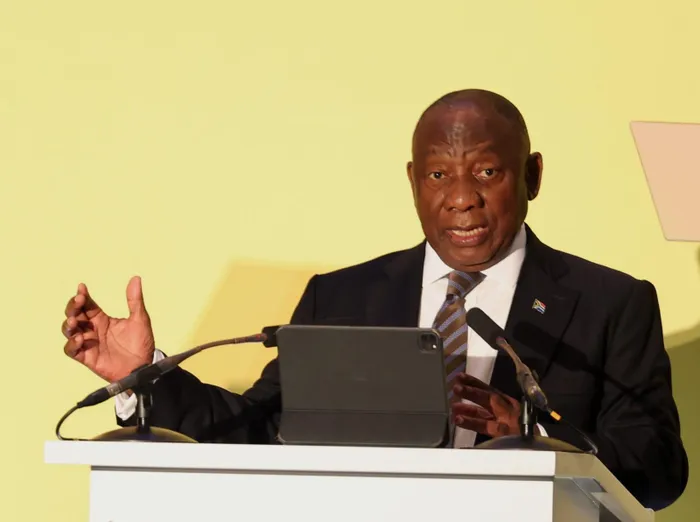
President Cyril Ramaphosa speaking at the BlackRock South Africa Infrastructure Investment Summit on Wednesday.
Image: GCIS
The president said South Africa planned to spend more than R1 trillion on infrastructure over the next three years while opening more sectors to private participation.
“We are opening the rail network to greater private sector participation and rebuilding operational capacity through Transnet and the Passenger Rail Agency of South Africa,” Ramaphosa said.
He also floated ambitions for high-speed rail projects in the country after learning that BlackRock-backed infrastructure businesses already operate high-speed rail networks in other parts of the world.
“I have two speed trains to build,” Ramaphosa said, before jokingly adding after interjections from ministers: “The minister says three. So we have three speed trains to build.”
Head of BlackRock Africa, Khoabane Phoofolo, said the summit highlighted both the opportunities and challenges surrounding infrastructure development in South Africa and globally.
“From an opportunity standpoint, I think I’ve already been tasked with a forex delivery,” Phoofolo joked.
“I sent an email to my team of 15, and I think they’ve all accepted $133 billion per head will be focused on deploying assets into South Africa.”
Minister in the Presidency Khumbudzo Ntshavheni said infrastructure development remained central to South Africa’s long-term economic recovery strategy.
“Infrastructure is a catalyst for economic growth and drives inclusive development as it enables access to markets, essential services and economic opportunities,” Ntshavheni said.
She said government had committed significant funding towards infrastructure over the medium-term budget period but acknowledged that public funding alone would not be sufficient.
“Private sector funding is a component that is too critical for South Africa’s infrastructure development trajectory,” she said.
BUSINESS REPORT