

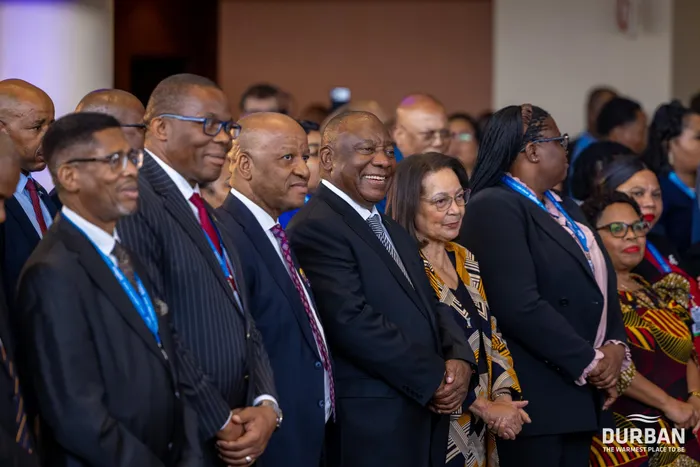
President Cyril Ramaphosa officially opened Africa’s Travel Indaba on Tuesday.
Image: Durban Tourism / Facebook
President Cyril Ramaphosa has hailed Durban and the broader KwaZulu-Natal province as a model for tourism-led economic growth, saying renewed investor confidence in eThekwini was already driving a wave of hotel and infrastructure developments along the province’s coastline.
Speaking at the opening of Africa’s Travel Indaba yesterday, Ramaphosa said Durban’s turnaround demonstrated how government and business partnerships could revive cities and reposition them as globally competitive tourism destinations.
“Hotels are springing up because we are creating a conducive climate,” Ramaphosa said.
He said the city had emerged from years of governance and infrastructure challenges following interventions through the Presidential eThekwini Working Group, which brought together government and business leaders to stabilise and rebuild confidence in the metro. Ramaphosa described Durban as “the true maker of tourism in South Africa,” adding that tourism investment had a far-reaching economic impact beyond hotels and hospitality.
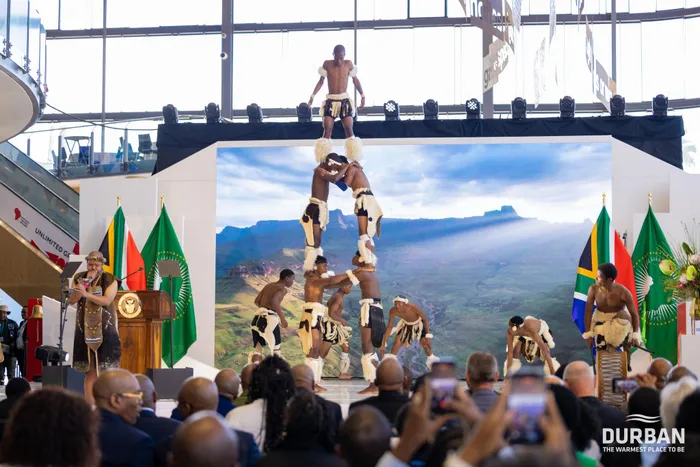
Africa's Travel Indaba is being held at the Inkosi Albert Luthuli International Convention Centre in Durban.
Image: Durban Tourism / Facebook
He said the sector benefited transport operators, farmers, digital marketers, event organisers, artists and township entrepreneurs while creating jobs for young people, women and people living with disabilities.
Tourism Minister Patricia de Lille echoed the president’s sentiments, describing tourism as an “economic catalyst” capable of transforming communities and driving inclusive growth. Addressing delegates at the Indaba, De Lille said South Africa’s tourism sector contributed 4.9% to the country’s GDP and created 954,000 direct jobs in 2024, according to the latest Tourism Satellite Account figures.
“With a record 10.5 million visitors in 2025, we are no longer speaking about recovery. We are speaking about growth,” she said. She attributed the sector’s momentum to deliberate collaboration between government, the private sector and communities through initiatives such as the Tourism Growth Partnership.
De Lille highlighted several major tourism-related investments already under way, including a R10.5 billion investment in the Cape Winelands Airport project and nearly R2.5 billion committed to the new Club Med Beach and Safari Resort in KwaZulu-Natal, which is expected to open in July.
She said the projects reflected growing investor confidence in both South Africa and the African continent. The minister also pointed to broader efforts to diversify tourism offerings beyond traditional leisure travel.
These include a R120 million investment, supported through a partnership with the European Union, into the Kgodu-modumo Dinosaur Interpretation Centre at the Golden Gate Highlands National Park, which has already attracted more than 90,000 visitors since opening last year.
De Lille said the Department of Tourism would soon hand over a R23 million refurbishment of the Banga Nek campsite at the iSimangaliso Wetland Park as part of efforts to improve tourism infrastructure in rural and conservation areas.
Ramaphosa said tourism should not be viewed merely as a leisure industry but as a strategic economic sector capable of diversifying African economies heavily reliant on commodities.
“For countries struggling with commodity dependence, tourism is the answer,” he said. The president noted that before the Covid-19 pandemic, tourism contributed about 7% of Africa’s GDP directly and indirectly while supporting tens of millions of jobs across the continent.
He said countries including Rwanda, Kenya, Tanzania and Mauritius had shown how tourism could become a pillar of national growth.
Ramaphosa also used the platform to call for easier travel across Africa, saying expensive flights, visa restrictions and poor connectivity continued to hold back tourism growth on the continent.
He urged African countries to market themselves collectively through regional tourism packages that would allow travellers to move seamlessly between destinations in Southern, East and Central Africa.
“We need to market Southern Africa collectively,” he said.
For more stories from The Mercury, click the link THE MERCURY