

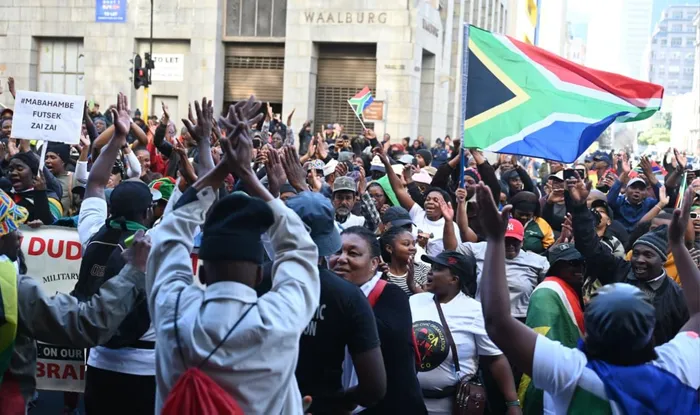
Supporters of LACO and other anti-undocumented migrant groups protest, accusing undocumented foreign nationals of occupying jobs that they say should be reserved for South Africans, particularly in sectors that do not require scarce skills.
Image: Ayanda Ndamane / ANAStudio
Confused about the differences between legal migrants, asylum seekers, refugees, and undocumented migrants in South Africa? This article details the crucial distinctions and the latest government actions shaping immigration laws.
There is often confusion over the difference between legal migrants, asylum seekers, refugees and undocumented migrants - and what the law says about each of them.
Recent government operations targeting undocumented foreign nationals, as well as renewed policy proposals from the Department of Home Affairs, have brought immigration laws into the spotlight.
Officials have reiterated that these actions are aimed at people who are in the country unlawfully, while those with valid documentation remain protected under South African law.
Here's what the law says.
A legal migrant is a foreign national who is lawfully in South Africa under the Immigration Act or other applicable legislation.
This includes people who have a valid visa or temporary residence permit; Permanent residence; A recognised refugee permit; or a valid asylum seeker permit while their application is being processed.
The Department of Home Affairs says foreign nationals entering South Africa must generally possess a valid passport or travel document and, where required, an appropriate visa before entering the country.
The two terms are used interchangeably, but have distinct meanings in the eyes of the law.
An asylum seeker is someone who has fled their country and applied for protection in South Africa but whose application has not yet been finalised.
According to government information, asylum seekers receive a temporary Section 22 permit while their application is being considered, allowing them to remain lawfully in South Africa until a decision is made.
However, a refugee is someone whose application has been approved and who has been formally recognised under the Refugees Act as needing protection because of persecution, conflict or similar circumstances in their home country.
Under the Immigration Act, an "illegal foreigner" is someone who is in South Africa in contravention of the Act.
This may include people who entered the country unlawfully; overstayed the validity of their visa or permit; had their permit expire without renewal; or remained in South Africa after losing their legal status.
The Immigration Act empowers immigration authorities to detain and deport people found to be in the country unlawfully, subject to the procedures laid down in the legislation.
Employers may hire foreign nationals but only if they have the legal right to work.
Section 38 of the Immigration Act prohibits employers from knowingly employing an undocumented foreign national or someone whose immigration status does not permit them to work for that employer.
Employers who contravene the law may face criminal penalties if convicted.
The issue continues to make headlines following government operations against undocumented migrants and Cabinet's approval of a revised White Paper on Citizenship, Immigration and Refugee Protection.
The proposed reforms seek to modernise South Africa's immigration system, strengthen border management and clarify the country's approach to economic migration, refugee protection and asylum processes. Many of the proposals will still require legislative changes before taking effect.
In June, the Inter-Ministerial Committee on Migration said employers who knowingly hire undocumented migrants would face prosecution under the Immigration Act, while reaffirming that enforcement actions are directed at unlawful immigration and related criminal activity.