

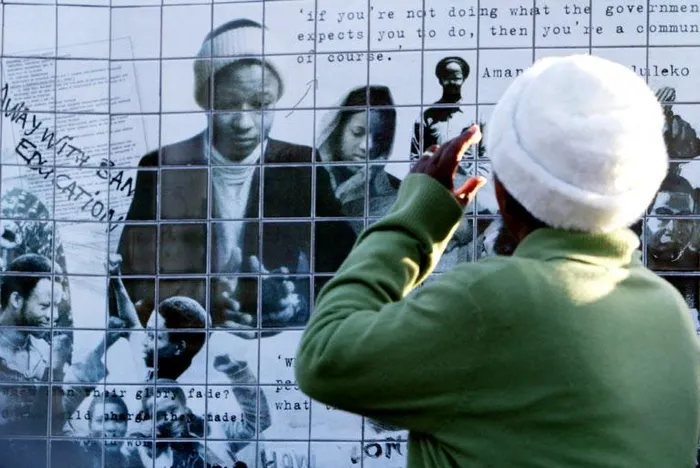
Mrs Nomkhitha Mashinini views a collage compiled in honour of her son, Tsietsi Mashinini, one of the leaders of the 1976 Soweto student uprising, in Johannesburg. The youth of 2026 must mobilise and become politically conscious in the same self-sacrificing spirit of the 1976 generation to ensure their voices are heard in the corridors of power and across society at large, says the writer.
Image: AFP
Edwin Naidu
Fifty years on from the Soweto Uprising on June 16, 1976 the struggle continues. But where are the voices of youth in South Africa?
If the youth of 1976 proved that courage has no age, what is going on with the younger generation? For the youth of 1976, defiance was not born out of privilege or power, but out of a willingness to stand up and fight an unjust system.
South Africa’s democracy was shaped by teenagers who refused to turn the other cheek. Every June, we are reminded that the bravest decisions in our history were made by those the country tried hardest to silence, the youth.
Five decades later, as South Africa marks 50 years since the Soweto Uprising on June 16, some scholars warn that Youth Day has become “a celebration with a nod to 'the radical ideas and practices of 1976,'” and that we are losing sight of the seriousness of its political legacy.
The Soweto Uprising was organised, political, and deeply intellectual youth work, rooted in Black Consciousness, community structures, and a clear enemy: apartheid. But with apartheid gone from the statute books 32 years ago, millions of young people would not have been born under National Party rule.
Compared to the class of 1976, it begs the question of whether the youth of 2026 are apathetic. Many will have you believe that young people spend considerable time on social media platforms such as TikTok, Instagram, and YouTube, and bare their souls via digital self-expression (music, fashion, memes). It is about the latest haircut trends or who uses the best brands.
But with youth unemployment at 62.4% for ages 15–24 and 40.4% for ages 25–34, young people are desperate to build a future. They’re influenced by Amapiano, hip-hop and local creators and influencers. It is a far cry from the youth of five decades ago.
While my generation of golden oldies may also have taken a liking to Amapiano, they’re probably nostalgic for Pink Floyd’s "Another Brick in the Wall," played during the 1980 Tri-Cameral election boycotts. Pertinently, "Soweto Blues", a track written in response to the 1976 Soweto Uprising by Miriam Makeba, became one of the defining musical protest songs of the era. Bittersweet symphonies!
Across the continent, the data shows that youth face similar challenges. The African Union’s Agenda 2063 identifies youth as the “drivers of transformation” but warns that exclusion from economic and political life threatens stability.
The UN’s World Youth Report highlights that African youth are among the most economically marginalised.
Studies in journals such as African Affairs and the Journal of Youth Studies show that young people are politically aware but deeply distrustful of formal institutions, which they see as corrupt, gerontocratic, or indifferent.
In South Africa, youth unemployment is above 60% for those aged 15–24. Mental health challenges are rising. Many young people feel they are “born free but jobless,” inheriting a democracy that has yet to deliver dignity.
That is why it is unfair to expect the youth of 2026 to replicate the heroism of the youth of 1976. They are exhausted. They are excluded. They are surviving. Significant barriers exist in unemployment, exclusion from decision-making, weak education-to-work transitions, and persistent inequality.
Social media-savvy youth in South Africa do not need to be as drastic, but they must turn digital energy into political power. Today’s youth have tools that 1976 could not dream of: social media, encrypted messaging, and digital archives.
Digital must become integral to the struggles of youth in 2026. They must use such platforms to educate, organise, and document, not only to react. They must opt for digital mobilisation that leads to real meetings, assemblies, campaigns, and policy proposals.
A 2024 study of African elections found that people in the youngest group (18–25) have felt less motivated to vote than any other age group. Their reasons may vary, but government performance on key issues affecting young people, such as employment, may be a significant contributing factor.
Finally, the actions of the youth of 1976 amounted to a demand for a seat at the table of learning. In 2026, the youth must find their voice, demand real seats at the table, and build their own tables. UN and AU frameworks repeatedly call for youth participation in governance, but implementation is weak.
Throughout Africa, liberation movements that came to power after leading anti-colonial struggles dominated African politics for decades. But since the 2000s, and especially the 2010s–2020s, many have lost elections. The trend is widespread. One wonders whether the ANC will be next?
If so, will it be at the hands of disenchanted youth, peeved to get ineffective bureaucracy such as the National Youth Development Agency, rather than proper help for their aspirations? Young faces in Cabinet? Do they exist under the ANC?
The youth of 2026 must mobilise and become politically conscious in the same self-sacrificing spirit of the 1976 generation to ensure their voices are heard in the corridors of power and across society at large. Otherwise, South Africa will continue to be led by dinosaurs who have long passed their sell-by date. That’s not what the youth of 1976 fought for.
* Naidu heads Higher Education Media Services, publisher of www.ednews.africa