

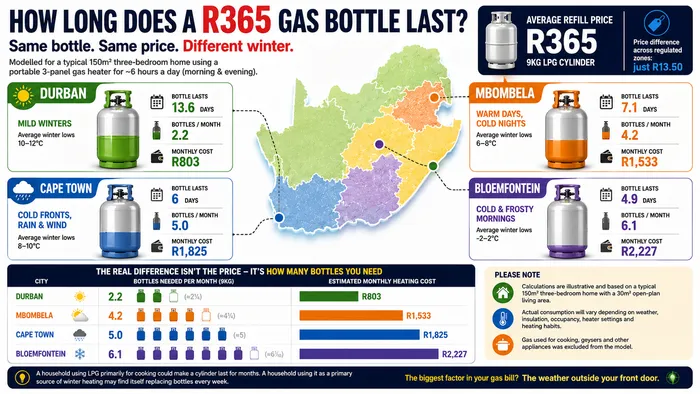
Heating a house with just gas will put a dent in your wallet.
Image: ChatGPT
For households turning to gas this winter, the real cost is often determined not by the price of the refill but by how quickly cold weather burns through it.
Earlier this week, analysis of the Department of Mineral and Petroleum Resources data showed that the difference between some of South Africa's cheapest and most expensive regulated LPG zones is just R13.50 on a standard 9kg cylinder. Retail prices across major centres also showed surprisingly little variation, with many 9kg refills selling for around R365.
Yet South Africa's vastly different winter climates mean households can face very different heating bills despite paying broadly similar prices for gas.
To illustrate the difference, we modelled a typical 150m² three-bedroom home with a 30m² open-plan lounge and dining area, a 13.5m² main bedroom and two 9.5m² bedrooms.
The model assumes a portable three-panel gas heater is used for around six hours a day, split between mornings and evenings, with heater settings adjusted to reflect typical winter conditions in different parts of the country.
The results suggest that where you live may have a bigger impact on your gas bill than the price of the bottle itself.
Durban emerges as the most affordable of the cities modelled. While Durban residents may disagree, average winter temperatures remain considerably higher than those experienced inland.
Under the model, a household relying on a gas heater for around six hours a day could make a 9kg cylinder last about 13.6 days. That translates into roughly 2.2 cylinders a month and a monthly heating bill of around R803.
Mbombela tells a different story. Winter afternoons regularly climb above 20°C, creating the impression that heating demand should be limited.
But temperatures can fall sharply after sunset, with overnight lows often dropping to around 6°C. Those large day-night temperature swings mean households still spend a significant amount on heating.
Based on the theoretical house, a 9kg bottle would last about 7.1 days, requiring around 4.2 cylinders a month. At current prices, that translates into a monthly heating bill of roughly R1,533.
Cape Town's challenge is different again. Rather than cold nights alone, the city contends with repeated winter cold fronts that bring rain, wind and prolonged periods of damp weather.
Cape Town winters, generally June to August, are often known for a mild Mediterranean climate with cool, wet, and occasionally stormy weather, although cold fronts push those temperatures down dramatically.
Even when temperatures are not drastically lower than elsewhere in the country, homes can feel colder for longer periods, encouraging households to run heaters for extended stretches.
Under the model, a 9kg bottle would last about six days, meaning a household could consume around five cylinders a month at a cost of roughly R1,825.
Bloemfontein sits at the opposite end of the scale.
Winter overnight temperatures regularly fall to around freezing, with frost a common feature during the coldest months. While daytime temperatures often recover into the high teens, households frequently face long periods of heating demand during mornings and evenings.
There are also dramatic swings to contend with, just like Mbombela.
That means, for our house, a 9kg cylinder would last just 4.9 days. That works out to around 6.1 cylinders per month, and a monthly heating bill of approximately R2,227.
The findings suggest that geography affects gas costs less through the price of the bottle than through the number of bottles households need to buy.
A Durban household could spend less than R1,000 a month on gas heating under the modelled scenario, while a Bloemfontein household could spend almost three times as much despite paying roughly the same amount for each refill.
The difference is more acute when viewed over the course of a winter season. A household in Bloemfontein could consume nearly three times as many cylinders as a comparable household in Durban, turning what appears to be a relatively small household expense into a significant monthly cost.
The calculations are illustrative and actual consumption will vary depending on weather conditions, house design, insulation, occupancy levels and heating habits. Gas used for cooking, geysers and other household appliances was excluded from the model.