

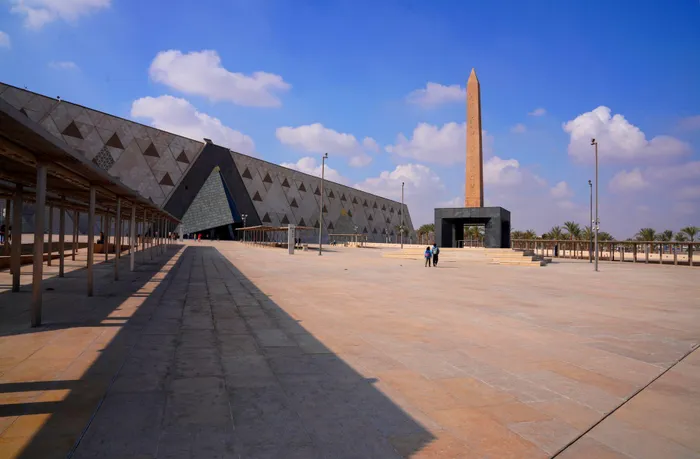
Clear skies frame a wide-angle view of the Grand Egyptian Museum, highlighting a prominent obelisk.
Image: Pexels/ George Wang
I came across an article recently that described museums not simply as tourist spots, but as custodians of human history and cultural heritage.
The deep poignancy of those words was not lost on me.
While sightseeing, tours, and activities often dominate a trip, culture enthusiasts naturally gravitate toward prominent museums in the country they visit.
There is a hypnotic quality to journeying through time via artefacts, preserved art, and memorabilia that celebrate the legacy of a nation and its people.
Having only opened its doors in November 2025, the Grand Egyptian Museum (GEM) in Giza has already achieved an impressive feat by becoming the world's third most visited museum.
This accomplishment stands as a clear testament to the global interest in Egypt’s history.
Situated just two kilometres from the Giza Pyramid complex, the museum showcases a wide array of Egyptian artefacts spanning the country's rich history, from the Predynastic Period to Roman Egypt.
Its extensive collection comprises over 100,000 items, including 20,000 pieces making their public debut, such as the complete King Tutankhamun collection.
Visitors are also drawn to newly restored highlights, including the second solar ship of Khufu, the collection belonging to Queen Hetepheres (mother of King Khufu), and the artefacts of Yuya and Thuya (parents of Queen Tiye).
An Instagram post by @nationbrandco read: “According to ‘Forbes’, Egypt’s Grand Egyptian Museum has become the third most visited museum in the world since opening in November 2025.
“Beyond the headline lies a powerful nation branding lesson.
“Egypt has shown that heritage is not just something to preserve; it is one of a country’s greatest strategic assets. “When history is thoughtfully curated, invested in and shared with the world, it becomes a driver of tourism, economic growth and global influence.”
The post continued: “In 2025, Egypt welcomed 18.6 million international visitors, confirming that cultural heritage can be one of the most powerful engines of a national tourism strategy.
“For African countries, the lesson is clear: our history is not only part of our identity, it can also be one of our greatest competitive advantages. Investing in world-class museums and cultural institutions means investing in the future of tourism.”