

dfdfd
Image: Meta AI
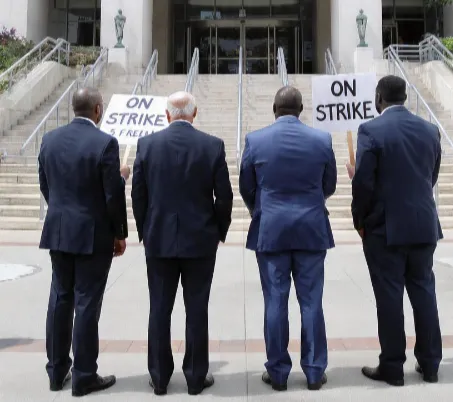
Legal Aid South Africa employees will embark on a two-day protected strike on June 17 and 18 due to chronic understaffing, frozen vacancies, salary disputes, and deteriorating working conditions.
The South African Local Government Association Workers’ Union (SALAWU) said strike action would take place after serving the required notice to the organisation.
The strike follows months of failed attempts to resolve disputes through the Commission for Conciliation, Mediation and Arbitration, with the union saying employees have reached breaking point.
Legal Aid South Africa provides legal representation and legal services to people who cannot afford private legal assistance, including in criminal, civil and land matters.
Among SALAWU’s key concerns are frozen vacancies, increasing workloads and what it describes as a steady erosion of employee benefits.
“Positions and vacancies have been frozen, resulting in unreasonable over-workload and chronic understaffing,” the union said in a statement announcing the strike.
The union’s concerns mirror warnings made by Legal Aid South Africa’s own management during a briefing to Parliament’s Portfolio Committee on Justice and Constitutional Development last month.
Presenting the organisation’s budget challenges, Legal Aid executives said a R261 million budget reduction had forced difficult staffing decisions. Management told MPs that “346 positions would not be replaced if they leave, would not be filled when there’s retirement and so forth”, representing a 22% reduction from the approved establishment.
The organisation warned Parliament that failing to replace staff could affect service delivery.
“It means that we won’t be able to deliver services efficiently and at the right quality because our staff will then have higher caseloads,” Legal Aid South Africa said. Management added that growing workloads could also “compromise the mental health of the staff”.
Legal Aid South Africa described its finances as a “shoestring budget”.
“From our point of view, our budget is a shoestring budget. You can’t really manoeuvre too much because we don’t have a buffer,” management told MPs.
Executives also asked for a budget increase. We appeal to the portfolio committee on justice and positional development to assist in addressing the budget reduction challenges that we have currently.
“In order to restore staff capacity and cover operational costs to sustain service delivery outcomes, Legal Aid SA requires at least R261 million for 2026-2027 financial year.
SALAWU has also continued to challenge Legal Aid South Africa’s decision to enforce retirement at age 60, arguing that employees expected the retirement age to revert to 65 and that the policy has encouraged experienced staff to seek employment elsewhere in the justice sector.
According to the union, employees retiring at 60 face reduced earnings, pension implications and changes to medical benefits. SALAWU estimates that an employee earning R350,000 a year could lose up to R1.75 million over five years because of the earlier retirement age.
The union further alleges that salary benchmarking discussions have stalled, performance incentive bonuses have been reduced, and employee morale has deteriorated since the current board took office in 2024.
“In labour’s view, the current Board has done absolutely nothing positive or in the interest of employees since assuming office in 2024,” the union said.
The funding pressures facing Legal Aid South Africa have also attracted concern from government.
Addressing the parliamentary committee, Deputy Minister of Justice and Constitutional Development Andries Nel warned that Legal Aid South Africa’s mandate was expanding while resources were shrinking.
“The challenge that we are sitting with is that as the mandate expands there’s not a commensurate expansion of resources. In fact, the trend is the other way. It’s a reduction,” Nel said, while commending it for what it had achieved.
Nel warned that resource constraints could have consequences across the justice system.
“If Legal Aid South Africa doesn’t have the financial and the human resources to do that, it’s going to lead to backlogs in our courts,” he told MPs.
The deputy minister also said, “I do want to come back to this issue of the need for both in the Executive and in Parliament for us to develop a resource allocation framework, especially for the Justice, Crime, Prevention and Security cluster”.
The entity was unable to comment this morning, ahead of publication. It has, however, previously disputed the union’s version of events.
Legal Aid said the retirement age of 60 was formally approved by the board in 2018 and later approved by both the ministers of justice and finance in 2020, following consultation processes with employees.
The body also noted that employees due for retirement can “apply for an extension of employment on a year-to-year basis. Such applications are considered on their merits, taking into account factors including scarce skills requirements and financial implications.”
Five employees retired in January 2026, while a further 25 employees are expected to retire before the end of the current financial year.