

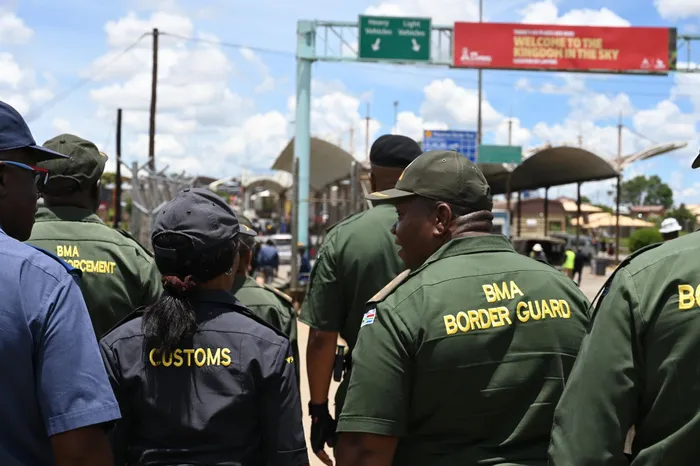
The Border Management Agency officers keep a close watch on South Africa's ports. The writer says a deeper conversation is needed around immigration and governance.
Image: Border Management Authority
Every period of heightened public anxiety in South Africa seems to produce the same familiar conclusion: immigration has become the country's greatest problem, and the solution lies in tighter borders, stricter enforcement, and tougher rhetoric.
It is an argument that resonates emotionally because it offers a simple explanation for a society grappling with unemployment, deteriorating public services, rising crime, and deepening economic uncertainty. Yet simplicity is often the enemy of sound public policy.
The real challenge confronting South Africa is not merely the movement of people across its borders but the state's diminishing capacity to govern that movement in a manner that is lawful, effective, and capable of sustaining public confidence in its institutions. Migration has accompanied every stage of human civilisation, shaping economies, cultures, and political systems long before the modern nation-state emerged.
No country has ever permanently insulated itself from the movement of people, particularly in an era characterised by globalisation, regional integration, and increasingly interconnected labour markets. The question, therefore, is not whether migration can be stopped, because history suggests it cannot, but whether governments possess the institutional capability to manage migration in ways that strengthen rather than fracture social cohesion.
South Africa's public discourse has become trapped in a false binary that forces citizens to choose between being pro-immigration and anti-immigration, when the far more important question is whether the country has developed governance systems capable of managing migration intelligently.
That distinction matters because immigration, by itself, rarely creates instability. Instead, it exposes weaknesses that already exist within the institutions responsible for border management, labour regulation, urban planning, public service delivery, and law enforcement. In many respects, migration functions less as the cause of institutional failure than as the mirror that reflects it.
This is why anti-immigration sentiment often intensifies, not simply because migration increases, but because confidence in government declines.
When citizens believe that borders are poorly managed, documentation systems are dysfunctional, municipalities are overwhelmed, economic opportunities are shrinking, and public services are deteriorating, migration ceases to be viewed as one policy issue among many.
It instead becomes a powerful symbol of broader institutional decline, allowing complex governance failures to be condensed into a single, highly visible target. Migrants become the face of frustrations that originate elsewhere.
This distinction is critical because it challenges one of the most enduring misconceptions in contemporary political debate. South Africa does not face an immigration crisis in isolation. It faces a governance crisis within which immigration has become the most visible manifestation.
If every undocumented migrant were removed tomorrow, the country would still confront persistently high unemployment, failing municipalities, inadequate infrastructure, declining educational outcomes, unreliable electricity, fragile public finances, and weakened public trust in institutions.
Removing migrants cannot, by itself, resolve problems whose origins lie in decades of institutional underperformance. None of this suggests that immigration should be unmanaged or that concerns expressed by South Africans are illegitimate.
Every sovereign nation has both the right and the responsibility to regulate its borders, enforce its immigration laws, and protect the integrity of its labour market. Citizens are entitled to expect that those entering the country do so lawfully, that documentation systems function efficiently, and that the government maintains accurate knowledge of who enters, who leaves, and who remains within its territory. Effective border management is not incompatible with constitutional values. It is an essential component of them.
However, there is an important difference between governing migration and politicising migration. The former requires administrative competence, policy coherence, and institutional coordination. The latter relies on slogans that promise quick solutions to structural problems.

Nyaniso Qwesha
Image: Supplied
History repeatedly demonstrates that societies experiencing prolonged economic hardship often become susceptible to narratives that attribute complex challenges to visible outsiders, even when empirical evidence suggests those challenges stem from far deeper governance failures.
Such narratives may generate political support in the short term, but they rarely produce sustainable policy outcomes. South Africa should therefore begin measuring the success of its immigration system differently.
Rather than evaluating immigration policy solely through the number of arrests, deportations, or border interceptions, policymakers should assess what might be described as immigration resilience, namely the capacity of institutions to regulate migration without generating economic disruption, constitutional instability, or social conflict.
A resilient immigration system is not one that simply restricts movement. It is one that possesses the administrative capability to process applications efficiently, remove unlawful entrants through lawful procedures, protect both South African and migrant workers from exploitation, enable municipalities to plan effectively for demographic change, and communicate transparently with citizens in ways that strengthen rather than erode public trust.
This broader understanding also carries important implications for political leadership. During periods of economic uncertainty, language matters.
Leaders who reduce complex governance failures to simplistic immigration narratives may succeed in mobilising public frustration, but they also risk weakening the very social cohesion upon which long-term stability depends.
Responsible leadership neither dismisses legitimate public concerns nor inflames them for political convenience. Instead, it distinguishes carefully between problems requiring institutional reform and problems requiring political theatre.
Perhaps this is the deeper lesson that South Africa should recognise. Immigration is not testing the country's borders nearly as much as it is testing the resilience of its institutions. It is asking whether government departments can coordinate effectively, whether municipalities can anticipate demographic pressures, whether labour markets can function fairly, whether public services can adapt to changing realities, and, above all, whether citizens still believe that the state possesses both the competence and the legitimacy to govern in the public interest.
The future of South Africa will not ultimately be determined by how loudly it debates immigration. It will be determined by whether it develops institutions capable of governing demographic change with intelligence, fairness, and constitutional integrity. Strong borders remain important, but strong institutions are indispensable.
Borders define the geographical limits of a nation, whereas institutions determine the quality of life within those borders. History consistently reminds us that societies do not unravel because people move. They unravel when governments lose the capacity to manage that movement wisely, consistently, and credibly.
If South Africa genuinely wishes to avoid future social disruption, the national conversation must move beyond the emotionally charged question of whether the country should be for or against immigration.
The more consequential question is whether it is prepared to build institutions capable of governing migration in ways that preserve public confidence, strengthen economic resilience, and protect social cohesion.
That is not simply an immigration agenda. It is a governance agenda. And in the years ahead, it may prove to be one of the defining tests of South Africa's democratic maturity.
Qwesha is a trade finance consultant with expertise in global commerce and risk management and regularly contributes to a number of publications