

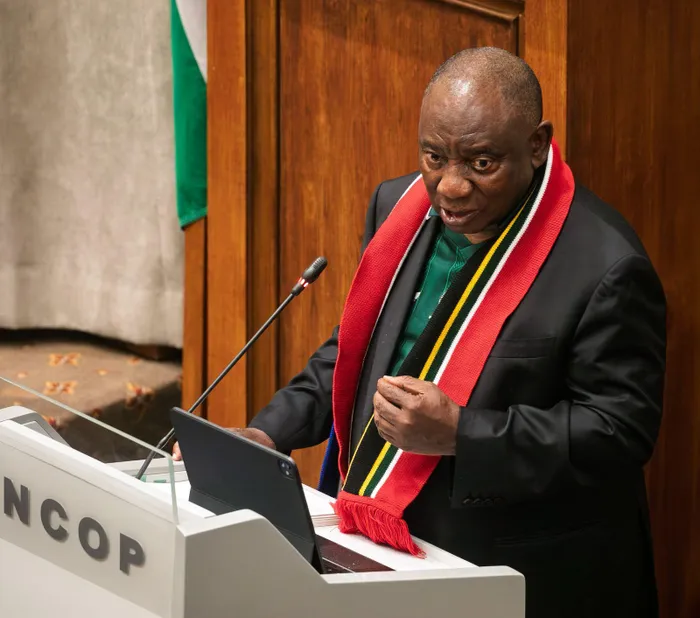
President Cyril Ramaphosa appeared before the National Council of Provinces for a question-and-answer session.
Image: Zwelethemba Kostile/ParliamentofRSA.
As President Cyril Ramaphosa appeared in the National Council of Provinces for a question-and-answer session, he said that security forces are ready to ensure Tuesday is a normal working day amid concerns of anti-illegal immigration protests on 30 June.
Ramaphosa answered questions relating to illegal immigration in South Africa, corruption within law enforcement, and illicit trade. He especially answered questions regarding the concerns of next week’s March and March-led protest.
More than 20 anti-migrant organisations and civil groups, who are behind the looming June 30 protests, have vowed that there will be no violence, looting, or death. They have been calling for undocumented foreign nationals to leave the country by Tuesday.
The remarks were made during a joint media conference in which March and March leader Jacinta Ngobese-Zuma said that they had the support of many South Africans.
Operation Dudula, United South Africa, and Progressive Forces of South Africa are among the 27 groups behind the protest.
Concerns over next week’s protest prompted Police minister Firoz Cachalia to announce a R600m police operation with SAPS deployed across all nine provinces.
"Our message is clear, everyone has the constitutional right to protest peacefully and within the confines of the law," he said. "However, criminality, intimidation, violence, the destruction of property and any attempt to undermine public safety will not be tolerated."
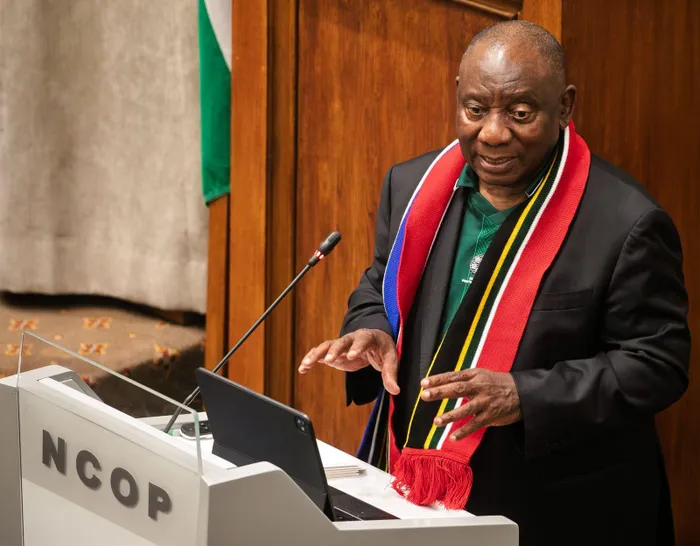
President Cyril Ramaphosa appeared before the National Council of Provinces for a question-and-answer session.
Image: Zwelethemba Kostile/ParliamentofRSA
While in the NCOP, Ramaphosa said that the government is putting in place immediate measures to deal with illegal immigration, strengthening border control, policy enforcement and the asylum system.
“As a government, we have put in place security and other measures to deal with any attempts to destabilise our country, whether by citizens or foreign nationals, and we will not tolerate any attempts to destabilise the country by anyone, whether marching or otherwise.
“Security forces are ready,” Ramaphosa said.
He said that while minister Leon Schreiber is reforming immigration measures being implemented, these reforms have been a long time in the making.
“It started in the sixth administration, and the work is continuing, and I should say that this is a collective work. It's not a work of one person. A number of people and officials are involved.
“The Director-General of Home Affairs, Mr Livhuwani Makhode, is leading the whole administrative process. The policies and decisions have been taken by Cabinet some time ago, and we're very pleased with the work that is being done,” Ramaphosa said.
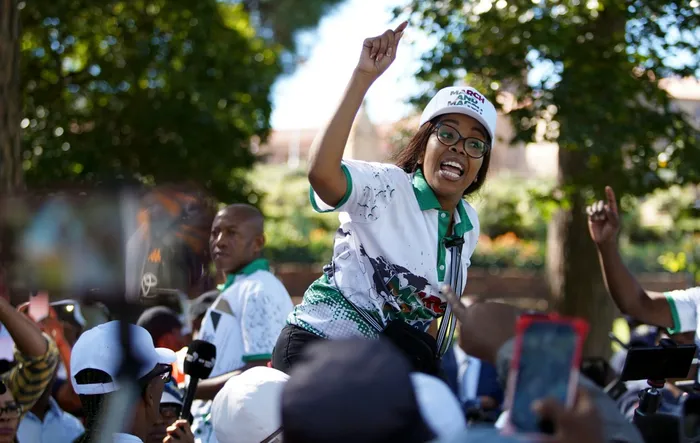
March and March Movement claims eThekwini Municipality refused permission for its planned 30 June protest, citing security concerns, and says it will challenge the decision.
Image: OUPA MOKOENA/Independent Newspapers
“And Dr Schreiber is, indeed, following in the footsteps of what had already been set in place. The process of implementing all these measures is such that we are ready to deal with whatever disruption or instability could take place. I'm a strong believer that South Africans are peaceful people.
“They are not xenophobic, they are not afrophobic as well, and they want peace. They just want every day of the week to go on on a peaceful basis without any disruption of their lives, disruption of services, and any danger to the life of anyone,” Ramaphosa said.
“So on the 30th, as people are saying, all manner of things will happen, we are taking measures to ensure that the 30th becomes a normal day where people will be able to work, to go about their business. Our security forces are ready. The National Joint Operational and Intelligence Structure is firmly in charge of what could happen; therefore, it is our responsibility collectively,” he said.
He told the NCOP members that they all have the responsibility to speak out.
“We should take whatever action that is necessary on a legal basis, and work with our security forces and work with our government officials. This is the responsibility that we all bear. But having said that, I'm able to say that our security forces will be ready to prevent anyone from wanting to destabilise the country,” Ramaphosa said.
He touched on the recently announced measures in his address to the nation on June 7 that they are taking to deal with illegal immigration, but also highlighted that this approach has been endorsed also by the Presidential Coordinating Council, “which brings together all three spheres of government and our traditional leaders, was quite pleased with the approach that we are taking”.
Ramaphosa added that briefings with faith-based organisations, traditional leaders, organised labour, and organised business have occurred as part of the government's response to crack down on violations of immigration, labour and other laws that are violated.
He said that enforcement agencies are intensifying their identification and deportation of undocumented foreign nationals, and that inspections of employers' premises are increasing.
“The Department of Employment and Labour is recruiting 10,000 inspectors, as I announced, and will increase penalties for employers breaching the Immigration Act. The second part of our response is to strengthen border security.
“We are directing resources to border infrastructure, technology, as well as bringing in more personnel, to guard our borders,” Ramaphosa said.
He added that the Cabinet approved a revised White Paper on citizenship, immigration, and refugee protection to guide a unified legal framework managing their response to migration.
“The National Labour Migration Policy, and the Employment Services Amendment Bill, will introduce quotas for the employment of foreign nationals in particular.”
He added that to handle the backlog of asylum abuse, the refugee appeal authority has recruited a number of advocates as additional adjudicators, and continues to receive capacity support from the UN High Commission for Refugees.