

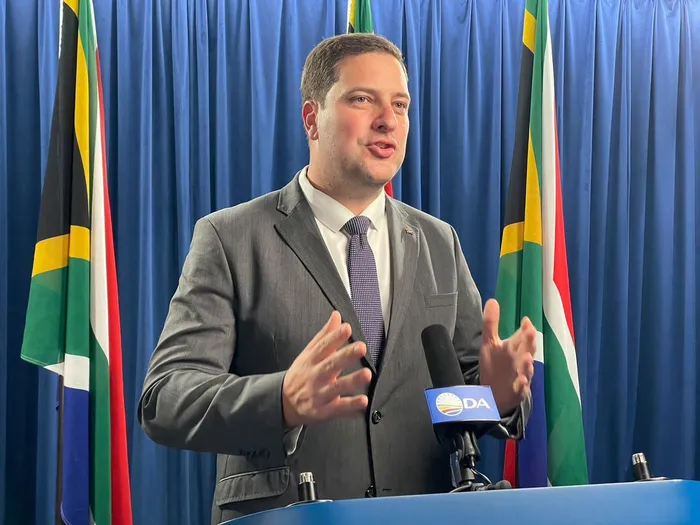
Geordin Hill-Lewis urged South Africans not to target foreign nationals during upcoming protests, saying frustration must not be allowed to escalate into violence or lawlessness.
Image: DA/ X
DA Federal Leader Geordin Hill-Lewis has called for calm ahead of planned nationwide protests on Tuesday, 30 June, warning that frustration over unemployment, crime and illegal immigration must not be allowed to escalate into violence against foreign nationals.
Hill-Lewis’ remarks come amid calls for undocumented foreign nationals to leave South Africa ahead of planned protests on Tuesday, 30 June.
In an address on Wednesday night, Hill-Lewis said South Africans were facing genuine hardships, with millions unable to find work, families struggling financially and communities feeling abandoned.
However, he urged citizens not to allow those frustrations to be exploited by those seeking to promote division and violence.
"We must never allow certain politicians or vigilantes to abuse the hardship caused by a failing economy to scapegoat and incite violence against foreign nationals to promote their own agendas," he said.
Hill-Lewis said South Africans should reject hatred and remain committed to the values that guided the country’s democratic transition.
"South Africans are not a hateful people. We are a decent, generous, resilient people.
''Let us once again show the best of who we are, not the worst of who we are," he said.
"In our transition to democracy, we were an example to the world that divisions can be resolved peacefully."
He warned that threats of violence and anarchy ahead of the planned demonstrations could not be accepted in a constitutional democracy, stressing that law enforcement remains the responsibility of the state.
"The law must be enforced by the state — not by mobs, not by vigilantes, and not by politicians who stoke hatred for votes," he said.
Hill-Lewis added that no individual or group had the authority to demand identification documents from members of the public, or to determine who may live in South Africa.
"No one may demand another person's papers in the street. No one may threaten a family, close a shop, block a road, or loot a business," he said.
Hill-Lewis also addressed broader economic frustrations, saying South Africa’s structural challenges could not be reduced to the presence of vulnerable migrants.
“South Africa’s deepest problem is not a vulnerable person selling vegetables on a corner who happens not to be born here,” he said.
“It is an economy that does not grow, a state that does not work, and a government that has failed to create jobs, secure our borders, fight crime and deliver basic services.”
While acknowledging concerns over illegal immigration, he said the law must be enforced in a manner that respects human dignity.
"If people have come to our country illegally, the law must be applied – but it must be applied with the full knowledge that we are dealing with human beings," he said.
Hill-Lewis also criticised those who use inflammatory rhetoric despite the consequences, saying such actions fuel instability.
"So we must condemn those who speak words they know may cost lives and speak them anyway," he said.
"These people are not leaders. And their words promise only violence and chaos for our country."
He argued that South Africa’s difficulties stem from years of corruption, weak institutions and poor economic growth.
"We are in this position today because the institutions which are supposed to enforce the law have been broken by years of corruption and bad government," he said.
"And we're in this position because South Africa's economy is simply not growing nearly fast enough to create jobs."
He said rebuilding the state required competent leadership and functional institutions, describing it as a long-term process rather than a quick fix.
He pointed to reforms being implemented by Home Affairs Minister Leon Schreiber, saying the department was working to rebuild immigration systems, digitise processes and combat corruption.
Hill-Lewis said Schreiber was strengthening the country’s immigration system, ensuring that those in South Africa illegally were processed lawfully and deported where necessary, while respecting human dignity.
"That is how a serious country deals with illegal immigration and rebuilding the state," he said.
He called on the South African Police Service and other law enforcement agencies to enforce the law "without fear or favour" ahead of the planned demonstrations.
Hill-Lewis also said he had instructed Cape Town’s law enforcement services to be ready, visible and firm in maintaining public order and protecting businesses, public transport, schools and places of worship.
Earlier on Wednesday, he said he had contacted President Cyril Ramaphosa, urging cooperation across all spheres of government to prevent violence and uphold the rule of law.
"Every mayor, every premier, every minister and every law enforcement agency has a duty to lower the temperature, prevent violence, protect communities and uphold the law," he said.
Hill-Lewis said South Africa’s deepest problem was not vulnerable migrants trying to survive, but rather an economy that is failing to grow and a state that is failing to function effectively.
"It is an economy that does not grow, a state that does not work, and a government that has failed to create jobs, secure our borders, fight crime and deliver basic services," he said.
He urged South Africans not to be drawn into hatred or fear ahead of the planned protests, but instead to stand for peace, order and constitutional values.
Politics