

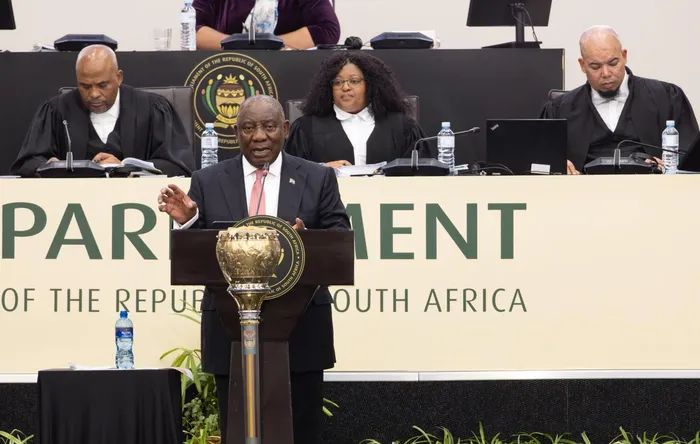
President Cyril Ramaphosa’s challenge to the parliamentary process puts South Africa’s democracy to a crucial test.
Image: GCIS
South Africa's constitutional democracy was founded on a simple but profound principle: no person, regardless of rank, office, political influence, or historical stature, stands above the law. It is a principle that transformed a nation emerging from apartheid into a constitutional state governed not by personalities but by institutions.
It is therefore deeply troubling that President Cyril Ramaphosa has reportedly approached the courts urgently to seek an interdict halting Parliament's impeachment-related processes arising from the Phala Phala controversy.
The legal merits of such an application will ultimately be determined by the courts. Every citizen, including the president, enjoys the constitutional right to seek judicial relief. Yet beyond the legal technicalities lies a larger political and constitutional question: what message is sent when the head of state seeks to suspend a parliamentary accountability process designed precisely to scrutinise the conduct of those who hold high office?
For years, President Ramaphosa has positioned himself as a champion of constitutionalism, accountability, transparency, and institutional reform.

Anda Mbikwana
Image: Supplied
His political identity has been closely associated with restoring public trust in state institutions after the era of state capture. He has repeatedly emphasised the importance of strengthening democratic oversight and ensuring that public office bearers are subjected to rigorous scrutiny.
It is against this backdrop that many South Africans will perceive a troubling contradiction. The Constitution establishes a system of checks and balances. Parliament is not a ceremonial institution existing at the executive's pleasure.
It is an independent arm of government tasked with holding the executive accountable. When parliamentary oversight mechanisms are activated, they perform a constitutional duty rather than a political inconvenience.
The concern is therefore not merely about a single court application or a single scandal. The concern is about precedent. If every accountability process can be delayed, suspended, or neutralised through prolonged litigation, then constitutional oversight risks becoming a theoretical ideal rather than a practical reality.
The Constitution was never intended to create a governing class insulated from scrutiny through procedural manoeuvres. It was intended to ensure that those entrusted with power remain answerable to the people through democratic institutions.
What makes the current situation particularly significant is that President Ramaphosa is widely regarded as one of the senior political figures associated with South Africa's constitutional transition. Whether as a negotiator, statesman, or advocate of constitutional governance, his public legacy has long been intertwined with the values embodied in the Constitution itself. That history creates a higher standard, not a lower one.
Citizens reasonably expect those who invoke constitutional principles in moments of political advantage to embrace those same principles when they become politically uncomfortable. Constitutionalism cannot be selectively applied. It cannot be celebrated when it protects power, and it is resisted when it demands accountability.
The true strength of constitutional democracy is tested not when institutions support those in power, but when they investigate them. South Africa's democratic project has survived because its institutions, however imperfect, have repeatedly demonstrated the courage to confront power. The courts have done so.
Independent media have done so. Chapter Nine institutions have done so. Parliament, too, must be allowed to fulfil its constitutional responsibilities without undue interference. This is not a question of guilt or innocence. It is not even a question of political popularity. It is a question of constitutional consistency.
The president, like every South African, is entitled to the protection of the law. But he is equally subject to its scrutiny.
The Constitution was designed as a sword against impunity, not a shield against accountability. If South Africa is to remain faithful to the values upon which its democracy was built, that distinction must never be forgotten.
Mbikwana is a scholar writing in his personal capacity on matters of constitutional law and democratic governance.