

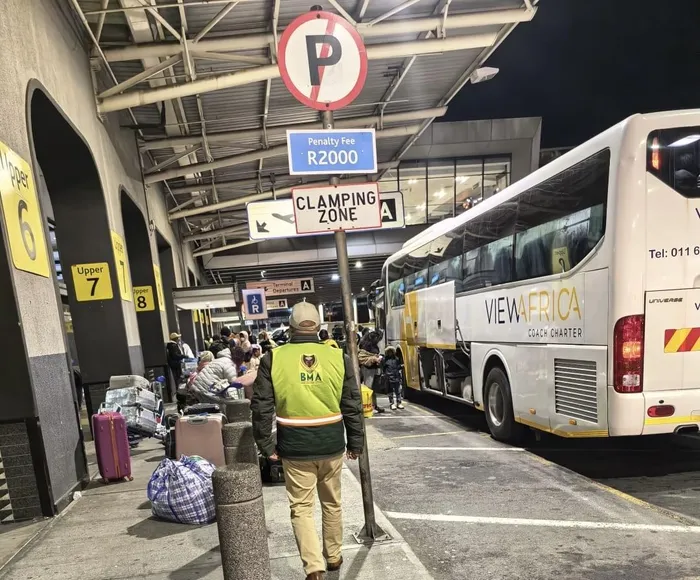
South African authorities, working with the Ghanaian High Commission and the Department of Home Affairs, oversaw the weekend repatriation of more than 650 nationals through OR Tambo.
Image: Supplied/BMA
Dr Kwame Nkrumah opened our continental eyes to the true meaning of exploitation and inequality when he wrote his ground-shaking book entitled Africa Must Unite in 1963, in which he launched damaging criticism against neo-colonialism as well as the danger of hinging our hopes on our former colonial masters for economic salvation.
In his moving autobiography, he also admonished the exploitation of man by man regardless of their race, where he describes ‘African Parasitism’ as a situation where the custodian of hospitality is used and abused by his visitors who fail to acknowledge ingratitude as anything but monstrous.
He graphically states: “It is a custom among Africans that any relative, however distant the relationship may be, can at any time arrive at your home and remain under your roof for as long as he wants. Nobody questions his arrival, how long he intends to stay, or his eventual departure.
This hospitality is sometimes very much abused, for if one member of the family does well for himself, he usually finds his compound filled with men and women, all claiming some distant kinship, and all prepared to live at his expense until the money runs out.” In our illegal immigrant’s discourse, African parasitism has been like a hidden wound.
This metaphor is quite disturbing. It is a stone-cold-fact that we now have a new assertive generation that tells the visitor that he has overstayed his visit, because young people have a natural sense of justice. They have seen jobs that were rightfully theirs being taken by foreign nationals, as well as their elected leaders taking infinite pains to defend the indefensible and thus losing their credibility in the midst of the storm.
Our democracy was like a cake that just came out of the oven, and it still needed some time to cool before it could be frosted before the country was invaded by illegal foreign nationals. The behaviour of people who abuse their host’s hospitality is parasitic. African leaders who are democratically failing their people are also reinforcing the notion of xenophobia as an escape route for their misgovernance, thus exposing their subjects to servitude in tranquility.
These leaders are sweeping their parasitic behaviour under the carpet. For example, Zimbabwean president Emmerson Mnangagwa is perpetuating parasitism by extending his term of office. These leaders are turning their subjects into paupers, and nobody is accusing them of pauperism. The issue of illegal foreign nationals in South Africa is a thorny issue that works on the nation’s conscience. Our politicians are turning a blind eye ostensibly for African unity.
When the truth bomb is about to detonate, all our weird excuses about illegal foreign nationals overlap like tectonic plates, and we just wait for them to grind together, bracing for the earthquake thanks to the anger quake of the nation.
Why are young people behaving like an angry wave towards their leadership? The answer comes from the British Attorney-General, Hartley William Shawcross, at the Nuremberg Trial in 1946: “There comes a point when a man must refuse to answer to his leader if he also has to answer to his own conscience.”
Tragedies and disasters such as the June 1976 riots teach us valuable lessons, though they may not always have good students. In the early 1890s, racial tension was running high in southern Mississippi. Black labourers were being persecuted by a gang of vigilantes known as the White Caps who professed to be upholding the forces of law and order, like the March on March Movement.
Enraged South Africans who are calling for the deportation of foreign nationals are being accused or labelled as xenophobic by foreign nationals. Both sides are filled with sulphuric rage; South Africans are galvanising into action to get rid of illegal foreign nationals.
On the other side of the coin, foreign nationals are vulcanising their resistance not to leave the country because they feel that they played an important role in the liberation of South Africa. Foreign nationals have a term to describe the collective behaviour of South Africans. Remember that behaviour is an observable act, are things that we do or do not do. They call this behaviour xenophobia.
Being xenophobic is as weighty as practising active racism. The ones who are labelled xenophobic try doubly hard to justify their behaviour. The government also tries to adopt an endearing approach by proclaiming that refugees are uniquely integrated into South African communities and not relegated to the peripheral refugee camps.
We need to put some new continental lenses on the issue of illegal immigrants if we want to avoid disaster. In 1964, Luigi Barzini conducted a groundbreaking study entitled ‘The Italian’. When he executed his study, most African nations were still under the yoke of colonial rule. He asked the following research questions: Why are they the planet’s masters of verbal diplomacy but still so inept at home government?
Why are they so individually valiant yet collectively unsuccessful as an army? How can they be such shrewd merchants on the personal level, yet such inefficient capitalists as a nation?
His findings had much to do with a sad Italian history of corruption by local leaders and the exploitation by foreign domination, all of which has generally led Italians to draw the seemingly accurate conclusion that nobody and nothing in the world can be trusted.
Because the world is so corrupted, misspoken, unstable, exaggerated and unfair, one should trust only what one can experience with one’s own senses.
Someone said that: “In a world of disorder and disaster and fraud, sometimes only beauty can be trusted.” We should ask ourselves the above questions as the African continent and come up with suggested solutions instead of hiding behind false narratives that would derail us for the next 63 years.
Dr Mabila Mathebula is an author and a life coach