

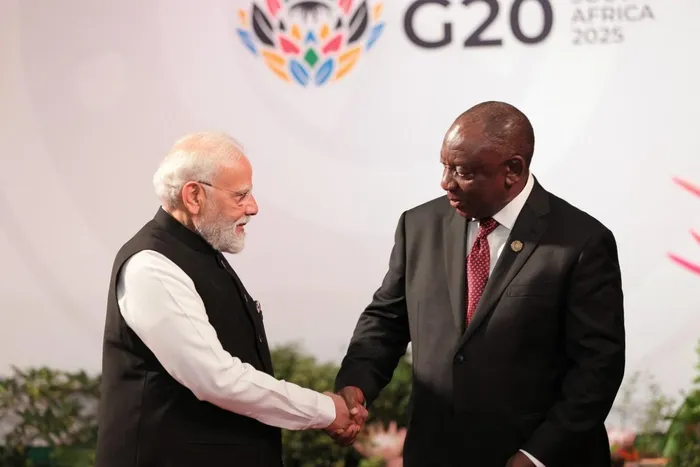
South African President Cyril Ramaphosa welcomes Indian Prime Minister Narendra Modi as he arrives for the opening of the G20 Leaders' Summit at the Nasrec Expo Centre in Johannesburg on November 22, 2025. As BRICS expands, the opportunity for India and South Africa to redefine their global economic roles grows stronger.
Image: AFP
The global economic centre of gravity is shifting, and nowhere is that more evident than in the rapid expansion of BRICS.
As the bloc's 2026 Chair, India assumes leadership at a defining moment when geopolitical tensions, slowing growth in advanced economies, rising debt and a fragmenting global trading system are accelerating the transition towards a more multipolar world.
Against this backdrop, the enlarged BRICS offers India, South Africa and other member countries a unique opportunity to strengthen trade, investment and development cooperation while giving the Global South a greater voice in shaping international economic governance.
What began as a five-member grouping of Brazil, Russia, India, China and South Africa has evolved into a coalition of 11 member states and 10 partner countries.
The inclusion of Egypt, Ethiopia, Indonesia, Iran, Saudi Arabia and the United Arab Emirates reflects the growing appetite among developing nations for alternative platforms that prioritise economic cooperation, infrastructure development and reform of global institutions.
Today, BRICS accounts for around 40% of global GDP, more than a quarter of world trade and nearly half the world's population. Its economic weight, demographic strength and abundant natural resources make it an increasingly influential force in the global economy.
For India, one of the world's fastest-growing major economies, the expanded BRICS presents both an opportunity and a responsibility. New Delhi is well positioned to leverage its strengths in manufacturing, digital technologies, pharmaceuticals, services and innovation to deepen economic ties with fellow members while championing South-South cooperation.
The enlarged bloc also creates significant opportunities for South Africa. The inclusion of major Middle Eastern economies expands market access for value-added manufactured goods and agro-processed products, while opening new avenues for investment, energy cooperation and stronger regional supply chains.
At a time when Pretoria is seeking to diversify export markets and reduce its dependence on traditional trading partners, BRICS offers an increasingly attractive platform for economic expansion.
The bloc's greatest strength lies in its diversity. It brings together the world's second-largest economy, China; high-growth markets such as India and Indonesia; energy powerhouses including Saudi Arabia, Russia, Iran and the UAE, alongside emerging African economies such as Egypt, Ethiopia and South Africa. Far from being a weakness, this diversity creates natural complementarities that can underpin more resilient supply chains, increased intra-BRICS trade and deeper investment flows.
India's growing commercial engagement with the bloc illustrates this potential. Bilateral trade with BRICS partners reached about US$417 billion in FY2026 and now accounts for more than a third of India's merchandise trade. With exports to BRICS expected to double to US$200 billion by 2030, the bloc is becoming central to New Delhi's long-term trade strategy.
Yet BRICS is about more than commerce. Unlike traditional economic groupings dominated by advanced economies, it seeks to strengthen collaboration among developing countries facing similar challenges. Cooperation increasingly spans industrial development, digital transformation, infrastructure, customs integration, financial cooperation and technology sharing.
The establishment of the New Development Bank has further strengthened the bloc's institutional credibility by providing an alternative source of development finance focused on infrastructure, climate resilience and sustainable development. As the infrastructure financing gap across the Global South widens, the bank is likely to play an increasingly important role in mobilising investment and supporting long-term growth.
Foreign direct investment presents another promising frontier. BRICS economies attracted about US$346 billion in FDI in 2024—almost a quarter of global investment flows. Energy, infrastructure, logistics, agriculture, advanced manufacturing, financial services and digital technologies are emerging as key sectors for deeper collaboration.
For India and South Africa, this offers opportunities not only to attract investment but also to expand their own investments across the bloc, strengthening regional value chains and accelerating industrial development.
The expansion of BRICS does not come without challenges. Its members differ widely in political systems, economic priorities and strategic interests. Maintaining cohesion while translating ambitious declarations into practical outcomes will require pragmatic leadership and sustained commitment.
That is precisely where India's chairmanship assumes significance. If New Delhi can harness the bloc's diversity as a strategic advantage, deepen economic integration and strengthen institutions that address the development priorities of emerging economies, BRICS will become far more than an expanded coalition of developing nations. It will emerge as a central pillar of a more balanced, inclusive and resilient global economic order.