

Johannesburg residents face a new reality as City Power's latest electric tariffs rise by up to R122, following Nersa's approval of an 8.63% increase.
Image: Supplied
Even as the utility lessens the impact of rising electricity costs, households in Johannesburg will pay between R56 and R122 more each month under City Power's new electricity tariffs.
The National Energy Regulator of South Africa approved an average increase of 8.63% for City Power, which was lower than Eskom's increase and those approved for several other metropolitan municipalities. The new tariffs went into effect on Tuesday.
Acting City Power chief executive Charles Tlouane said that “the revenue generated through these tariffs enables City Power to maintain and upgrade aging infrastructure, strengthen the electricity network, improve reliability, and continue delivering quality services to our customers. At the same time, we remain committed to protecting vulnerable households through targeted tariff interventions and our Free Basic Electricity Programme”.
The Auditor-General’s municipalities report for 2024/25 found that City Power incurred R11.8 billion in irregular expenditure since 2021/22. “Since 2021-22, 77% of the R73.9 billion in irregular expenditure incurred by metros and their entities has been due to non-compliance with legislation on procurement and contract management.
While consumers often hear percentage increases, City Power's own tariff examples show what the increases mean in rands and cents.
A household consuming 250kWh of electricity a month will now pay R680.93, up from R624.65, an increase of R56.28. This is broadly equivalent to a one- or two-person household in a flat or townhouse using a fridge, lights, television, kettle, microwave, washing machine and an electric geyser with modest hot water use.
A household using 374kWh a month will pay R1,033.26, approximately R85 more than previously. This is broadly representative of a small family in a townhouse or modest house with an electric geyser, regular laundry, a fridge, home office equipment and everyday household appliances.
For households consuming 450kWh a month, the monthly bill rises from R1,438.21 to R1,559.79, an increase of R121.58. This is typical of a larger family home with higher hot water demand, more frequent use of appliances such as washing machines, dishwashers or tumble dryers, and increased electricity use during winter.
Although electricity consumption varies widely between households, the examples broadly represent a lower-usage household, an average family home and a larger household with higher electricity demand.
The increases come as many households continue to grapple with increasing living costs, with electricity joining food, transport and municipal rates among the biggest monthly expenses.
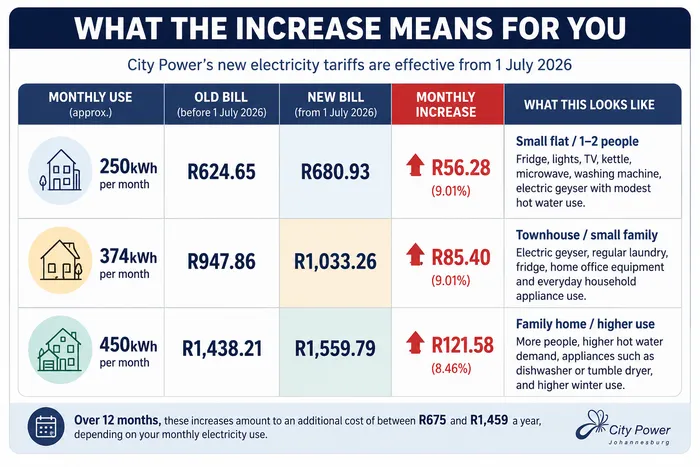
What the City Power increase might mean for your pocket.
Image: ChatGPT
City Power said the approved increase remained below Eskom's 8.76% tariff increase, even though the utility's bulk electricity purchase costs increased by 9.01%.
It said targeted tariff interventions had reduced increases for some residential customer categories, with Residential Prepaid High customers receiving an average increase of 8.71%, while Domestic Single Phase customers would see increases of 5.91%.
The utility also retained support for qualifying indigent households.
Registered indigent customers remain exempt from the R70 monthly service charge and the R140 network capacity charge, reducing their monthly costs by R210. Eligible households also continue to receive between 50kWh and 120kWh of free electricity each month through Johannesburg's Expanded Social Package, depending on household size and income.
The programme is available to qualifying households earning R7,800 or less a month, as well as pensioners, unemployed residents, people living with disabilities and other qualifying groups.
Tlouane said the utility had worked to contain the increase while continuing to invest in infrastructure.
“We understand that electricity tariff adjustments have a direct impact on households and businesses, particularly during challenging economic times. This is why we have worked carefully to contain the increase wherever possible while ensuring that we continue investing in the infrastructure needed to keep our supply areas powered,” he said.
IOL BUSINESS
Johannesburg residents face a new reality as City Power's latest electric tariffs rise by up to R122, following Nersa's approval of an 8.63% increase.
Image: Supplied