

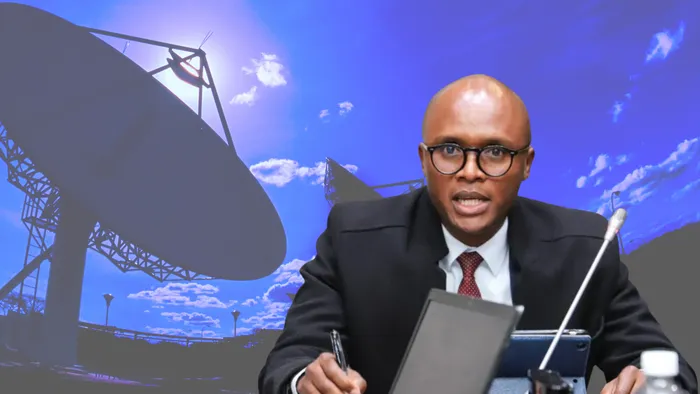
The Minister of Communications and Digital Technologies, Solly Malatsi, will deliver the keynote address on 30 June 2026
Image: X / IOLGraphics
As South Africa confronts deepening fractures in public trust, AI-driven disruption, and the accelerating pace of digital communication, Decode., a pan-African reputation advisory and strategic communications firm, will host the fourth annual Social Media Summit for Government (the Summit) from 30 June to 1 July 2026 at the Johannesburg Business School in Auckland Park, Johannesburg.
The summit will bring together experts in big tech, digital transformation, communications, policy, academia, media, and content creation under the theme: Reimagining Citizen Engagement through Human Intelligence (HI) + Artificial Intelligence (AI).Hosted in partnership with the University of Johannesburg Business School (JBS) and endorsed by the Public Relations Institute of Southern Africa (PRISA), the Summit is South Africa's leading platform and community of practice for government and public sector communication professionals.
The Minister of Communications and Digital Technologies, Solly Malatsi, will deliver the keynote address on 30 June 2026, which is observed annually as World Social Media Day. His address is expected to offer high-level strategic insight into the state's vision for digital transformation: how platforms, data, and innovation can be harnessed not merely to disseminate information but to rebuild trust between government and the citizens it serves.
Lorato Tshenkeng, CEO of Decode, said, "We are honoured to welcome Minister Malatsi as our keynote speaker at a time when South Africa's digital governance agenda has never been more contested, more visible, or more consequential. He sits at the precise intersection of the summit's core preoccupations, digital transformation, civic engagement, and the policy frameworks that will determine how South Africa navigates an increasingly complex information environment."
Bradly Howland, president of PRISA, said the minister's participation signals the importance of professional communication leadership at a moment when trust, transparency, and accountability are under intense public scrutiny.
"Public sector communicators are operating in an environment where speed, accuracy, credibility, and public trust matter more than ever. PRISA sees this summit as an important platform to advance standards, strengthen capability, and support communicators who are expected to serve citizens in an increasingly complex digital age."
Inside the ProgrammeThe two-day programme spans keynote addresses, panel discussions, fireside conversations, insights presentations, and practical breakaway sessions covering AI in the public sector, responsible technology use, digital storytelling, ethics, citizen participation, social media and journalism, attention economics, and collaborative approaches to the future of government communication.
A major feature of the summit is the panel "Crisis Communication+: AI, Speed, and Sensitivity," moderated by Kemantha Govender, communications manager at the Wits School of Governance. The panel convenes three of South Africa's most seasoned communicators: Fikile-Ntsikelelo Moya, GM of Marketing and Communications at the Electoral Commission (IEC); Chrispin Phiri, ministerial spokesperson at DIRCO; and Matshepo Seedat, ministerial spokesperson at the Department of Higher Education and Training.
The panel follows a contextual presentation by Toni Mautsu, CEO of Social Light—Africa's first AI-powered media monitoring platform—who will deliver an insights session on AI-powered social listening and crisis intelligence, providing delegates with live frameworks for reading the digital room before a crisis breaks. Together, the two sessions form an unbroken arc from signal detection to institutional response.
Tshenkeng said the crisis panel is central to the summit's purpose. "In the age of AI and social media, a crisis does not wait for a formal statement or an internal approval process. It moves through communities, platforms, screenshots, influencers, WhatsApp groups, and newsrooms simultaneously.
Crisis communication can no longer be treated as damage control after the fact; it must become a discipline of preparedness, listening, judgment, and institutional accountability."
The summit will also feature the media panel "Decoding How Social Media Has Disrupted Mainstream Newsrooms and Is Rewriting the Rules of Journalism," moderated by Prof Onkgopotse JJ Tabane, editor of Leadership and BBQ magazines.
Panellists include Qaanitah Hunter, founder and editor of The Debrief Network; Lance Witten, editor-in-chief of IOL; and content creator Amahle Jaxx, exploring how social media, digital influence, and narrative power are reshaping credibility in a public sphere where authority is contested, attention is fragmented, and trust is built in real time.
Among other confirmed speakers are Alistair King (Wirecar Philipstown Foundation), Dr. Chris Mahlathi (CSIR), Dr Caroline Azionya (PRISA), Professor Mandla Rabebe (University of Johannesburg), Sipho Mthombeni (Google South Africa), Botshelo Baloyi (Umkho AI), and Palesa Mokomele (DKMS Africa).