

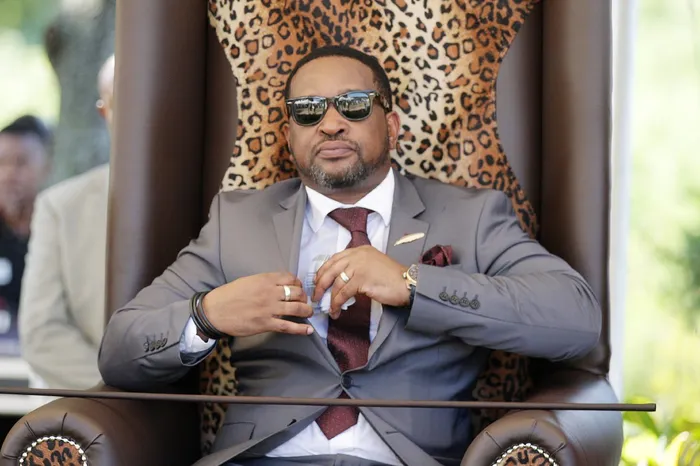
King Misuzulu kaZwelithini addresses leaked video scandal with public apology.
Image: Independent Newspapers Archives
THE office of King Misuzulu kaZwelithini has issued an official response to a leaked video showing the Zulu monarch berating his wife, Queen Nomzamo Myeni.
In a formal statement released on Friday, the royal household expressed “profound concern” over the unauthorised dissemination of the clips, noting they were leaked to the public without the King's knowledge or consent.
The four-minute-and-six-second video, which began circulating online on Thursday, July 9, shows the King holding what appears to be a green beer bottle while shouting at the Queen during a heated exchange.
Throughout the footage, a Siswati-speaking woman is heard in the background attempting to calm him down. During the confrontation, King Misuzulu accuses Queen Nomzamo of infidelity with a member of the Shembe Church, criticises her conduct as a royal wife, and threatens to assault her.
He also takes issue with her social media activity, including Facebook posts and a recent visit to the Kaizer Chiefs camp. “She’s out there without my permission. When you’re someone’s wife, you ask for permission to go to some places. At least let your husband know,” he says.
The King further suggests the Queen should be taught how to conduct herself, makes derogatory remarks about the leader of the Shembe Church, and admits he ascended the throne through witchcraft.
Queen Nomzamo appears visibly subdued throughout much of the exchange. As the King leaves the room, she turns to the camera and quietly says: “This is the life that I live, day and night.”
The palace stated that the recordings capture a private family setting from the past, which has since been overtaken by “extensive reflection, mutual reconciliation, and the ongoing fulfilment of royal duties.”
Emphasising that the footage is “historical in nature and do[es] not represent the present circumstances within the Royal Household,” the office highlighted the couple's joint official duties on the day the video surfaced, hosting Build One South Africa (Bosa) leader Mmusi Maimane at the KwaKhangelamankengane Royal Palace.
Their continued participation in public engagements, the statement noted, demonstrates an unshakeable commitment to the Zulu nation.
Despite contextualising the video, King Misuzulu did not shy away from accountability. Acknowledging that certain expressions made during an “emotionally charged moment” fell short of the dignity, restraint, and decorum expected from the throne, the King expressed deep remorse for the pain caused.
To this end, he has appointed a high-level delegation of senior Royal House elders to meet with Unyazi Lwezulu of the Nazareth Baptist (Shembe) Church.
The delegation was instructed to personally deliver the King’s sincere apology for his remarks, reaffirm the royal household’s longstanding respect for the church, and appeal for the acceptance of his heartfelt apology, while emphasising his commitment to safeguarding the dignity and unity of the Zulu Kingdom.
The circulation of the video has reignited debate over whether social media is a vital avenue for exposing abuse or a platform that sensationalises deeply personal conflicts.
The incident is the latest in a growing number of high-profile relationship disputes unfolding online, prompting widespread discussion about the King's conduct, the Queen's welfare, and the role of digital platforms in exposing intimate partner violence.
Responding to the controversy, Sonke Gender Justice cautioned against reducing such incidents to public spectacle. Co-executive director Bafana Khumalo noted that online exposure can both retraumatise survivors and serve as a desperate call for help.
“The exposure of these sordid affairs has two implications,” Khumalo said. “On the one hand, these exposures tend to be sensationalised and present a great potential of re-victimising the survivor. In some instances, these images are selectively shared without providing adequate context.”
Conversely, he acknowledged that sharing such videos could be an attempt to expose acute, repeated abuse that has remained hidden.
“It is very likely that when such a video is recorded, it is because the abuse has been repeated over time unabated,” he added, noting that public exposure should not distract from South Africa's broader gender-based violence crisis.
Khumalo explained that many survivors remain silent due to fear of not being believed, being blamed, or facing pressure to keep abuse within the family. “What that means in many instances is that the victim or survivor should remain silent and not report the abuse, and this is unacceptable,” he said.
However, he warned against the public rushing to analyse or take sides in viral disputes before all facts are known, urging that the gender-based violence and femicide (GBVF) crisis not be used for “nefarious intentions” by influencers.
Rather than sharing videos widely, Khumalo advised the public to report suspected abuse to the police or relevant state institutions like the Commission for Gender Equality and the South African Human Rights Commission.
Meanwhile, University of KwaZulu-Natal cultural expert Professor Sihawu Ngubane stressed the importance of not conflating the video’s contents with Zulu cultural practices.
“We are all sad about the situation. In my view, this has nothing to do with culture but a private family affair,” Ngubane said.