

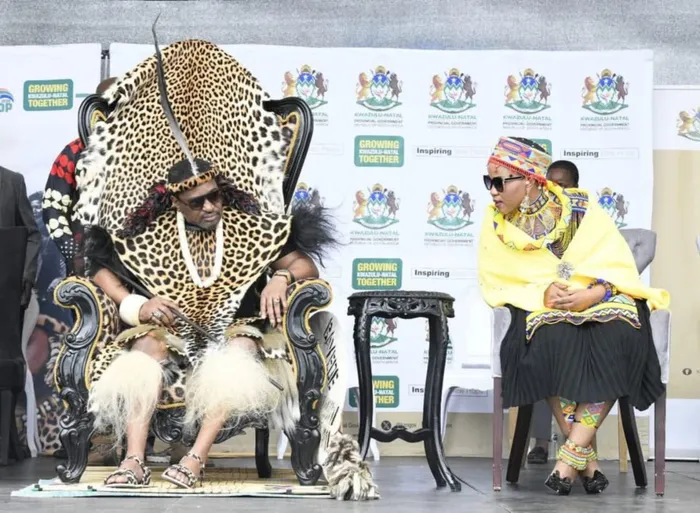
AmaZulu King Misuzulu kaZwelithini and Queen Nomzamo Myeni during a previous official engagement, amid growing public scrutiny following the release of a controversial video depicting a private confrontation.
Image: Supplied
The circulation of a leaked video showing AmaZulu King Misuzulu kaZwelithini shouting at Queen Nomzamo Myeni has renewed debate over whether social media is becoming an important avenue for exposing possible abuse or a platform that risks sensationalising deeply personal conflicts.
The four-minute video, which began circulating online on Thursday, shows the King holding what appears to be a beer bottle while shouting at the Queen during a heated confrontation.
In the footage, he accuses her of infidelity, criticises her conduct as a royal wife, and objects to her social media activities.
At the end of the exchange, Queen Nomzamo, who appears subdued throughout much of the recording, turns to the camera and quietly says: "This is the life that I live, day and night."
The video quickly spread across social media, prompting widespread debate about the King's conduct, the Queen's welfare, and the role of online platforms in exposing intimate partner conflict.
The incident is the latest in a growing number of high-profile relationship disputes to unfold online, raising questions about whether social media is becoming an avenue for survivors to seek help or simply amplifying intensely private conflicts.
Responding to the controversy, the Office of His Majesty King Misuzulu kaZwelithini confirmed that the recording was made public without the King's prior knowledge or consent, and described it as historical footage from a private family setting.
The King's office said the events shown in the video no longer reflect the current state of the royal household, noting that the King and Queen had recently undertaken official duties together at the KwaKhangelamankengane Royal Palace.
While maintaining that the recording was private, the King acknowledged that some of the language used during what the statement described as "an emotionally charged moment" had been inappropriate.
"His Majesty acknowledges that certain expressions made during an emotionally charged moment fell short of the dignity, restraint, and decorum that the nation rightfully expects from its Monarch," the statement said.
It added that the King "deeply regrets the hurt caused by his utterances" and had dispatched senior royal elders to apologise to the Nazareth Baptist Church over remarks made in the recording.
As debate intensified, Sonke Gender Justice cautioned against reducing incidents of abuse shared on social media to public spectacle, saying online exposure can both retraumatise survivors and serve as a desperate call for help.
Bafana Khumalo, co-executive director of Sonke Gender Justice, said the growing number of high-profile relationship disputes unfolding online reflected two competing realities.
"The exposure of these sordid affairs has two implications. On the one hand, these exposures tend to be sensationalised and present a great potential of re-victimising the survivor. In some instances, these images are selectively shared without providing adequate context," he said.
At the same time, Khumalo said videos shared online could represent an attempt to expose abuse that had remained hidden.
"It is possible that the one sharing the images may be seeking to expose acute abuse. It is very likely that the abuse may not be an isolated incident."
He said public exposure should not distract from South Africa's broader gender-based violence crisis.
"Exposing episodes of any form of abuse serves as awareness raising and may also be a call for help where those exposed to this feel helpless."
Khumalo said many survivors chose not to report abuse because they feared they would not be believed, would be blamed for what had happened, or would face pressure to keep abuse within the family.
"What that means in many instances is that the victim or survivor should remain silent and not report the abuse, and this is unacceptable."
He also warned against the public rushing to analyse or take sides in viral relationship disputes before all the facts were known.
"There are dangers in any wrongful reporting. GBVF is too serious a matter to be used for nefarious intentions. Influencers may have their own intentions, but this does not detract from the fact that all forms of abuse are unacceptable and must be challenged."
Khumalo said the emergence of such videos could indicate abuse that had persisted over time.
"It is possible that the exposure of the video is itself an attempt to shine a light on this. It is very likely that when such a video is recorded, it is because the abuse has been repeated over time unabated."
Rather than sharing such videos widely, Khumalo urged members of the public to report suspected abuse through the appropriate channels.
"We would advise social media users to rather share these videos where there is alleged abuse with the police to ensure that there is help provided. We also encourage members of the public to share this information with relevant state institutions like the Commission for Gender Equality or the South African Human Rights Commission as they have the mandate to deal with such matters."
University of KwaZulu-Natal cultural expert Professor Sihawu Ngubane said it was important not to conflate what appeared in the video with Zulu cultural practices.
"We are all sad about the situation. In my view, this has nothing to do with culture but a private family affair," Ngubane said.