


From desperation to recovery, this person clawed their way back.
Image: ChatGPT
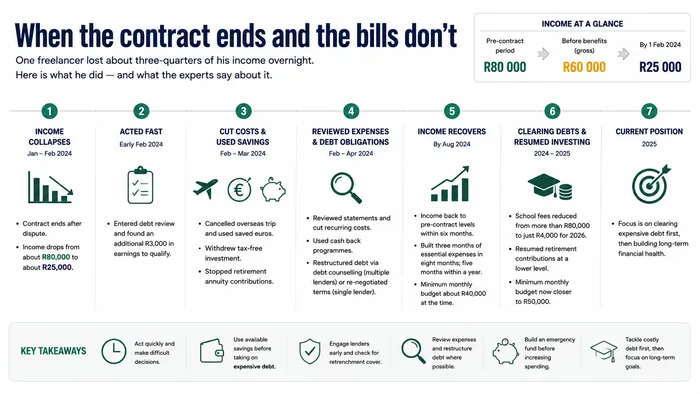
When a major contract suddenly fell away at the start of 2024, one South African freelancer saw his monthly income collapse almost overnight.
Until January that year, he had been earning the equivalent of about R80,000 a month through a contract arrangement. Before accounting for benefits such as medical aid and retirement annuity contributions, his gross income had been around R60,000 a month.
By 1 February, that figure had dropped to about R25,000. “It was pushing it,” he says of the income estimate. “That was based on freelance invoices I expected to be paid.”
The income shock followed a contract dispute and forced an immediate reassessment of his finances.
One of his first decisions was to enter debt review, a process that required him to demonstrate sufficient income to qualify. To do so, he had to find an additional R3,000 in earnings.
Hayley Parry, co-founder of financial wellness company Worth, says acting quickly was one of the most important decisions made.
“The first thing I’d commend this person for is that they acted quickly. Retrenchment is one of the most emotionally stressful financial events a person can experience, and many people respond by avoiding difficult decisions or hoping the situation will resolve itself.”

Hayley Parry, co-founder of financial wellness company Worth.
Image: Supplied.
At the same time, he began cutting costs wherever possible.
A planned overseas trip was cancelled. Euros that had been set aside for the holiday were redirected to living expenses. A tax-free investment was withdrawn. Retirement annuity contributions stopped.
“When I went freelance suddenly, I pulled my tax-free, and my euros that were planned for a trip. And I cancelled… everything,” he says.
Looking back, Parry says those decisions appeared sensible given the circumstances and the urgency involved.
“Using available liquid savings, including funds earmarked for discretionary goals such as travel, is generally preferable to accumulating expensive debt simply to maintain a pre-retrenchment lifestyle.”
Parry adds that consumers should also engage lenders early to explore payment relief options, as some credit providers may offer payment holidays or temporary restructuring arrangements. She also notes that consumers should check whether they have retrenchment-related cover attached to existing debt products.
“Many consumers do not realise that when they take on debt, they may also be paying a monthly premium for insurance that is specifically designed to cover those repayments if they are unable to do so because of retrenchment, disability, illness or death.”
Tips on how to quickly improve your financial situation.
Image: ChatGPT
Parry says it is worth checking loan, vehicle finance, credit card and store account statements for this additional charge and then asking the credit provider exactly what events are covered, how long repayments would be covered for, what exclusions apply, and what documentation is needed to claim.
“In a retrenchment scenario, this can make a significant difference to cash flow, because the policy may cover repayments for a set period while the person looks for new work,” says Parry.
Benay Sager, executive head of DebtBusters, says that in cases involving a sudden loss of income, people should focus on reviewing non-debt expenses and debt repayments.
Sager says reviewing bank and credit card statements, reassessing recurring costs such as cellphone contracts, internet services and entertainment subscriptions, and looking for savings opportunities could all help stretch available income.
In addition, Sager notes that people can sign up to retailers’ cash back programmes and use them regularly. “Most of these programmes are free to sign up to, and depending on the use, one can get decent amounts of cash back and stretch those rands,” he says.
Sager says many people incorrectly assume that debt obligations cannot be adjusted when circumstances change. “Debt repayments can be restructured if the person is unable to service their debt obligations.”
In cases involving a partial loss of income, Sager says debt counselling could be an option, particularly for consumers with multiple lenders, and could help protect assets. Where the lending relationship is with a single lender, debt repayment terms can be re-negotiated directly.

Benay Sager, executive head of DebtBusters.
Image: Supplied.
Within six months, his income had recovered to pre-contract levels. Within eight months he had accumulated three months of essential expenses in cash, building that to five months within a year against a minimum monthly budget of about R40,000.
Parry says that stood out. “Perhaps the most encouraging aspect of this case is what happened after employment was secured. Rather than immediately increasing spending again, this individual focused on rebuilding financial resilience by establishing a meaningful emergency fund.”
School fees of more than R80,000 were steadily reduced to the point where only R4,000 for 2026 remains outstanding. About two years after stopping retirement annuity contributions, he resumed investing at a lower level. Today, his minimum monthly budget sits closer to R50,000.
Sager says that once income recovers, consumers should focus on reducing costly debt before turning their attention to other financial goals. “It is critical to clear off any expensive debt first,” he says.
Parry agrees that rebuilding long-term financial health should become the next priority. She says consumers should determine whether accelerated repayments could lower interest costs and shorten the debt review process.
Retirement investments should become a priority again once emergency savings have been rebuilt and high-cost debt is under control, says Parry.
Financial resilience is as much about adapting quickly as it is about having savings, says Parry. “The ability to adapt, cut costs, protect assets and rebuild afterwards is often what determines whether a financial setback becomes a temporary disruption or a long-term crisis.”
PERSONAL FINANCE