


A cohabitation agreement is not a sign that a relationship is expected to fail, it helps both people understand their responsibilities and reduces the risk of disputes later.
Image: Alex Green | Pexels
When a marriage ends, there is a legal framework to guide the division of assets, debt and financial responsibilities. For unmarried couples, the situation is often far less straightforward.
Lawyer Shaun Muskat says that the current law doesn't recognise a common-law marriage, although it will recognise a situation in which the parties have a cohabitation agreement – alongside traditional marriage with or without an antenuptial contract.
Cohabitation is increasingly a preferred option for couples, with the National Research Foundation citing a 2025 study that showed that cohabitation, with the decline in the rate of marriages, has increased, which it says signals "a significant shift in family formation outside the legal marriage system".
Statistics South Africa's latest Census, for 2022, indicates that the number of people cohabitating or "living together" is, at 3.7 million, a third of those who are "legally married".
Yet, as the 2025 study by Bertus Preller, a family law attorney at Maurice Phillips Wisenberg Inc, notes, there is a "notable" legal gap. "Unlike many jurisdictions, South Africa does not automatically recognise long-term cohabitation."
This results in many people living as though they are married – what is mistakenly called a common law marriage – without legal protection, says Preller. This, he says, is "a situation increasingly under scrutiny as cohabitation becomes prevalent".
Because there is no legally recognised marriage, separation can become an exceptionally painful process that could involve a court case to secure assets.
In the landmark Supreme Court of Appeal case Butters v Mncora, the cohabitation relationship ended and a dispute arose as to whether they had a tacit universal partnership agreement.

What to consider when you start cohabitating,
Image: ChatGPT
The two lived together for about 20 years and had children together, with Mr Butters building a successful business and Ms Mncora's contribution mostly being maintaining the household and raising the family.
The court ultimately found that there was a partnership and awarded Ms Mncora 30% of the net asset value accumulated during the relationship. Divorcelaws.co.za explains that the court emphasised the parties' contributions "are not limited solely to profit-generating activities", and underscored that a universal partnership does not necessarily require an explicit agreement — like any other contract, it can be formed tacitly, inferred from the conduct of the parties involved.
This, says Harry Joffe, head of legal services at Discovery Life, will mean proving various factors such as who brought what to the relationship, whether there were children, the length of the relationship, and other factors with each case being judged on its own merits. "You get principles, but you're not going to get a one-size-fits-all answer because every case is so different," he says.
For this reason, Joffe and other finance experts and lawyers advocate that people sign a contract when they move in together. Muskat says that a cohabitation agreement – a fundamental document between two parties to avoid any dispute at a later point in time – should be signed before people move in together and incur expenses.
The chairperson of the National Debt Counselling Association, René Moonsamy, says it's important to have practical money conversations before moving in together. "This should include income, debt, monthly expenses, savings, financial responsibilities and what happens if one partner can no longer contribute," she says.
"Understanding who carries which financial responsibilities can be very helpful, especially where couples share property, debt, children, household expenses or long-term financial commitments," says Moonsamy.
Moonsamy notes that if a couple that isn't married buys a home, vehicle, furniture or another major asset together, they should consider recording the arrangement in writing. "This should include who contributed to the deposit, who pays the monthly instalments, who is responsible for insurance and maintenance, and what should happen if the relationship ends," she says.
From a debt perspective, consumers should also understand who is legally responsible for the credit agreement, says Moonsamy. "If a vehicle or loan is only in one person's name, that person usually carries the full legal repayment obligation, even if both partners use the asset or agreed verbally to share the cost," she adds.
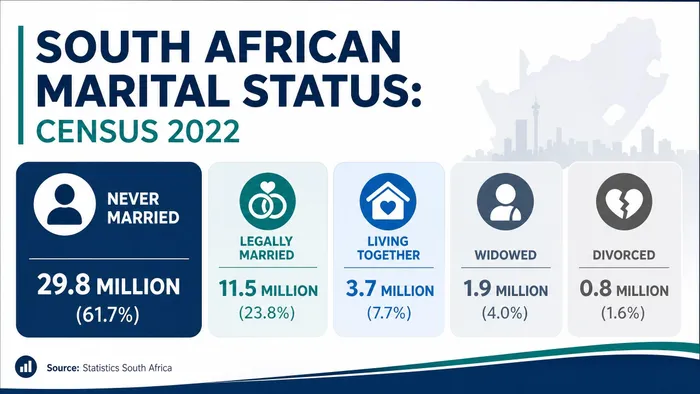
Statistics South Africa's stats on marital status.
Image: Manus
Charize Beukes, a financial planner at Brenthurst Wealth Management, says a cohabitation agreement should spell out various things, including who paid what, what happens if you split, and what happens if one partner dies. "Without this, you're relying on expensive litigation and unpredictable outcomes, neither of which make great retirement strategies," she says.
Beukes points to the example of buying a home. "Problems start if contributions are unequal and ownership isn't clarified because you might still be treated as equal owners, or you could have no claim at all if your name isn't on the title deed," she says.
In fact, Muskat says that couples should consider an "exit" agreement from the get-go.
"Moving in together should not only be an emotional decision. It is also a financial decision," says Moonsamy. Clear agreements, honest budgeting and early intervention can help consumers build financial wellness and help support a great relationship, she adds.
Having an agreement in place doesn't mean that the couple expects the relationship to fail, says Moonsamy. "It simply helps both people understand their responsibilities and reduces the risk of disputes later."
For Beukes, a cohabitation agreement is not a sign that a relationship is expected to fail. "This isn't a prenup for pessimists; it's a financial seatbelt that can help to prevent disputes should the relationship end," she says.
PERSONAL FINANCE