


The time to look at a Power of Attorney is before someone loses mental capacity.
Image: Pexels
When an ageing parent starts struggling with banking, paperwork or day-to-day finances, many families assume a Power of Attorney is the obvious next step. The reality is that the document only works if the person signing it still fully understands what they are agreeing to – a detail that often only becomes important when families need help most.
Power of Attorneys have general application – some circumstances include when a person is travelling overseas and appoints someone to manage tax filings, or when they cannot handle paperwork while recovering from surgery, says Malissa Conlin, director and general manager at Brenthurst Global Wealth.
A Power of Attorney is “about protection. It ensures that your affairs remain manageable when life becomes unpredictable,” says Conlin.
“A general Power of Attorney gives another person the ability to act in your place when you are not physically present,” explains PJ Veldhuizen, founder and MD of Gillan & Veldhuizen Inc.
It is also possible to buy a house remotely by granting a Power of Attorney. By ensuring the correct authentication of documents, buyers can have a trusted representative manage deals for them.
“Buyers can sign the required documents wherever they’re currently living, and these can then be authenticated through apostille or notarisation procedures,” says Bradd Bendall, BetterBond’s National Head of Sales.
For financial institutions, however, additional paperwork is required. “Even if you have a properly drafted Power of Attorney, most South African banks won’t accept it for account access. They want their own version in place, and it must be signed in person at a branch,” notes Conlin.
Those acting under a Power of Attorney should keep a detailed record of every transaction and decision made. “Anyone operating under a general Power of Attorney may later be called upon to account for the actions they took on behalf of that person,” says Veldhuizen.
It is a misconception that a Power of Attorney is designed to help families take over a loved one’s affairs once dementia, Alzheimer’s disease or cognitive decline sets in. In South Africa, a Power of Attorney becomes invalid once the person who granted it loses the mental capacity to understand and manage their affairs, says Remay Olivier, product manager of Trusts at FNB Fiduciary.
A Power of Attorney is not an “ageing parent document” but simply a practical legal tool for temporary authority, says Veldhuizen.
Neville Bredenkamp van der Spuy, senior associate attorney at Executor Law, describes an “assisted independence” phase of ageing. “A parent may no longer be able to drive safely, may need assistance getting to appointments, may begin struggling with banking, paperwork, or managing their property and finances, but remain perfectly capable of understanding their affairs and making decisions,” he says.
The difficulty is recognising where assistance ends and incapacity begins, as “legal capacity is not always easy to recognise as it begins to fade,” Bredenkamp van der Spuy says.
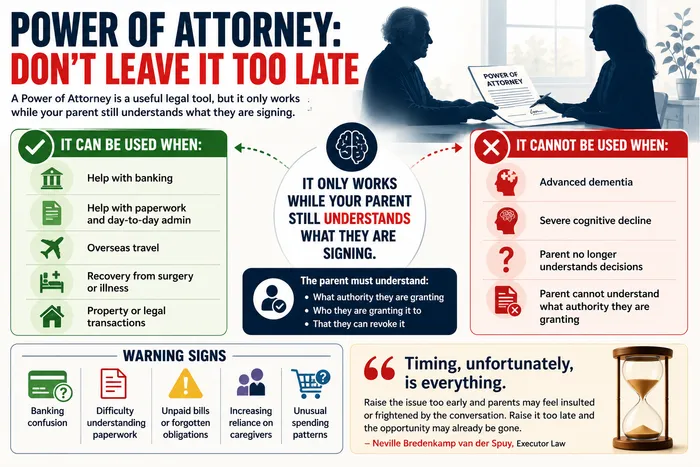
A Power of Attorney isn't never-ending.
Image: ChatGPT
When children want their parents to sign a Power of Attorney, the parent still needs to have legal capacity, which is “a person’s ability to understand the nature and consequences of the decisions they are making,” says Bredenkamp van der Spuy.
“The parent must understand what authority they are granting, who they are granting it to, and importantly, that they still retain the right to revoke that authority at any time,” says Bredenkamp van der Spuy.
Conlin says the Power of Attorney only works while the principal still has mental capacity. Once mental capacity is lost, the POA automatically becomes invalid. “There is no such thing as an ‘enduring Power of Attorney’ in South Africa,” she adds.
While families differ, there are certain practical and behavioural signs that may indicate it is time to investigate legal safeguards for an ageing parent such as confusion around finances, forgotten obligations, unusual spending patterns, increasing reliance on caregivers and difficulty understanding contracts or paperwork, says Veldhuizen.
“One of the saddest patterns we encounter is that these conversations often happen slightly too late,” says Bredenkamp van der Spuy. “Families wait until there is a crisis. A parent becomes lost while driving. Signatures begin changing noticeably. The bank raises concerns. Important documents can no longer be signed confidently or consistently.”
When cognitive abilities are lost “the legal foundation for the Power of Attorney falls away and the document becomes invalid,” says Bredenkamp van der Spuy.
“If someone acts on an invalid Power of Attorney, it can be considered fraud,” adds Kerryn Franck, director of chartered legacy and trust at Chartered Wealth Solutions.
“We have in fact come across backdated fraudulent documents in our practice, and that results in an even larger catastrophe since the matter then becomes criminal,” says Bredenkamp van der Spuy.
As a result, families will then have to investigate having a curator appointed. Depending on the circumstances, this could involve a curatorship application through the courts or administratorship through the Master of the High Court, says Bredenkamp van der Spuy.
“While family members may be involved, the court retains oversight over who is appointed and whether they are suitable to manage the individual’s affairs,” says Veldhuizen.
Bredenkamp van der Spuy says “timing, unfortunately, is everything. Raise the issue too early and parents may feel insulted or frightened by the conversation. Raise it too late and the opportunity may already be gone.”
IOL BUSINESS