

As we mark 16 Days of Activism against Gender-Based Violence, new data from Statistics South Africa reveals 60,000 sexual offence incidents involving 44,000 victims between April last year and March this year. .
Image: File
Recently, President Cyril Ramaphosa declared gender-based violence and femicide (GBVF) a national crisis. The statistics are devastating: three women are killed by an intimate partner every day in South Africa, and a quarter of women have reported experiencing physical or sexual abuse, according to the South African Medical Research Council.
As we mark 16 Days of Activism against Gender-Based Violence, new data from Statistics South Africa reveals 60,000 sexual offence incidents involving 44,000 victims between April last year and March this year. Only 56.3% were reported to police. About a sixth of reported incidents involved a spouse or intimate partner. And some people were abused more than once.
Psychological abuse is equally insidious. Almost a sixth of those affected experience it daily, yet only 26.6% report it to police. “For years, South Africa has been confronted with the deeply rooted reality of violence against women and children. Despite multiple interventions by government and civil society, this violence persists,” says Bridget Masango, chairperson of the Portfolio Committee on Social Development.
If you’re in an abusive relationship, leaving requires more than courage – it requires a plan. Here’s how to prepare financially.
Find the right legal support first
Attorney Simone Lamberti tells Personal Finance that even finding the courage to see a lawyer is a massive undertaking. Each case is unique, and it makes no difference whether you’re successful in business or a homemaker – abuse “does not discriminate”.
“The first thing that needs to happen is that someone who is being abused approaches the correct attorney – not only an attorney with legal expertise but one who has the emotional intelligence to appreciate the psychological realities of abuse, to support a client in taking the first step, never mind confronting the financial considerations that follow,” says Lamberti.
The first step is empowerment to prepare you to handle the process. Your attorney can then help you understand financial aspects like proprietary claims and maintenance through completing a Financial Disclosure Form (FDF).
The prescribed form provides an in-depth analysis of your household’s financial situation, including assets, liabilities, income and expenses. Completing the FDF helps you assess the costs of leaving your marital home and how these expenses will be met, which is important if you need to leave before approaching the court for protective relief.
Start building your Freedom Fund now
Hayley Parry, co-founder of Worth, advocates creating a Freedom Fund covering three months of living expenses on your own, including a deposit and one month’s rent, plus transport to work independent of anyone else.
“Nobody needs to know about this fund. Hopefully, you never have to touch it but be proactive. Too many women stay in unhealthy personal or professional relationships because they cannot afford to leave,” says Parry.
This sort of Freedom Fund is in addition to a buffer, says Parry. She says the first place to start is by putting money aside as a financial shock absorber, an Emergency Fund that acts as a buffer for emergencies life may throw at you. A goal of R10 000 can cover smaller expenses like urgent travel, health expenses or your child’s needs, she says.
Next, says Parry, build toward saving three months’ worth of living expenses by committing a specific percentage of your salary, bonuses, or cash gifts going into this fund, she adds.
Even if you never need a Freedom Fund, says Parry, it might help another woman escape a difficult situation.
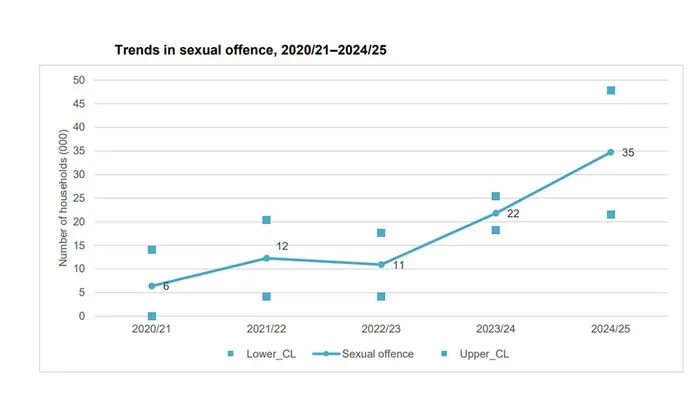
There was a fluctuation in the number of households that experienced sexual offence for a three-year period.
Image: Stats SA
Understand what’s at stake financially
Kashmeera Kanji, head of market analytics and R&D at Discovery Life, says any change in circumstances or relationship can significantly impact financial plans and stability.
“You may suddenly need to make decisions about settling debts, like your home loan or vehicle finance, medical expenses or your children’s education. Also, it’s not uncommon for one partner in a relationship to manage finances, which can leave the other unsure about what cover or policies even exist,” says Kanji.
Financial planning is of great importance, says Kanji. Though it can feel overwhelming, “it’s a powerful step towards regaining control of your finances and creating stability for yourself and those who rely on you”.
Review and protect your policies
Review life cover and other policies as soon as possible, says Kanji. This identifies who owns the policy and who has the power to change beneficiaries.
“It’s vital to take ownership of your policies, update beneficiaries, and ensure that your policies reflect your current reality,” says Kanji. In some cases, taking out a new policy may make sense to ensure financial security. “This isn’t just about policies; it’s about building independence and peace of mind.”
Updating your will is equally important to ensure your wishes are carried out as intended and assets are protected. “Even modest assets, such as a second-hand car, starter investments, or a savings account, should be protected,” she says.
There are legal remedies available, says Lamberti, including a protection order under the Domestic Violence Act – which covers all forms of abuse including financial and psychological ill-treatment.
Lamberti emphasises that your lawyer needs to be empathetic and responsive because they may need to be on call if you’re under threat.
16 Days of Activism against Gender-Based Violence runs between November 25 and December 10. If you want to get involved in helping now, or at any time of the year, head to http://www.tears.co.za, https://gbv.org.za/contact-us, http://www.powa.co.za, among others for more information.
PERSONAL FINANCE