


Cohabiting partners may not automatically inherit, receive retirement benefits, or benefit from life insurance.
Image: Magnific
When it comes to financial recognition, cohabiting partners occupy a curious middle ground.
Tax law treats them generously – the South African Revenue Service (SARS) recognises a permanent life partnership for income tax, donations tax, estate duty, capital gains tax and transfer duty purposes and cohabitants are deemed to be married out of community of property as long as there’s no proof to the contrary.
Family law, however, does not. And retirement funds operate under their own rules entirely.
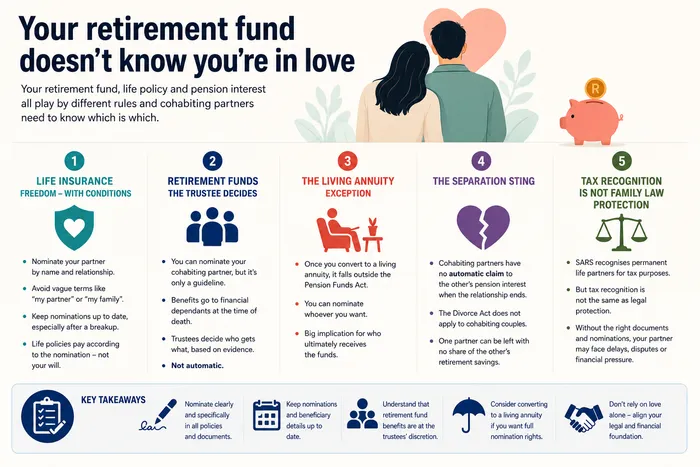
Life insurance policies offer the most straightforward protection. Either partner in a cohabitation relationship may nominate the other as a beneficiary, and the insurance company must pay the proceeds to that person.
While people have complete freedom of nomination, they need to be specific and partners should be clearly identified by name and relationship.
Vague descriptions such as “my partner” or “my family” can create uncertainty and delays at claim stage, Crue Invest notes. Divorcelaws.co.za adds that a clause in a policy that confers benefits on members of the insured's “family” may also cause problems, since a cohabiting partner may not be considered family for that purpose.
One critical point, says Harry Joffe, head of legal services at Discovery Life, is that life insurance policies should be left out of wills because that process just adds unnecessary complexity.
“Policies have a nominated separate beneficiary. If you put it in the will, it just causes more issues because it won't take precedence over the policy nomination,” Joffe says.
Discovery Life has seen cases where a member died, named ten people as beneficiaries of a policy in her will, but the daughter nominated on the policy was paid because those were the instructions in the policy.
In addition, nominations must be kept up to date, particularly after a relationship ends, says Joffe.
Retirement funds are more complicated. Cohabiting partners may nominate each other as beneficiaries on retirement funds, but the nomination form is a guideline, not a guarantee, says Crue Invest.
In terms of the Pension Funds Act, retirement fund death benefits must be distributed to those who were financially dependent on the deceased at the time of death — which could include a life partner, an ex-spouse, minor children, siblings or even aged parents. The board of trustees is required to identify all dependants, and the final allocation rests with the trustees based on the facts and evidence presented.
“It's up to the trustees of the fund to determine who your dependants are,” says Joffe. “Under a retirement fund, you actually only have a choice — it's dependent on who the trustees decide to pay.”
A cohabiting partner can qualify as a factual dependant if financial interdependency can be proved with the text being whether the surviving partner is financially worse off as a result of the death. But it is not automatic, and trustees have discretion, says Joffe.
What to know about inheritance for cohabitating couples.
Image: ChatGPT
There is, however, a significant exception. Once a member converts a retirement annuity into a living annuity, the living annuity falls outside the Pension Funds Act entirely.
“A living annuity is a different thing because it's not a pension fund anymore,” says Joffe. “You can nominate whoever you want.”
For cohabiting partners where one or both have substantial retirement savings, the decision of when and whether to convert to a living annuity has real implications for who ultimately receives those funds.
RAs, preservers, pension and provident funds all fall remain subject to trustee discretion. A living annuity does not. “So many people will mature their RAs as soon as they can and go into a living annuity,” says Joffe. “If you go into the living annuity, it's no longer under the Pension Funds Act.”
Unlike in death, where a cohabiting partner has a chance of being considered, for pension interests, the same isn’t true for a cohabiting partner, who has no automatic claim to the other partner's pension interest when the relationship ends.
This is because that relationship isn’t governed under the Divorce Act, explains Crue Invest. The right to a share of pension interest on divorce is limited to legally married couples, it adds.
“Where retirement savings are concentrated in one name, this can result in severe financial prejudice for the other partner,” Crue Invest warns, especially where the non-member partner is a stay-at-home parent while the working partner has been building retirement savings throughout the relationship.
For cohabiting partners, SARS is arguably the most generous authority they will encounter. Transfers between permanent life partners attract no donations tax, estate duty exemptions apply to assets bequeathed to a surviving partner, and capital gains tax rollover relief is available, Crue Invest notes.
But as Crue Invest notes, “tax recognition should not be confused with family-law protection”.
“Cohabiting partners may not automatically inherit, receive retirement benefits, or benefit from life insurance unless the correct documents and nominations are in place,” says René Moonsamy, chairperson of the National Debt Counselling Association.
“Without these, the surviving partner may face delays, disputes or financial pressure at an already difficult time.”
Charize Beukes, certified financial planner at Brenthurst Wealth Management, adds “if your ultimate commitment is to build wealth together, then at least ensure the legal and financial foundations match the emotional ones. Otherwise, you might end up with a great love story and a terrible balance sheet.”
PERSONAL FINANCE