

It's always best to have your paperwork in place before your partner dies.
Image: Pexels
While dying without a will is complicated for married couples as it is – given that the estate will be held up in court while everything is sorted out under the Intestate Succession Act – the situation becomes a lot more complicated for those who cohabite.
In general, the practical consequences of dying without a will – the Gawie le Roux Institute of Law – says means unintended disinheritance as well as delays and additional costs among other issues while the estate is split up according to the law.
There’s an order of beneficiaries, the institute explains, which moved from spouses and dependents down the ranks. However, the law makes it more complicated for unmarried life partners to inherit, regardless of the relationship’s duration.
“Without a valid will, a long-term cohabiting partner may receive nothing – one of the starkest risks of dying intestate,” a post on its website says.
Jane Bwanya’s story illustrates exactly what that limbo looks like. She lived with her partner, Anthony Ruch, from 2014 until his death in 2016. Though employed as a domestic worker, he paid for many of her living expenses.
They became engaged in November 2015, and their families were preparing for lobolo negotiations when he died. Ruch’s will nominated his mother as sole heir, but she had predeceased him, leaving the estate to be dealt with under intestate succession.
The executor rejected Bwanya’s claims for both inheritance and maintenance on the basis that she was not his spouse. She fought the matter all the way to the Constitutional Court, eventually settling for R3 million in the midst of a five-year court battle.
This is why experts recommend ensuring that all your wishes are clearly set down in writing. Harry Joffe, head of legal services at Discovery Life says going to court is slow and expensive. “Just make sure everything is done in writing properly. You don’t end up in this legal limbo,” he says.
The Bwanya case, which was set down in 2021, set a legal precedent and forced Parliament to change the current legislative environment, setting aside the Intestate Succession Act and the Maintenance of Surviving Spouses Act as unconstitutional.
In April 2024, the law changed when the Judicial Matters Amendment Act came into effect as a result of the ruling. The Intestate Succession Act was changed to expand the meaning of “spouse” to include surviving partners in permanent life partnerships with reciprocal duties of support, with the Maintenance of Surviving Spouses Act also being changed.
Simon Dippenaar, managing attorney, at SD Law in Cape Town, says “love is not defined by paperwork – but the law is”. He explains that a court needs evidence if you ever want to bring a case before it.
Dippenaar advocates keeping a clean record of contributions; retain messages that say, “our house,” “our business,” and so on. Also save photos that show a life together. “This is not about suspicion; it is about stewardship. If one of you is injured, if a family challenges an estate, if a bank queries authority, this mundane evidence will become critical,” he adds.
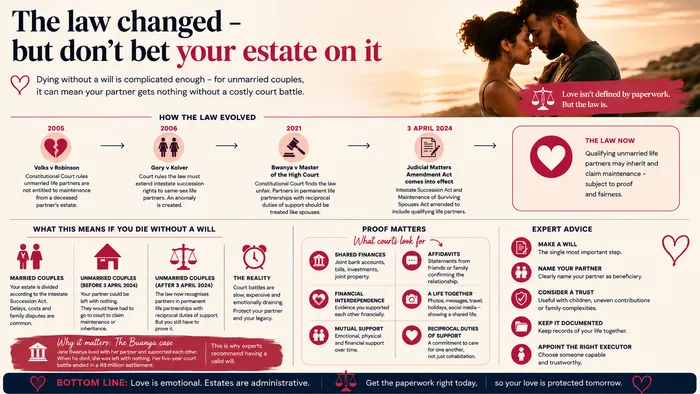
What you need to know about death when cohabitating.
Image: ChatGPT
Joffe says proving a relationship is not straightforward. Each case is judged on its merits and may require evidence such as shared finances, affidavits from friends or family, and other proof that the relationship was permanent and involved reciprocal duties of support.
Noting that the change in law corrects a past imbalance, Dippenaar says that “if your relationship was a genuine, permanent life partnership with reciprocal duties of support, the law will treat you like a spouse for intestate succession and survivor maintenance, subject to proof and fairness”.
However, Dippenaar still cautions that the best practice is a valid will.
Before the Bwanya case, the Constitutional Court in Volks v Robinson ruled in 2005 that excluding unmarried life partners from the protections of the Maintenance of Surviving Spouses Act was not unfair discrimination.
Its reasoning was: you chose not to marry, so you chose not to access the protections of marriage.
Complicating matters further, the Constitutional Court had already found in Gory v Kolver (2006) that the Intestate Succession Act’s protections must extend to same-sex life partners, granting unmarried same-sex partners more greater rights than their opposite-sex counterparts until Bwanya corrected that anomaly.
Charize Beukes, a certified financial planner at Brenthurst Wealth Management, says the biggest misconception is that a cohabitating partner automatically inherits. “The Master of the High Court will not be moved by heartfelt stories,” she says.
Beukes advocates having a valid will naming the partner as beneficiary, clear instructions on property and investments, and an executor who knows what they are doing. “A testamentary trust can be useful where there are children, uneven contributions, or concerns about future partners or family disputes,” she adds.
Lawyer Shaun Muskat adds that a cohabitation agreement should be drawn up to protect partners’ rights, and should reflect estate planning intentions, while a life policy with sufficient income payout is also worth considering to cover outstanding expenses left by the deceased.
The risk is that many couples build a life together financially without properly recording those arrangements, says René Moonsamy, chairperson of the National Debt Counselling Association.
“Cohabiting partners may not automatically inherit, receive retirement benefits, or benefit from life insurance unless the correct documents and nominations are in place,” she says.
“Bottom line: love is emotional, estates are administrative,” says Beukes.
PERSONAL FINANCE