

The Finance Ministry has cushioned South Africans from much of the adverse effects of the Middle East war on oil.
Image: Graphic: Nicola Mawson | GenAI & Freepik
Government’s temporary cushion on fuel price hikes will help stem much-feared inflation increases and could see rate cuts back on the table, but government can only hold the line for so long.
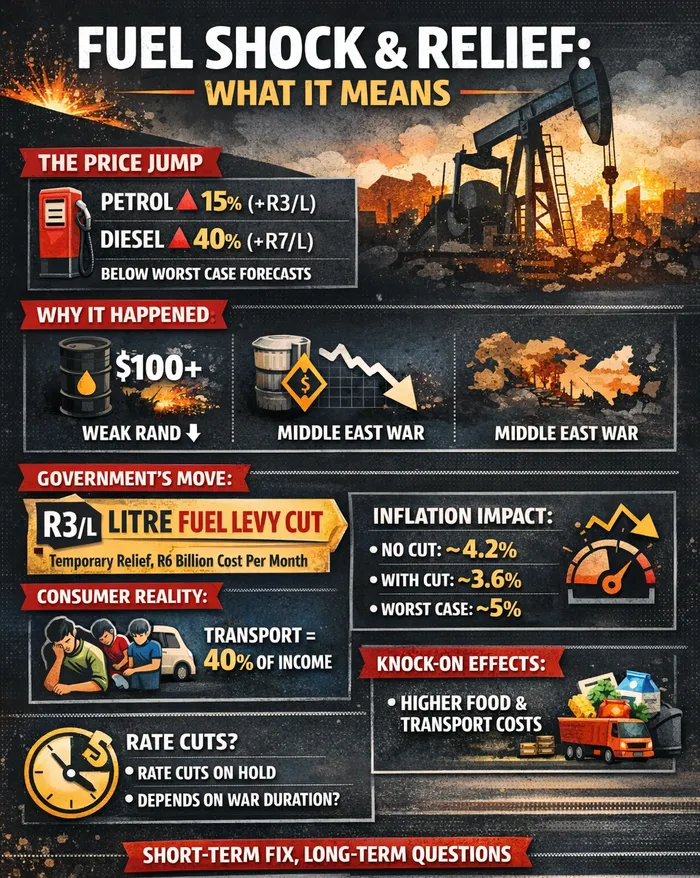
On Wednesday, the price of petrol price went up 15% and diesel 40% - lower than anticipated although the price of petrol still went up around R3 a litre with diesel some R7 more per unit.
Ahead of the announcement, economists had pegged petrol increases at between R5 and R6 a litre, with diesel set to ramp up by between R10 and R11, based on the most recent Central Energy Fund under-recoveries on the back of the fallout from the Middle East war.
In addition to oil spiking above $100 a barrel from under $60 at the start of the year, the rand has depreciated around 7% against the dollar this month according to Trading Economics data.
The South African Reserve Bank’s (SARB’s) latest quarterly bulletin notes that the oil price increase “is expected to exert significant upside pressure on domestic fuel prices in the coming months”.
April was already set to be a difficult month, with fuel prices due to increase by 21c a litre because of higher levies announced in the February National Budget, before the war changed the picture entirely.
Government announced a temporary reduction in the general fuel levy of R3 a litre in a similar move to what it did during the Ukraine war when oil prices spiked in similar fashion.
Here's what the latest fuel price hike means in figures.
Image: ChatGPT
PSG senior economist Johann Els says had the full under-recovery been passed on, inflation would have hit 4.2% in April. With the levy cut, he now projects 3.6%. “So that’s a big difference. For now, this is good news. It’s still a pain for consumers, but less of a pain than it would have been before,” he says.
In SARB’s interest rate statement released last week, governor Lesetja Kganyago said “given the oil price shock, we now project inflation to reach around 4% in the second quarter, with fuel inflation over 18%”.
Kganyago also said that a prolonged period of war could see inflation of 5% this year and rate hikes to bring it back to the 3% target. Should the conflict end sooner, the increase in the cost of living would be 4% with one rate hike this year.
It’s not clear how temporary this reduction will be, given that government needs to secure R6 billion in lost income from elsewhere each month it dials back taxes. Finance Minister Enoch Godongwana said on Tuesday that government was investigating what to do for May and June should the oil price remain high.
COSATU welcomed the move as a positive first step but says that much more relief is urgently needed. In a statement issued by parliamentary co-ordinator Matthew Parks, the federation says, “workers already drowning in debt, supporting up to seven relatives each and spending an average of 40% of their meagre wages on transport will not manage such painful diesel and paraffin, and even petrol price hikes”.
While the Organisation Undoing Tax Abuse (OUTA) calls the intervention necessary and appropriate, it says government should have acted sooner, which would have reduced panic, improved planning and softened the economic ripple effects already building across transport, food prices and essential goods.
“The relief will still help. It reduces the immediate pressure on already stretched households and limits the knock-on increases in public transport and the cost of basic goods in the coming weeks,” OUTA says. “But this is a temporary fix, not a solution.”
Els also does not expect serious second-round price impacts. “A big petrol price increase like this acts like a tax increase. It tends to be deflationary in terms of other prices,” he says, noting that consumers have a finite monthly budget with less discretionary spending as a result.
That dynamic, Els explains, provides some natural ceiling on how far broader price pressures can run even as fuel costs bite. As a result, he is confident that government’s intervention means delayed rate cuts rather than hikes.
In addition, supply disruptions are largely cyclical, driven by crude price fluctuations, exchange rate weakness and short-term logistics bottlenecks rather than any structural shortage, says Dr Ernst van Biljon, head lecturer in Supply Chain Management at the IMM Graduate School.
As historical patterns have shown, these pressures tend to self-correct as global supply balances adjust and exchange rates stabilise, says Van Biljon.
In the near term, however, road freight’s heavy dependence on diesel means price spikes feed directly through to distribution costs for food staples, fast-moving consumer goods and perishables, with some short-term stock volatility likely as a result, says Van Biljon.
Van Biljon adds government’s intervention is appropriate but that such measures “should be framed as temporary stabilisers rather than long-term subsidies.” Equally important, he says, is clear communication to prevent panic buying or speculative stockpiling.
“The outcome still depends very heavily on how long this war continues,” says Els. “If it’s for weeks rather than months, then we should see oil prices decline pretty rapidly – and petrol prices as well.”
However, Investec chief economist Annabel Bishop warns “for consumers, fuel price increases are not necessarily at an end if the war intensifies over April, negatively affecting fuel prices further. The fuel price increase tomorrow, if not quickly reversed in May will weaken gross domestic product”.
The next fuel price adjustment is due on 6 May.