


Explore the challenges faced by South African residents living in sectional title schemes, from maintenance disputes to governance issues, and discover the legal remedies available for resolving conflicts.
Image: Supplied
For many South Africans, sectional title living offers security and shared responsibility for maintaining a property. But when disputes arise between residents and those managing the scheme, tensions can escalate quickly.
Several residents who spoke to Personal Finance described conflicts with trustees or managing agents ranging from maintenance disputes to allegations of intimidation or poor governance.
South Africa’s community schemes – complexes, estates, retirement villages and share blocks – now number about 70 000 and form a significant part of the country’s urban housing landscape.
Lucy says some of her concerns about sectional title living relate to maintenance and health issues in the complex where she lives. One of the most serious problems involved mould in her unit. Although some repairs were eventually carried out, including replacing cupboards and waterproofing, she says the issue has remained a concern and believes other units in the complex may also have been affected.
Another issue was over the maintenance of common property, with dangerous chemicals left lying around and the quality of the water deteriorating, says Lucy.
Another dispute arose after contractors working on drainage systems allegedly caused a blockage that flooded her kitchen. Although Lucy was initially billed for repairs, the matter was eventually resolved after she disputed responsibility.
Situations like these, Lucy says, can be stressful for residents already juggling work, finances and family responsibilities.
Anne says her dispute with the body corporate and managing agents developed over a series of governance and maintenance concerns. According to documents submitted to the Community Schemes Ombud Service (CSOS), she lodged a dispute relating to the management of the scheme and the conduct of the trustee and managing agents.
Among the concerns raised were unresolved maintenance issues and delays in dealing with operational problems. Governance issues also emerged, including financial statements that had not been finalised and body corporate meetings that were repeatedly postponed, says Anne.
Anne says she repeatedly asked for information and updates but felt that responses from both the trustee and managing agents were often delayed or absent. Her complaint to CSOS only came after she unsuccessfully lodged an internal one.
Another owner in a Sectional Title Scheme, Susan, became involved in a dispute with trustees over the enforcement of certain rules. She says the conflict began with a fine she believed had been issued unfairly, escalating into broader disagreements about how rules were applied and whether residents were being treated consistently.
According to Susan, some trustees use their position to intimidate residents who challenge their decisions and act as if they are running their own dictatorship.
Not all concerns relate to specific disputes. Another resident, Martha, says she believes some trustees and managing agents misuse funds belonging to body corporate members.
While the allegations and experiences differ, they illustrate the kinds of tensions that can arise in community schemes.
Disputes within these schemes are not uncommon, says Annelize Joubert, director at Loock du Pisanie Inc. Attorneys and a service provider member of the National Association of Managing Agents.
Living in close proximity under a shared governance structure creates friction when trustees are required to enforce rules or make decisions affecting residents, Joubert says.
Some disputes escalate beyond governance disagreements and may “include claims of intimidation, harassment, reputational harm, or even physical confrontation”, says Joubert.
However, Joubert cautions that it is important to distinguish between disputes relating to the governance of a scheme and conduct that falls outside that framework. “The fact that the alleged perpetrator happens to be a trustee does not convert a personal dispute into a community scheme governance matter,” she says.
Where behaviour amounts to intimidation, harassment, defamation or physical aggression, the matter may need to be addressed through ordinary legal remedies rather than through the scheme’s governance structures.
Johlene Wasserman, director of Community Schemes and Compliance at Van Deventer Dowlath & Marx Incorporated, says trustees operate within strict legal limits.
“While these situations can feel very personal, it is important to remember that trustees are not above the law and their powers are limited. Trustees must act collectively, reasonably and in good faith, and their conduct is regulated by both legislation and the scheme’s rules,” says Wasserman.
Many disputes arise not from deliberate abuse but from the fact that trustees are often untrained volunteers tasked with managing complex legal and financial responsibilities, says Wasserman. “Community schemes are essentially small democracies, but they often involve managing multi-million-rand assets and complex legal obligations,” she adds.
“Most disputes aren’t about bad behaviour; they’re about uncertainty, inconsistent processes, and people trying to make complex decisions without the right tools.”
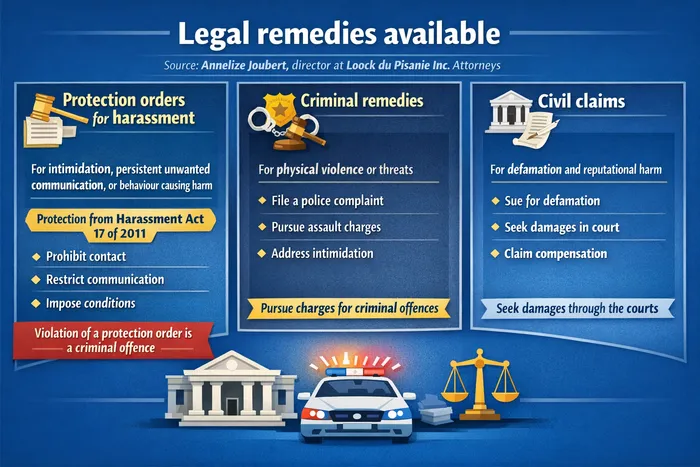
Legal remedies available when disputes at housing estates go beyond governance issues.
Image: ChatGPT
Legal remedies available
Joubert lists remedies available to people who feel they have been abused by trustees:
Protection orders for harassment If conduct amounts to intimidation, persistent unwanted communication, or behaviour that causes harm or inspires a reasonable apprehension of harm, an affected individual may approach the Magistrates’ Court under the Protection from Harassment Act 17 of 2011.
Such orders may prohibit contact, restrict communication, or impose conditions designed to protect the complainant from further harm. Importantly, the breach of a protection order constitutes a criminal offence.
Criminal remedies Where conduct escalates to physical confrontation or threats of violence, an aggrieved party may lodge a complaint with the police and pursue criminal charges such as assault, intimidation, or related offences.
Civil claims If statements are made that unlawfully damage a person’s reputation, the affected individual may pursue a civil claim for defamation and seek damages through the courts.