

In the past five years, a million South African consumers have been victims of what Statistics South Africa calls “consumer fraud”. Between 2023/24 and 2024/25, reports increased 37.9%. In 2024/25 alone, more than half a million people were affected – a figure that jumped 54.2% year-on-year.
Image: Picture: File
Dear Personal Finance Reader
Your [streaming service] account payment failed. Please update your payment details here to continue watching: [fake streaming service login link].
Millions of South Africans are scammed each year with messages like this, or others purporting to be from the South African Revenue Service, couriers, which seems to have surged since Temu and Shein became a thing, debt collectors, or the bank encouraging people to click on fake links.
Earlier this week, a company found by the Financial Services Conduct Authority to be a scam, Banxso, was placed into final liquidation. Court documents suggest more than 7,000 investors may have been affected, with at least 130 losing R133.3 million.
Judge Le Grange noted that applicants “alleged they were lured to invest via deepfake advertisements featuring prominent individuals such as Elon Musk, promising unrealistic returns. They deposited funds… and suffered near-total losses.”
Fraudsters will loiter on Facebook Marketplace, offer to buy an item, send a fake proof-of-purchase document along with “their” ID, then send a driver to collect the goods in what the South African Police Service calls “theft by false pretences” scams.
In the Eastern Cape, one of these fraudsters – Cleo Taylor – was sentenced to an effective 18 months a few years ago after defrauding people of R39 000, with individual items selling for between R2 500 and R16 000.
In the past five years, a million South African consumers have been victims of what Statistics South Africa calls “consumer fraud”. Between 2023/24 and 2024/25, reports increased 37.9%. In 2024/25 alone, more than half a million people were affected – a figure that jumped 54.2% year-on-year.
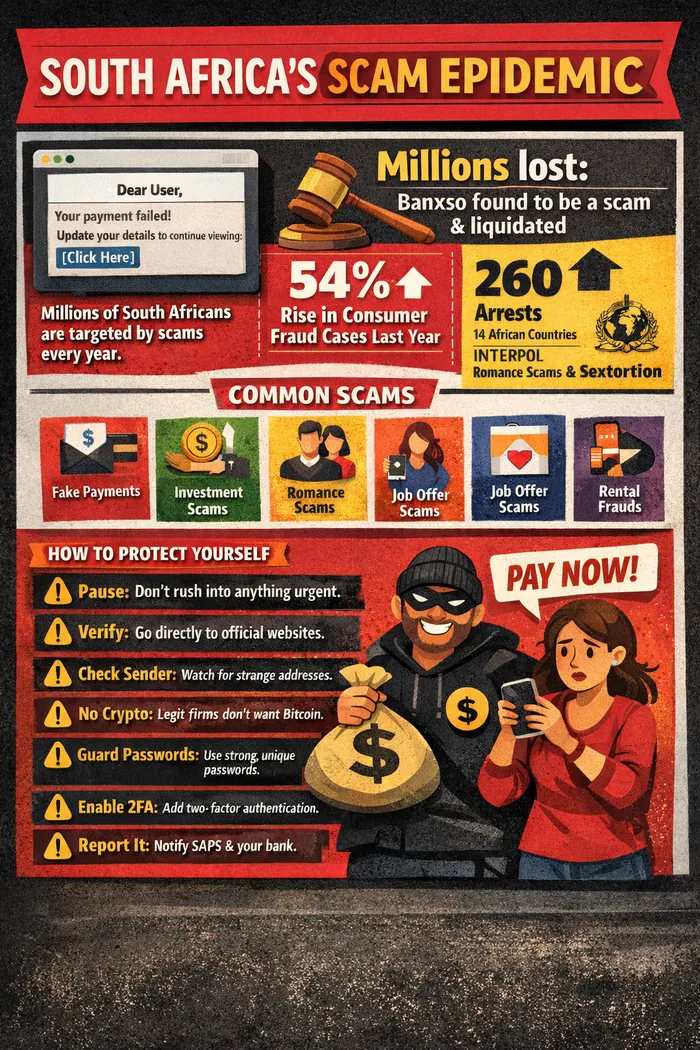
Scams in South Africa - the numbers.
Image: ChatGPT
It is the single largest crime in Statistics South Africa’s theft of personal property category for the past two years running.
Money or gift card scams were the most frequent type of fraud schemes in South Africa, with 13% of the 922 people surveyed by TransUnion for its Top Trends Report for the second half of last year being targeted and falling victim. Another 46% were targeted and didn’t fall victim.
That’s almost two in three people who have been the target of a scammer. Yet, less than a third of all people who were the victims of personal property theft report it to the police, Statistics South Africa found.
The problem is continental. Between July and August last year, INTERPOL arrested 260 suspects across 14 African countries who had targeted 1 463 victims through romance scams and sextortion.
Between last December and the end of January, another INTERPOL operation – Red Card – resulted in 651 arrests across 16 countries and the recovery of more than $4.3 million of the $45 million lost to high-yield investment scams, mobile money fraud and fraudulent mobile loan applications.
Common scams include:
Fake proof of payment. Someone buys an item from you on Facebook Marketplace, Gumtree or WhatsApp, sends a convincing “proof of payment” screenshot using a well-known bank’s branding. No money ever reflects, but the goods are already handed over.
Overpayment and refund scams. A buyer claims to have “accidentally” paid too much and asks you to refund the difference. The original payment later turns out to be fake or reversed.
Investment and trading scams. Victims are persuaded to invest in forex, crypto, property or “AI trading” platforms promising guaranteed or unusually high returns. Early payouts build trust, but once larger sums are invested, the platform disappears or withdrawals are blocked.
Romance scams. A fraudster builds a relationship online, often over weeks or months, then invents an emergency or business opportunity requiring money, framed as a loan or temporary help.
Job offers and recruitment scams. Victims are offered remote work or courier roles and asked to pay upfront for training or equipment. The job never materialises.
Rental deposit scams. Fraudsters pose as landlords, advertise properties they don’t own, and collect deposits. Victims often only realise after arriving to move in.
Online shopping scams. Shoppers pay for goods advertised on social media or cloned retail websites. Items never arrive, or cheap substitutes are delivered.
SIM-swap fraud. Criminals fraudulently port a victim’s mobile number, intercept banking OTPs, and move funds by impersonating the account holder to service providers.
Impersonation. Victims are contacted by someone claiming to be from their bank, SARS, SAPS or a well-known company and pressured into “verifying” details or moving money to a “safe” account.
What to watch out for:
PERSONAL FINANCE