
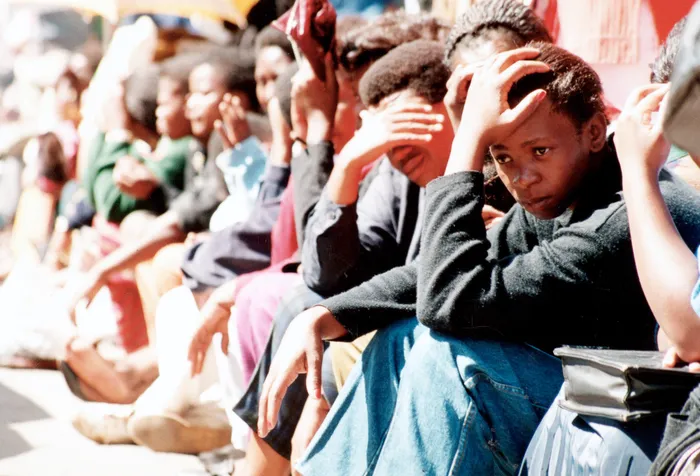
To reduce youth unemployment sustainably, we must tackle underlying problems that are structurally entrenched in our economy and education systems.
Image: File
To reduce youth unemployment sustainably, we must tackle underlying problems that are structurally entrenched in our economy and education systems.
Image: File
As South Africa prepares for the 2026 State of the Nation Address, the numbers tell a familiar story: youth unemployment hovers stubbornly at 44%, down marginally from 46% the previous year. Why is this the case, and what is to be done?
To reduce youth unemployment sustainably, we must tackle underlying problems that are structurally entrenched in our economy and education systems.
This does not stop us, however, from implementing temporary measures to massively boost youth employment in the short-term while we tackle these deeper problems.
Ultimately a successful national effort will need clear leadership and a collective action that builds momentum over at least a 10-year period.
We do have evidence of successful partnerships on which to build. Operation Vulindlela, the government-led initiative established in 2020 to drive reforms in electricity and freight logistics, is a case study.
While its implementation is being hard-fought, it demonstrates what effective leadership and collective action can achieve.
Implemented in partnership with socially-minded business, the initiative most notably helped end load-shedding and opened a pathway toward large-scale green-energy investment over the longer term.
Specifically in the youth employment domain, YES is off to a good start.
The initiative must be seen as one part of a bigger eco-system that assists young people, and was selected by organised business at the B20 as an example of a successful public-private partnership.
YES has supported 213,000 young people with full-time, minimum wage or better employment for 12 months – growing by 30% annually without drawing on taxpayer funding.
It has become the largest fully private-sector funded youth employment programme in the world. Critically, these young people are starting to lead and create the job-creating, taxpaying businesses that this country desperately needs.
Structurally, if we are to massify youth employment, we must start with schools. Employability after all must start in the schooling system.
Of the 1.2 million young people who started school 12 years ago, only about 10% passed matric with acceptable mathematics scores.
As a country we are haemorrhaging potential before these young people even reach the labour market.
Young people are spending twelve years of their lives and taxpayers are spending hundreds of billions each year in this massively inefficient and ineffectual process.
On the demand-side of the equation, a growing economy creates jobs – but we know there has been neither enough growth nor investor interest in labour-intensive sectors.
For every million young people entering the labour market annually, only 700,000 find work. And of those who do, too many end up in jobs that are neither decently paid nor meaningful to society.
Yet the potential of our youth is evident. We are seeing that when young people gain practical experience in one of the YES 1,950 private sector companies, transformation happens.
Of the 43,000 youth who completed the programme in 2024–2025, some 7,100 set up businesses – making YES a substantial pipeline for young entrepreneurs. Famous Brands absorbs 90% into positions as baristas, supervisors and specialists.
This know-how and intellectual property that young people gain in the process is an asset for long-term transformation. The more the youth understand how businesses operate and what it takes to grow the economy, the more likely South Africa is to succeed over the longer-term.
Which brings me to what government should prioritise in this SONA.
First, as part of the radical reforms needed in basic education, there must be a mandatory focus on work readiness and entrepreneurship. We must focus attention on the public schools that are currently the worst-performing 50% of public schools while acknowledging those that are high performers.
Second, restructure post-school education and training (which consumes over R100 billion a year of taxpayer funds), so that all certification is reviewed according to how it enables actual employment. We need to ensure that graduates and taxpayers generate a return on that investment.
Third, massively expand the Youth Employment Service by making it simpler for companies to participate. Without requiring any additional public funding, an extra 100,000 youth jobs a year could be created simply by allowing firms to reclaim their existing skills-development spending when they hire young people through YES placements.
Fourth, deploy large-scale public employment programmes focused on rolling out and maintaining infrastructure necessary for economic growth – roads, water systems, railways, fibre networks. Social infrastructure jobs such as teacher assistants and home-based care are also critical.
Fifth, reform employment laws to allow companies to more easily hire under-24s. The current regulatory burden is crushing. With poor economic conditions and an education system that does not adequately prepare young people for work, there’s limited incentive for companies to hire inexperienced workers. We need to lower that barrier.
Finally, government and business must agree on a practical programme to grow the economy with explicit focus on labour-intensive sectors. Until the economy grows consistently, employment growth will remain constrained.
The youth of today will be the value-producing workers, employers, and leaders tomorrow.
It is therefore no exaggeration to state that youth employment initiatives are the most important endowments South Africa can make towards achieving a sustainable future.
Ravi Naidoo, CEO of Youth Employment Service (YES).

Ravi Naidoo, CEO of Youth Employment Service (YES).
Image: Supplied.
BUSINESS REPORT