

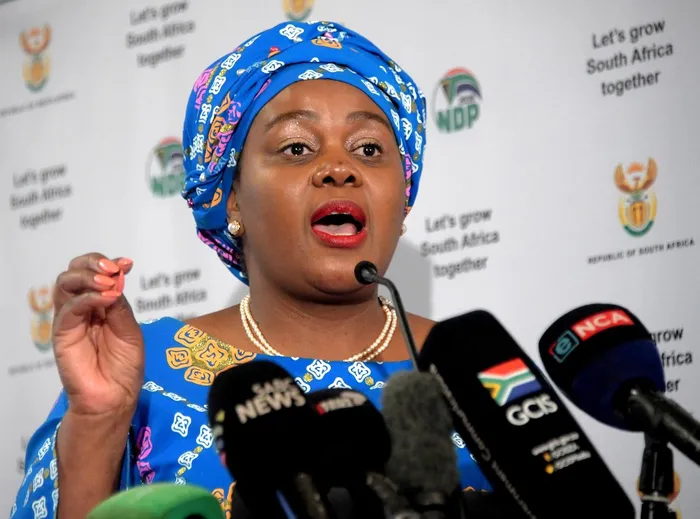
Minister of Justice and Constitutional Development and chairperson of the Interministerial Committee on migration, Mmamoloko Kubayi reported that the arrest of Ndodana Tshuma raises urgent questions about border security and the responsibilities of governing authorities.
Image: GCIS
Minister of Justice and Constitutional Development Mmamoloko Kubayi has confirmed that Ndodana Mkhanyisi Tshuma, a British-Zimbabwean fugitive wanted for the alleged murder of his wife and two daughters, was not flagged as a fugitive when he entered South Africa on July 5.
Tshuma was apprehended on Friday by the South African Police Service (SAPS) and Interpol in Johannesburg following a swift response to an Interpol alert.
Addressing a press conference on Sunday, Kubayi praised the efforts of law enforcement agencies, stating: "I firstly wish to commend our SAPS and Interpol for the sterling work that they have done this week in the arrest of Ndodana Mkhanyisi Tshuma."
She confirmed that Tshuma arrived at OR Tambo International Airport from Britain and assured that extradition to the UK would proceed once all required legal documentation is completed.
"At the time he went through OR Tambo, he had not yet been flagged by British authorities. So if he had been flagged, he would not have entered the country," Kubayi explained.
The minister said Tshuma's extradition requires her signature on the necessary documents, and that efforts are being made around the clock to expedite the process.
This high-profile case comes as South Africa grapples with increasing pressure regarding undocumented immigration and border security.
Anti-illegal immigration groups have ramped up their activities, demanding swift action from the government.
The minister's remarks coincided with reports of Bellarmine Chatunga Mugabe, son of the former Zimbabwean president, being spotted in South Africa shortly after his deportation - a sighting that ignited debate on social media regarding his identity.
In her address, Kubayi also announced a strategy aimed at eradicating irregular migration, which includes the arrest of individuals who assist undocumented foreign nationals.
"Our strategy is aimed at removing all forms of irregular migration, including arresting those aiding and abetting undocumented foreign nationals," she said.
Acting Police Minister Firoz Cachalia, who was part of the briefing, weighed in on the current situation, highlighting the seriousness of the immigration crisis.
"Our responsibility as a democratically elected government is to listen and respond to the issues being raised by our people," he stated, addressing calls for leniency towards illegal immigrants, particularly those from Nigeria. He further emphasised that the government would not entertain amnesty requests during this critical period.