

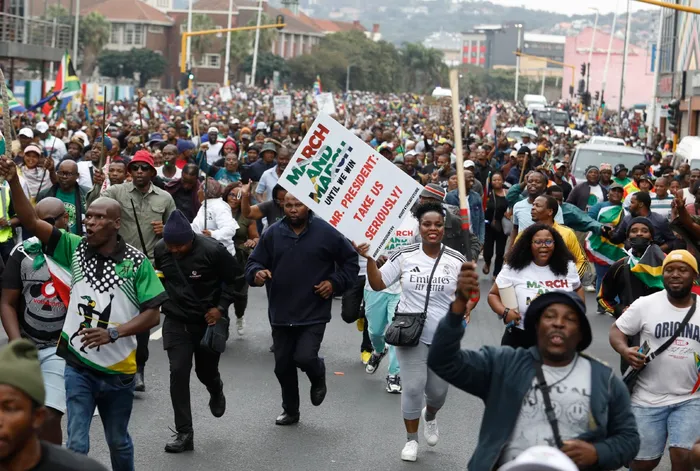
On June 30, South Africans marched in response to the perceived threat of undocumented foreign nationals. While some label the march as xenophobic, others see it as a desperate call for government accountability. Shabodien Roomanay unpacks the deeper issues of governance and the erosion of public trust in the state.
Image: Doctor Ngcobo / Independent Media
On June 30, some South Africans marched against what has been described as the growing presence of undocumented foreign nationals. Many will dismiss the march as xenophobic. Others will celebrate it as ordinary citizens finally taking back their communities. Many would claim Black on Black hatred. Afrophobia.
These interpretations miss the real story. The real scandal is not that South Africans are angry. They have a right to be. The real scandal is that they have reached the point where they believe they must do the job government abandoned years ago. Every sovereign state has one non-negotiable responsibility: it must know who enters its borders, who remains within them and under what legal authority. That is not nationalism. It is the first principle of statehood. Without it, immigration policy becomes fiction and the rule of law becomes selective. South Africa has spent decades pretending otherwise. We have border posts that are routinely compromised, an immigration system crippled by industrialised corruption and crippling administrative dysfunction and asylum processes that take years instead of months and enforcement so inconsistent that compliance has become largely voluntary. Every Auditor-General's report, every parliamentary committee and every commission has pointed to the same institutional failures. Yet governments have preferred speeches to solutions. Year in year out, the same ribbon-cutting at an installed tap in a village is mentioned at the SONA. Then they express surprise when citizens lose patience.
Let's be clear.
If government had competently enforced immigration law over the past three decades, there would be no need for marches demanding that it do so now. The uncomfortable truth is that the state created the conditions in which organisations styling themselves as defenders of communities could emerge. Vacuums never remain empty. When government abandons its responsibilities, someone invariably steps in to fill the space.
That should concern every South African. Vigilantism takes root. Third forces see an opportunity to fund and destabilise the country. Disgruntled leaders and members of political parties exploit the situation for their own gain. Especially when the country is in an election year. The irony is that the government issued statements on July 1 thanking all and sundry: the “intelligence community”, the police, the army and the citizens for “a peaceful day”
The argument is not that citizens should remain silent. They should not. But because enforcing immigration law is not a civic activity. It is an exclusive function of the state.
No private organisation possesses the legal authority to determine who is undocumented. No protest organiser has access to immigration records. No community forum can lawfully decide whether someone is an asylum seeker awaiting adjudication, a permanent resident, a visa holder, or a South African citizen.
Yet public rhetoric increasingly collapses all of these distinctions into a single category: "foreigner."
That is how constitutional democracies begin to lose their way. Once identity is judged by accent, appearance or surname rather than legal process, the rule of law has already started to erode. Ironically, those who claim to defend the law risk undermining the very principle that separates lawful government from mob justice. But moral outrage directed solely at protestors is equally dishonest. It is politically convenient to condemn vigilantism while remaining silent about the institutional collapse that gave birth to it.
Government cannot spend years failing to secure borders, failing to process immigration applications, failing to remove those unlawfully present, failing to root out corruption within Home Affairs, and then suddenly rediscover its commitment to constitutionalism when frustrated citizens organise themselves.
The Constitution binds government first. Its primary obligation is not to lecture citizens about legality after years of administrative paralysis. It is to govern competently enough that citizens never feel compelled to enforce the law themselves. The debate about undocumented migration has become trapped between two dishonest extremes.
One insists that raising immigration concerns is inherently xenophobic. The other suggests that almost any response is justified because government has failed.
Both positions are dangerous.
A mature democracy should be capable of holding two ideas simultaneously.
First, South Africa has every right, indeed every obligation, to enforce its immigration laws consistently and fairly. No country can sustain public confidence if its borders are perceived to be porous or its immigration system arbitrary.
Second, only the state may enforce those laws.
Not neighbourhood patrols.
Not political movements.
Not self-appointed guardians of national identity.
Because history teaches a simple lesson: once societies allow private groups to decide who belongs, those groups rarely stop at the limits originally imagined. Already there is a call for weekly “inspections” designed to root out hidden “foreigners”. Will we soon have American mercenaries (also know as ICE) in our country?
Today's undocumented migrant becomes tomorrow's refugee. Tomorrow's refugee becomes the citizen who speaks with the wrong accent. Eventually, anyone can become the outsider. South Africa knows this better than most nations.
We have lived through a political system that classified human beings according to identity, deciding who belonged where, who could work where and who enjoyed the protection of the law. We should be the last country willing to flirt with replacing legal process with public suspicion.
None of this absolves government. Quite the opposite. The 30 June march is not primarily an indictment of immigration. It is an indictment of governance. It is evidence that millions of South Africans no longer believe the state is capable of performing one of its most fundamental constitutional duties. That collapse of confidence should terrify every political party far more than any protest ever could. The answer is neither open borders nor vigilante enforcement. It is competent government.
Secure borders. Efficient asylum systems. Swift adjudication.
Key to all of this is corruption-free immigration administration. Visible enforcement carried out by trained officials accountable to the Constitution and the courts. That is what functioning states do. South Africans have every right to demand that government restore order to the immigration system. But they should direct that anger where it belongs. Not at the stranger on the street. At the state that abandoned its post.

On June 30, South Africans marched in response to the perceived threat of undocumented foreign nationals. While some label the march as xenophobic, others see it as a desperate call for government accountability. Shabodien Roomanay unpacks the deeper issues of governance and the erosion of public trust in the state.
Image: Supplied
* Shabodien Roomanay is the board Chairman of Muslim Views Publication, a founding member of the Salt River Heritage Society, and a trustee of the SA Foundation for Islamic Art.
** The views expressed do not necessarily reflect the views of IOL.