

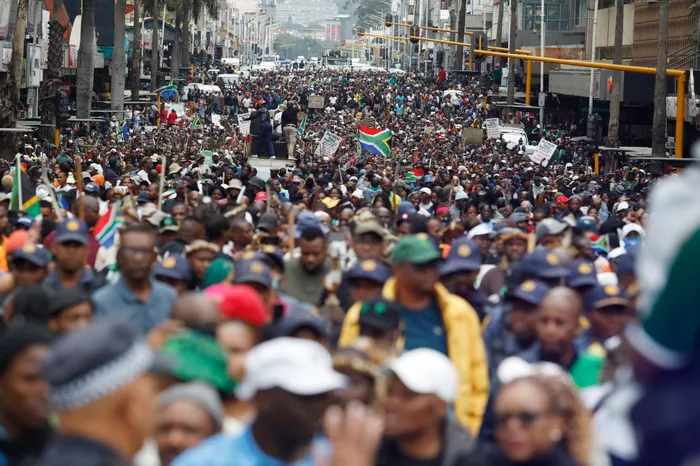
The weekly anti-migrant protests announced by March and March leader Jacinta Ngobese-Zuma are expected to begin on Thursday, following the nationwide demonstrations held on 30 June targeting undocumented foreign nationals.
Image: Doctor Ngcobo
The weekly anti-migrant protests announced by March and March leader Jacinta Ngobese-Zuma are expected to begin on Thursday, following the nationwide demonstrations held on 30 June targeting undocumented foreign nationals.
More than 20 civic groups, led by the March and March movement, participated in the protests across all nine provinces, calling for undocumented foreign nationals to leave South Africa.
More than 900 people were arrested during law enforcement operations conducted alongside the protests, with police saying most of those arrested were undocumented foreign nationals and individuals implicated in looting and other criminal activities.
Ngobese-Zuma confirmed on social media on Wednesday that the main weekly march would take place in Mthwalume on KwaZulu-Natal's South Coast.
Additional demonstrations are expected in Gauteng, including in Mamelodi, Springs, Soshanguve and Soweto.
Addressing protesters outside SAPS Point police station in Durban after thousands marched through the city on 30 June, Ngobese-Zuma said the campaign would continue every week until the government responded to the movement's demands.
"For as long as they haven't left, we are marching every Thursday," she told supporters.
She also warned that if authorities continued deploying large numbers of police officers to monitor the demonstrations, the cost to the state would continue to increase.
"We hope the government has a budget for another R600 million," she said, adding that the continued presence of undocumented immigrants would require ongoing security operations.
Ngobese-Zuma further alleged that drugs were being sold openly in some communities and claimed that criminal activity linked to undocumented immigration remained a major concern among supporters of the movement.
Meanwhile, police say they are ready to monitor "every situation" after the announcement that weekly protests will continue until the government removes undocumented immigrants from South Africa.
National Joint Operational and Intelligence Structure (NatJoints) chairperson Lt-Gen Tebello Mosikili said authorities had noted the movement's intention to continue protesting.
She said the South African Police Service (SAPS), together with other law enforcement agencies, was prepared to maintain law and order.
Mosikili said SAPS had been working closely with several stakeholders, including the South African National Defence Force (SANDF), private security companies and community structures under long-standing operational programmes.
“We have signed the MOU (Memorandum of Understanding) called Eyes and Ears, which involves working with private security companies. I want to reiterate what I said the other day: the South African Police Service remains in charge and remains constitutionally mandated in terms of policing in the country," she said.
"Any other law enforcement agency that works alongside the South African Police Service does so in support and supplementation when required."
The top police official acknowledged the movement's plans to continue protesting.
"We have noted that March and March has publicly announced that it will continue with the marches for the next six months.
"As I have indicated, we will continue to monitor every situation and continue to support every individual in this country who wishes to exercise his or her rights in terms of Sections 16 and 17 of the Constitution when it comes to demonstrations, marches, picketing and any other related activities," Mosikili said.
She added that authorities would continue working with private security companies, the SANDF and the Department of Home Affairs.
"I'm not sure why we are singling out private security companies in this case because we did not work only with private security companies yesterday. For me, that is a clear definition of community policing because we police with our partners as well as the Community Policing Forum as a structure," she said.
Meanwhile, immigration expert Dr Gideon Chitinga told IOL News that the South African government should engage both documented and undocumented immigrant communities through structured dialogue to better understand the drivers of migration and identify opportunities for immigrants and South Africans to contribute to the economy together.
Chitinga said broader structural issues also needed attention, including addressing the external drivers of irregular migration and improving the efficiency of institutions responsible for processing immigration into South Africa.
“I don't know whether those issues can be addressed immediately, but there are significant factors the government has to consider, particularly relations with neighbouring countries from which many undocumented immigrants originate. External drivers of migration must be addressed within a broader framework that also considers related regional issues.
"So diplomatic relations, regional trade and regional integration are important. South Africa is the biggest exporter to its neighbouring countries. Any deterioration in those relationships could significantly affect trade and, over time, harm South Africa's economy," he said.
Chitinga said the immigration debate was being shaped by two distinct issues.
"One is the noise. There is simply too much noise around immigration, the institutions driving the debate and the interests behind them. There is a lack of transparency between what should ordinarily be civic movements and political interests, and that complicates the conversation. Social media has only amplified the noise.
"At the policy level, there should be meaningful engagement within immigration institutions, between government departments and with civil society, including activists, academics, think tanks and other interested stakeholders," he said.
He reiterated that the government should establish dialogue platforms with both documented and undocumented immigrant communities.
"These communities have a deeper understanding of what is happening within their own neighbourhoods and the sectors in which they participate economically.
"It will also create opportunities to understand why they left their countries for South Africa and, where they contribute to the economy, identify ways in which they can work together with South Africans within those communities," he said.
IOL News