

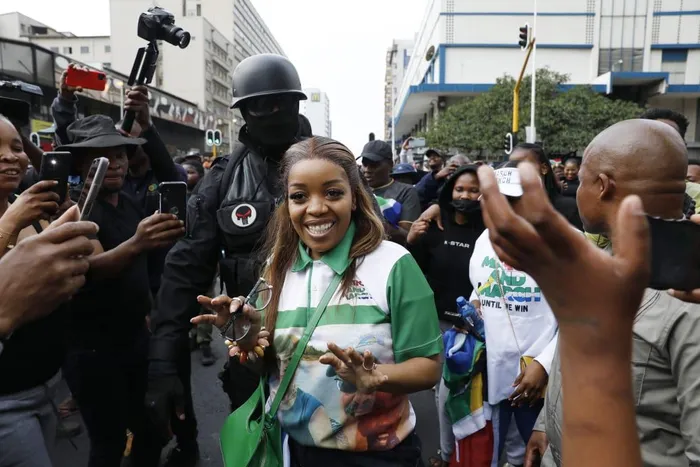
March and March leader Jacinta Ngobese-Zuma says weekly Thursday protests will continue until government responds to their demands.
Image: Doctor Ngcobo/ ANA studio
March and March leader Jacinta Ngobese-Zuma says she has repeatedly sought a meeting with President Cyril Ramaphosa but has received no response, despite the Presidency meeting with two of the movement’s associates this week.
Speaking to journalists in Durban on Tuesday after thousands of supporters marched through the city over undocumented immigration, Ngobese-Zuma said she was not aware that Ngizwe Mchunu and Nkosikhona Ndabandaba, popularly known as Phakel’umthakathi, had met President Cyril Ramaphosa on Monday, nor had she been involved in discussions leading up to the meeting or informed of what was discussed.
She announced that demonstrations against undocumented immigration would be held every Thursday for the next three months until government responded to the movement’s demands.
“For as long as they haven’t left, we are marching every Thursday,” she said.
Ngobese-Zuma said the movement had repeatedly sought a meeting with President Ramaphosa but had received no response.
“We’ve sent several requests to meet with him, but he has not responded to any of them,” she said.
Asked whether she would meet Ramaphosa if he extended an invitation, Ngobese-Zuma questioned why such a meeting had not already taken place.
“Well, if he wanted to meet us he would have done it by now, but I guess it’s the Zuma surname,” she said.
Ngobese-Zuma said she believed President Ramaphosa had previously spoken about ethnic mobilisation and hoped he would address the issue differently, saying the protests reflected concerns raised by people from different backgrounds across the country.
“The President said a lot of things about ethnic mobilisation and all of that and, you know, I was hoping that he would address those things, where all of those things come from, because all of these people across the country are not one ethnicity. It’s a number of people, different races. You saw for yourself today, all complaining about the same thing,” she said.
She reiterated that the demonstrations would continue even if turnout declined.
“Even if it’s 20, 30 people, my protest shall happen. We have given the government three months for the Thursday protests,” she said.
Meanwhile, during the Inter-Ministerial Committee media briefing on Tuesday, Minister of Justice and Constitutional Development Mmamoloko Kubayi confirmed that the meeting took place after government received a request for the President to engage with representatives of the organisation.
Kubayi said government regularly engaged a range of stakeholders and did not dictate who organisations should send to meetings.
“We receive a request for the President to engage with the representative of the organisation, and it was up to the delegation to decide who arrives,” she said.
She said government's approach was to engage any stakeholder that requested a meeting or was identified as important to the process, regardless of whether they supported or opposed government's position.
Meanwhile, ANC Chief Whip Mdumiseni Ntuli said the governing party believed Tuesday's nationwide demonstrations had largely been peaceful and reflected South Africans' constitutional right to protest.
"I think our view as the ANC is that to a very large extent the demonstrations yesterday were very peaceful," he said.
Ntuli acknowledged that the ANC, as the governing party, had to accept responsibility for shortcomings in government's handling of immigration.
"There's no way that the ANC can abdicate a responsibility in that regard," he said.
However, he argued that undocumented immigration was not unique to South Africa and had to be understood within the broader context of economic hardship across the region, which had driven many people to seek opportunities in the country.
He said government had already begun implementing measures to address the issue through the Inter-Ministerial Committee established by Ramaphosa, although he acknowledged that many South Africans believed progress had been too slow.
"It's understandable as well that our people are frustrated and unhappy, and I think they don't think that those measures are moving with the pace that is required. Hence, they're exerting pressure by taking to the streets," he said.
Ntuli said public demonstrations should not be condemned, provided they remained peaceful.
"I think the pressure from the people on the ground should also not be denounced or condemned. It's an intervention that our people have decided to do on their own, but as long as that is being carried out in a dignified manner," he said.
He rejected suggestions that government was doing nothing to address undocumented immigration, saying the challenge was complex and influenced by regional migration and economic conditions.
"But I think to suggest that the government is doing nothing would be overstressing the reality. Government is doing something that is not adequate," he said.
Ntuli said Ramaphosa’s meeting with Mchunu and Ndabandaba on Monday formed part of government’s ongoing engagement with stakeholders on undocumented immigration.
"I believe that the President is going to continue to engage with all of them, up until they all understand what government is doing and what contributions can they make together to reinforce the intervention of the government so that we have a lasting solution to the problem," he said.
IOL Politics