

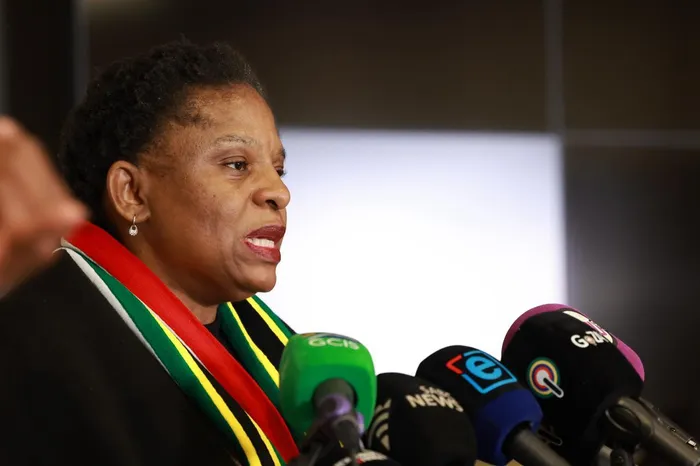
Government says it will continue enforcing immigration laws, strengthening municipal bylaw enforcement and maintaining public order as demonstrations over undocumented immigration continue across South Africa.
Image: GCIS
Minister in the Presidency Khumbudzo Ntshavheni says government is not worried about the threat of weekly protests against undocumented immigration in the country, stating that demonstrations have been taking place regularly and that law enforcement agencies are managing them to ensure they remain peaceful.
Her remarks come after March and March leader Jacinta Ngobese-Zuma announced on Tuesday that supporters would take to the streets every Thursday until the government acted to remove undocumented immigrants from South Africa.
Addressing thousands of protesters outside SAPS Point in Durban after the march through the city, Ngobese-Zuma said the campaign would continue weekly until government responded to their demands.
"For as long as they haven't left, we are marching every Thursday," she said.
Speaking during a media briefing on Tuesday, Ntshavheni said government was not concerned about the notice of weekly demonstrations, explaining that protests had already been occurring on a daily basis since the beginning of June.
“We are not worried because there have been demonstrations actually every day since the beginning of June,” she said, adding that while some members of the public may not have been following them closely, such demonstrations had been taking place across different areas.
She further stated that authorities had been ensuring that all protests remained safe and peaceful, with security forces intervening where necessary.
“We have been making sure that those demonstrations are safe and those demonstrations are peaceful. Where there was interventions needed, the law enforcement agencies and the security infrastructure intervened,” she said.
Ntshavheni said government had initiated a national dialogue process aimed at encouraging South Africans to engage with one another on the country’s challenges, saying the President had accepted the proposal to host the dialogue, which she described as an important platform for national conversation.
“The importance of that national dialogue is that South Africans needed to converse with each other, converse about their challenges, but also converse through each other,” she said, adding that the current protests against illegal immigration formed part of broader national discussions taking place in the country.
Ntshavheni said Cabinet had held five iterations of discussions on illegal immigration and that the Inter-Ministerial Committee (IMC) dealing with the issue was not newly established in June, but had been formed in March during a Cabinet meeting.
She said the committee had been working to identify policy gaps and strengthen government responses to immigration-related challenges.
She also referenced earlier immigration-related interventions, including the establishment of the Border Management Authority (BMA) and the first white paper on immigration, saying these formed part of ongoing efforts to strengthen border control and immigration management.
According to her, previous government interventions had also included measures linked to foodborne disease outbreaks, which incorporated immigration-related streams of work.
Ntshavheni said government was also addressing broader enforcement challenges at municipal level, including by strengthening health inspections, bylaw enforcement, and local government capacity.
She raised concerns about undocumented foreign nationals operating in certain informal business spaces, stating that some property owners were accommodating such activities for financial gain.
“We are also building up capacity to enforce bylaws. Municipalities, you have seen in the cities of Johannesburg, they have been very consistent in enforcing bylaws to make sure that our areas are clean but also we do not have things that are activities that are illegal in the areas, including people that are undocumented,” she said.
She further said government was strengthening coordination across law enforcement agencies and improving deployment in order to ensure safety and stability in communities
Referring to the President’s State of the Nation Address, Ntshavheni said the security cluster had been directed to intensify efforts to combat crime and organised crime, including through the use of technology.
Addressing concerns about possible disruptions linked to the protests, she said government had already assured the public that the country would remain safe during the recent demonstrations.
“We assured you that the country will be safe. There's not going to be a shutdown. There's not going to be intimidations,” she said, noting that marches held in the lead-up to 30 June had remained peaceful and complied with the rule of law.
Responding to questions about whether there was a “third force” behind the protests, Ntshavheni said it was the responsibility of government to ensure peace and stability. She said any threats to public order would be dealt with decisively by relevant security structures.
“Our responsibility as the government is to ensure that South Africa is peaceful. What is behind measures that threatens the peace of South Africa is for us to confront and deal with decisively,” she said.
She added that matters relating to intelligence and national security should be left to the relevant structures, saying government would continue to act to ensure law and order while strengthening efforts to address criminality and unsafe communities.
IOL Politics